


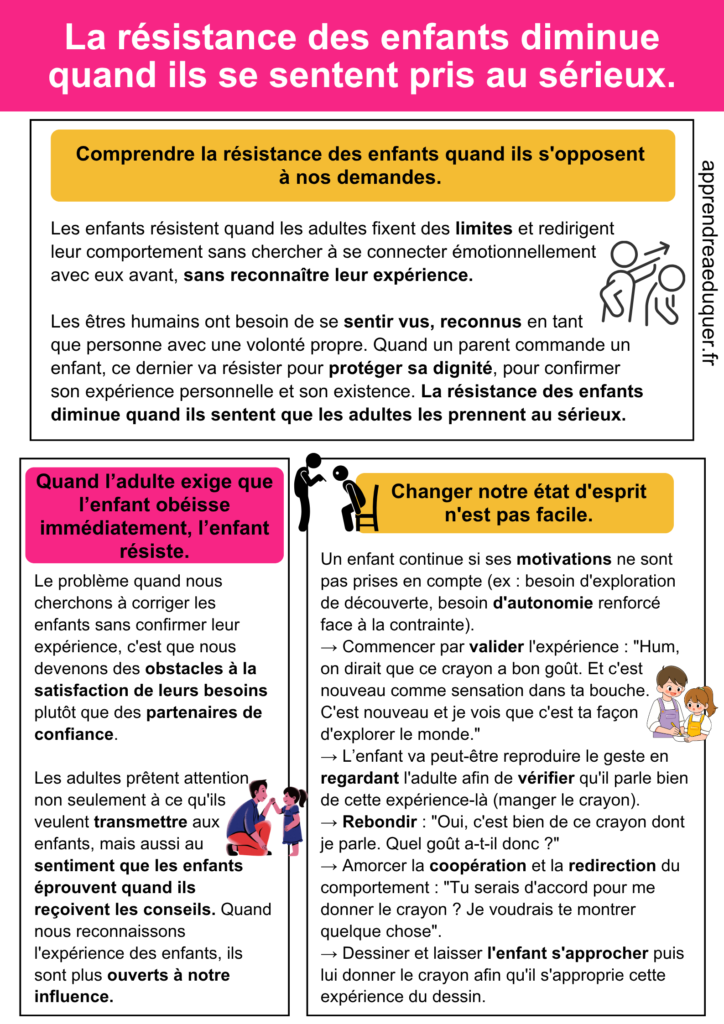
Child resistance often melts away the moment children sense that we take them seriously. As parents, we can be tempted to set limits, stop behavior we find inappropriate, or redirect our kids without first connecting emotionally or acknowledging what they are going through.
Yet human beings need to feel seen, recognized as people with a will of their own, and confirmed through the eyes of others. When a parent simply tells a child what not to do, the child is likely to push back to protect their dignity and confirm their own experience.

This article explores a gentler path: becoming a witness to your child's experience rather than a judge of it, and discovering how that shift changes the whole dynamic of the relationship.
Quick takeaways
- Children resist when they feel unseen; validation lowers resistance.
- Witness the experience first, then redirect the behavior.
- Snatching objects away disrespects the child and escalates conflict.
- Name and appreciate the need behind the behavior before setting limits.
- Connection makes cooperation possible; correction alone rarely works.
- This approach matters most when your urge to correct is strongest.
Understanding resistance when children oppose our requests
It can feel strange, even counterintuitive, to validate a child's words and gestures at the very moment we are trying to stop or redirect those same gestures, however good our reasons: health, safety, or socialization. Yet when we recognize a child's experience and our words move in their direction, they become far more open to our influence.
Child resistance decreases when we position ourselves as witnesses of their experience rather than as judges. The trouble with correcting children without seeing or confirming what they feel is that we turn into obstacles to their needs instead of trusted partners.
Adults need to pay attention not only to what they want to pass on, but also to the feeling the child has while receiving the advice. Shifting this mindset is not easy, since most of us were not raised this way and few people around us practice it. Still, this approach changes the relationship for more harmony and mutual satisfaction.
Why pushing harder usually backfires
When a child hears only what to stop, the natural impulse is to resist in order to protect their dignity and feel like a singular individual. The more we demand that a child stop what they are doing, the greater the chance they continue, because their motivations and experience are ignored: the need to explore, to discover, or to assert autonomy against constraint.
When a parent feels powerless and incompetent, that discomfort may be a signal to follow the child's direction instead of going against it. Many everyday battles, from a child who throws everything down to one who refuses to get dressed, soften when we first acknowledge the drive behind the behavior.
This is also why children at six years old can seem so fierce: they are testing whether their inner world matters to us. Recognizing that world costs nothing and protects the relationship.

| Situation | Judging response | Witnessing response |
|---|---|---|
| Child chews a pencil | "Stop that right now" | "That's a new sensation for you" |
| Child throws food | "No throwing!" | "You're testing how things fall" |
| Child refuses shoes | "Put them on now" | "You'd rather stay barefoot" |
| Child grabs a toy | "Give it back" | "You really wanted that toy" |
| Child dawdles at bedtime | "Hurry up" | "You're not ready to stop playing" |
In practice: when a child puts a pencil in their mouth
Picture a child chewing on a pencil. It is tempting to tell them to stop or to pull it from their hands. On one hand, cooperation is unlikely; on the other, snatching an object away is disrespectful and may trigger a justified burst of protest.
Instead, start by warmly validating the experience: "Hmm, that pencil must taste interesting. And it's a new sensation in your mouth. I can see this is your way of exploring the world." The child is likely to be surprised and curious, pausing to look at the pencil with fresh eyes or checking your face to confirm you mean it.
Moving toward cooperation
You can then encourage them: "Yes, I really do mean that pencil. What does it taste like?" The child will probably take it out of their mouth, and that is the moment to invite cooperation: "Would you agree to give me the pencil? I'd like to show you something." Draw, let the child come closer, then hand it back so they can own the drawing experience.
This approach asks us to look first for what we can appreciate in the moment rather than what must be corrected. It works best when the urge to correct is strong and safety is not immediately at stake. For calmer routines overall, these parenting organization tricks help too, and parents of little ones may enjoy a look at toys for 18 month boys that channel exploration safely.
Redirection after connection
Once a child feels witnessed, redirection becomes a shared project instead of a power struggle. The sequence matters: connect first, then guide. Jumping straight to correction skips the step that makes cooperation possible.
This same principle applies across daily life. A child who resists a diaper change may simply need their curiosity honored first. If you are preparing a nursery and juggling logistics, these crib to bed tips pair well with a connected mindset. And when a little one is unwell and irritable, knowing what otitis feels like helps you respond to pain rather than fight the behavior it produces.
Even mealtimes benefit: offering a snack like avocado and cheese toast becomes easier when you invite the child into the preparation rather than issuing orders.
What changes when we become witnesses
The shift is subtle but powerful. Children who feel taken seriously no longer need to fight for their dignity, so the resistance loses its purpose. Parents, in turn, stop feeling like obstacles and start feeling like partners.
This does not mean abandoning limits. It means delivering them after acknowledgment, so the child hears the boundary as care rather than dismissal. Over time, the home feels calmer, and both sides get more satisfaction from the relationship.
For families who want to go further, exploring educational toys can offer children meaningful outlets for the exploration drive that so often looks like misbehavior.

My hands-on take
I remember the first time I tried this with my own child during a pencil-chewing phase. My instinct was to snatch it away, and I had done exactly that for days, always meeting the same protest. One evening I paused and said, "That must feel interesting in your mouth." He froze, looked at me, and actually took the pencil out on his own.
Since then, I try to catch myself before correcting. It does not always work, and on tired days I still reach for the quick command. But when I manage to witness first, the whole room feels different, and I am reminded that being seen is what my child is really asking for.
Frequently asked questions
Does validating my child mean giving in?
No. Validation acknowledges the child's experience without removing the limit. You can confirm what they feel and still hold the boundary, which makes cooperation more likely.
What if the behavior is dangerous?
When safety is immediately at stake, act first to secure the child. The witness approach works best for everyday behaviors where health and safety are not instantly threatened.
Why does my child resist even simple requests?
Resistance often signals that the child feels unheard or controlled. Confirming their experience before redirecting gives them the sense of dignity they are protecting.
How long does this approach take to work?
It is a gradual shift in communication habits rather than a quick fix. With consistent practice, most parents notice a calmer tone in daily interactions over time.
Product Reviews
 Best Toys for Dogs With High Prey Drive |
Best Outdoor Toys for 3-4 Year Olds |
Best Outdoor Toys for 6 Year Olds |
Best Harness for Poodle |
Best LEGO Sets for Adults |
Best Travel Toys for 4 Year Olds on Airplane |
Best Toy Stores in Washington DC |
Best Potty Training Toys |
Best Toys for Tripod Dogs |
Maillot equipe de france







