


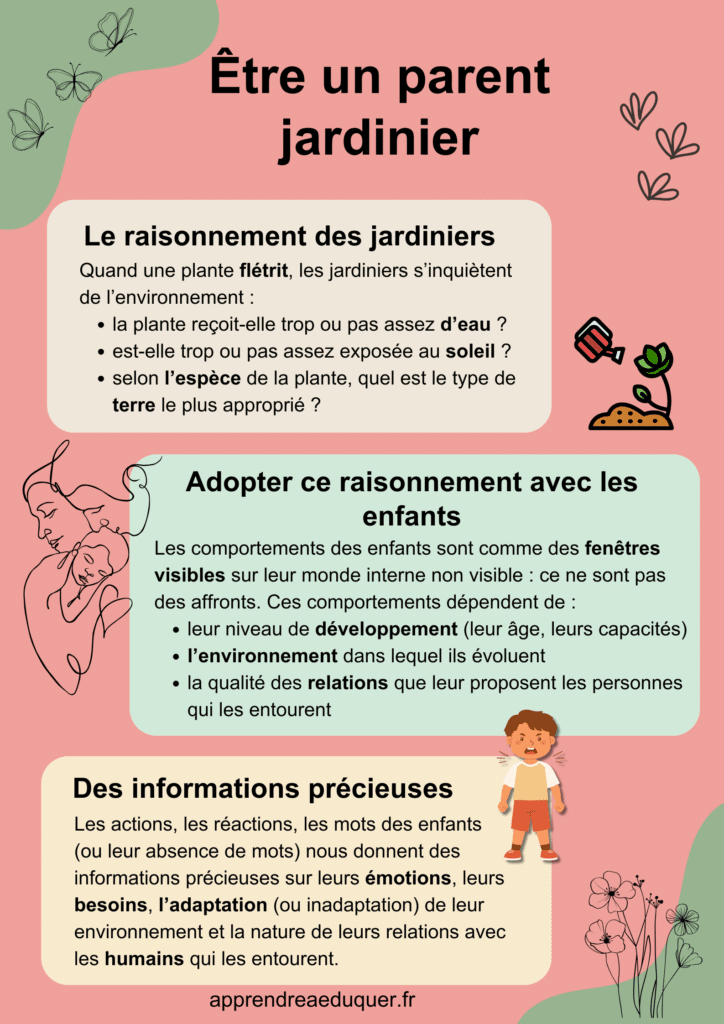
Child behavior is a message about the environment, the living conditions, the developmental stage and the inner life of the child — emotions and needs included. When a plant wilts, a gardener does not scold the plant; they ask whether it gets too much or too little water, whether it sits in the right light, and which soil suits its species.
We can reason the same way with our children. Their actions, reactions and words (or their silence) are windows onto something we cannot see directly. They are not personal affronts but indicators of mental health, and that health depends heavily on the environment and on the quality of the relationships around them.

Quick takeaways
- Behavior is a visible window onto invisible emotions and needs.
- Ask what the environment is missing before correcting the child.
- Punishment and rewards address symptoms, not causes.
- Connection, free play and respected rhythms are core needs.
- Attachment grows through warmth, listening and physical closeness.
- Respectful parenting also means questioning how society supports families.
The gardener mindset: behavior as a visible window
A gardener facing a wilting plant studies the surroundings first: water, sun, soil type. Parents can borrow this habit and treat a difficult moment as information rather than an attack. The behavior tells us something about emotions, needs, and whether the environment is adapted to the child.
This lens changes everything. Instead of asking “how do I stop this?”, we ask “what is this showing me?”. If you want to go deeper into that shift, these thoughts on children’s evolutionary process explore whether we should direct or simply accompany a child’s development.
It also means accepting that the environment is not always suited to children’s needs — and that noticing this is the first step toward adjusting it.
Punishment treats the symptom, not the cause
Punishing a child labeled “aggressive” or “rude”, sending the “disobedient” one to the corner, or promising a reward for behaving “well” addresses symptoms only. The cause stays untouched, and the distress underneath often grows.
Looking behind what is shown or heard lets us understand what is happening inside, and possibly intervene when there is suffering. This is reasoning in terms of needs, which requires knowing the main human needs and admitting the environment is sometimes poorly adapted.
It is also worth remembering that development itself explains a lot; a look at maturational delay characteristics can help parents tell a passing stage from a genuine difficulty.
| What you observe | Possible unmet need | Practical response |
|---|---|---|
| Clinginess, whining | Connection and closeness | Ten minutes of undivided attention |
| Anger after a “no” | Space to feel frustration | Stay calm, name the emotion, hold the limit |
| Restlessness, meltdowns | Movement, sleep, outdoor time | Run, climb, rest earlier |
| Constant “I’m bored” | Free, unguided play | Offer open-ended materials, step back |
| Defiance at transitions | Predictability and rhythm | Warn ahead, keep routines stable |
Learning to reason in terms of needs
All humans share common needs, and as a social species our relational needs matter enormously, as does physical contact. Every child needs love — proven through unconditional affection — space to express their being (emotions, desires, creativity), and physical closeness with trusted people.
Questions a gardener would ask
Does this child need more connection time with me or the other parent? Do they feel special and important to at least one adult who counts? Can they express emotions openly, including anger at a parent who says no — anger being precisely the emotion that heals frustration? Is there enough free, unguided play time, and is their rhythm respected? Are physiological needs met: sleep, movement, play, contact with nature?
Attachment theory stresses physical and emotional closeness with at least one caring adult. When an adult responds to cries, listens without censoring, and offers empathy and warmth, the child grows certain of being worthy of love and learns, by imitation, to care for others. Everyday routines support this too, as these tips for your baby gently illustrate.

Why “obvious” care is hard in practice
For some adults this feels obvious; for others it is a heavy weight on parents who have their own needs, past wounds that interfere with the relationship, limits and constraints. Many of us finish work completely drained, and many mothers feel alone and unsupported.
Many children are rushed through learning at school and deprived of free time, while contradictory advice leaves parents paralyzed — don’t hold them too much, or give them everything. And how do you stay empathetic when your own traumatic memory lights up at every tantrum? Simple pleasures, like a shared Three Kings afternoon, can rebuild the connection these pressures erode.
Respectful, non-violent parenting goes far beyond a list of phrases to make children listen. It invites a deeper reflection on how society is organized to care for humans — which is why so many parents on this path end up changing careers, choosing home education or alternative schools, joining ecological associations, moving to the countryside, or reshaping their relationships.

Small environmental shifts that support the inner world
You do not have to reorganize your whole life to apply the gardener’s logic. Start with the basics: protect sleep, allow daily movement, and guard pockets of unstructured play. Open-ended toys and simple materials often serve this better than guided activities, as these open ended toys show.
Outdoors time is another lever; even small outings reset a child’s mood, and these tips to protect your baby from the sun make summer days easier. For toddlers, a few backyard toys can turn a garden into a daily outlet for energy.
Connection is the other half. A predictable ritual — a story, a walk, a shared game — tells the child they matter. If you are choosing materials for that time together, these toys for 2 year olds and toys for 6 month olds are organized by developmental stage rather than by hype.
My hands-on take
In our home, the gardener idea became a habit I actually use. When one of my children slams a door or refuses to get dressed, my first reflex is still irritation, but I have learned to pause and run through a short mental list: sleep, food, movement, connection. More often than I expected, one of those is the answer, and the behavior softens once it is filled.
What helped most was picking one ritual we never skip — a slow walk after dinner, no phone — and protecting free play from our own scheduling instincts. I still get it wrong on tired evenings. But treating behavior as information rather than an insult has made our house calmer, and it has made me far less quick to punish.
Frequently asked questions
Does this mean I should never set limits?
No. Limits are part of a safe environment. The gardener approach simply asks you to hold the limit while staying curious about the need behind the behavior, rather than adding punishment on top of distress.
How do I know if a behavior is a phase or a real problem?
Look at duration, intensity and how it affects daily life. A passing stage usually softens when connection and rest improve; persistent distress is worth discussing with a professional.
What if I am too exhausted to do any of this?
Start with the smallest possible shift: one ritual of connection, one protected block of free play. Your own needs count too, and support for you is part of caring for your child.
Is this only about emotions?
No. Sleep, movement, play, nature and rhythm are physiological needs that shape behavior just as strongly as emotional ones.
Product Reviews
 Best Toys for Dogs With High Prey Drive |
Best Outdoor Toys for 3-4 Year Olds |
Best Outdoor Toys for 6 Year Olds |
Best Harness for Poodle |
Best LEGO Sets for Adults |
Best Travel Toys for 4 Year Olds on Airplane |
Best Toy Stores in Washington DC |
Best Potty Training Toys |
Best Toys for Tripod Dogs |
Maillot equipe de france







