


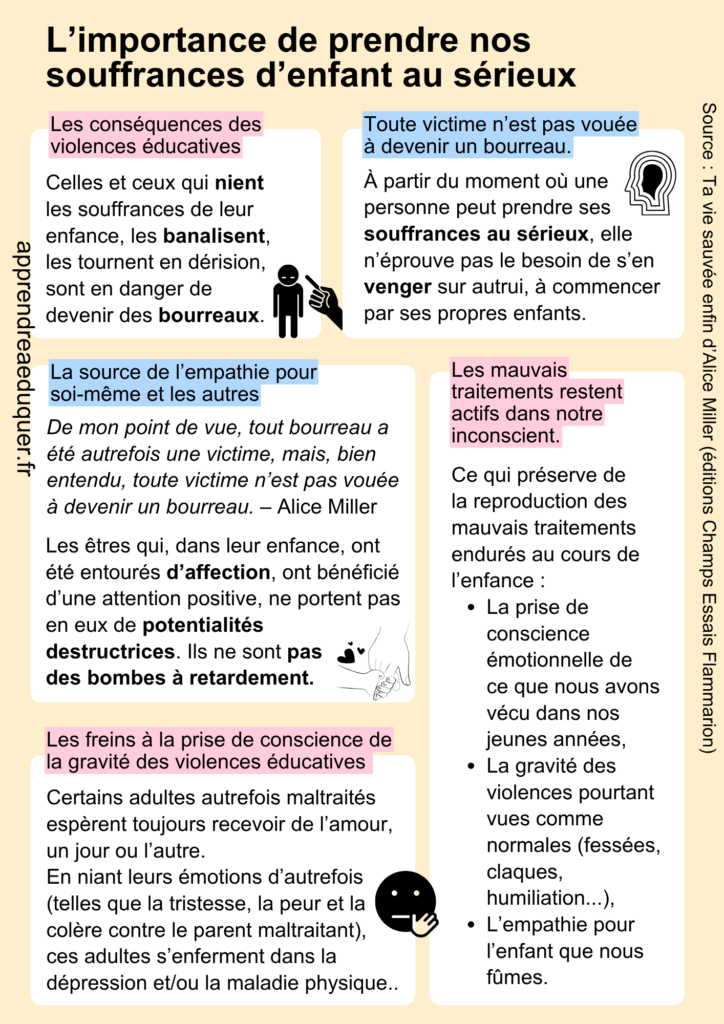
The consequences of ordinary educational violence are easy to overlook, precisely because the word "ordinary" makes them sound harmless. In her book on the subject, Alice Miller argues that smacks, slaps, threats and emotional repression are real violence, and that their effects stay active in the unconscious long after childhood ends.
Miller's central claim is uncomfortable but simple: only people who deny, trivialise or mock their own childhood suffering are at risk of becoming tormentors themselves. Once someone can take that suffering seriously, the need to avenge it on others, starting with their own children, fades.

Quick takeaways
- Denial of childhood suffering, not the suffering itself, is what Miller links to becoming a tormentor.
- Affection and positive attention in childhood leave no destructive potential behind.
- Smacks, slaps and threats count as violence even when adults call them ordinary.
- A child blames himself to protect the image of loving, all-powerful parents.
- Fully felt anger, witnessed with empathy, ends the need to excuse mistreatment.
- Once you love yourself, you cannot simultaneously love the person who hurt you.
Why taking childhood suffering seriously matters
Miller, a specialist in the consequences of ill-treatment inflicted on children, insists that denial is the dangerous part. People who were surrounded by affection and positive attention in childhood, she writes, do not carry destructive potential inside them. They are not time bombs, and they have empathy for themselves and for others.
Her most quoted line sums up the mechanism: every tormentor was once a victim, though of course not every victim is doomed to become one. The difference lies in whether the pain was acknowledged or buried. This is the same logic behind movies about respect: stories help children name what they feel before it goes underground. The same applies to after sun care, where small, attentive gestures show a child their comfort is taken seriously.
None of this requires a dramatic history. Everyday gestures that adults dismiss as trivial still register with a small child, and they deserve the same seriousness we give to visible injuries.

What stops us from seeing the gravity of it
Maltreatment usually stays hidden, denied by the child who grew into an adult, by the parents who inflicted it, and by society at large. Childhood is also idealised, both individually, by adults who romanticise their own early years, and collectively, as a carefree and happy time.
For Miller, only an emotional awareness of what we actually lived through, together with empathy for the child we once were, protects us from reproducing the ill-treatment that remains active in our unconscious. That awareness is what a calm newborn routine quietly models in practice: attention to real signals rather than to the story we prefer. The same principle of noticing real signals applies to everyday hygiene habits and to choosing suitable small mammals for children.
She noticed in her therapeutic practice that many mistreated people defend their parents energetically and try to understand them. They do so hoping to receive a little love one day, whatever the price to their health, and by denying buried emotions such as anger at the abusive parent they shut themselves into depression or physical illness.
Why the child blames himself
For a small child, parents are all-powerful, omniscient and loving, always. When a loving father or mother shouts and hits, the child tries to explain it by accusing himself, so as to keep intact the image of those divinities he needs in order to survive.
| Situation | What the adult tells himself | What Miller suggests |
|---|---|---|
| A slap in childhood | "It was nothing, it was for my own good" | Name it as violence and take the pain seriously |
| Parents who shouted | "They loved me, they were tired" | Feel the anger instead of excusing it |
| Idealised childhood | "My childhood was happy" | Question the story and check the emotions |
| Waiting for parental love | "One day they will show affection" | Give up the child's position and live with reality |
| A supportive witness | "Nobody wants to hear this" | Let a lucid witness show empathy for the wounds |
| Own child's anger | "He must not talk to me like that" | Allow the anger so it is not stored |
Our duty as adults: feel the anger of the former child
Almost every child who needed understanding, love and respect from their parents and received only humiliation and blows does not even know that something else exists. Beatings, threats, blackmail and emotional repression are not identified as violence, so these children, once grown, keep waiting for love from people incapable of genuine affection.
Children cannot give up the illusion of being loved, and they come to believe that everything inflicted on them was done out of love. An adult, however, is not condemned to keep telling that story, to accept violent acts dressed up as affection, or to believe there is no alternative to violence, even so-called ordinary violence.
In working on themselves, with or without therapeutic support, the adult has to learn to abandon the child's position and live with reality. That may mean rethinking the models we inherit, much as a Montessori toy choice asks us to rethink what we hand a child. The same applies to intimacy, as when couples face a lack of libido after becoming parents.
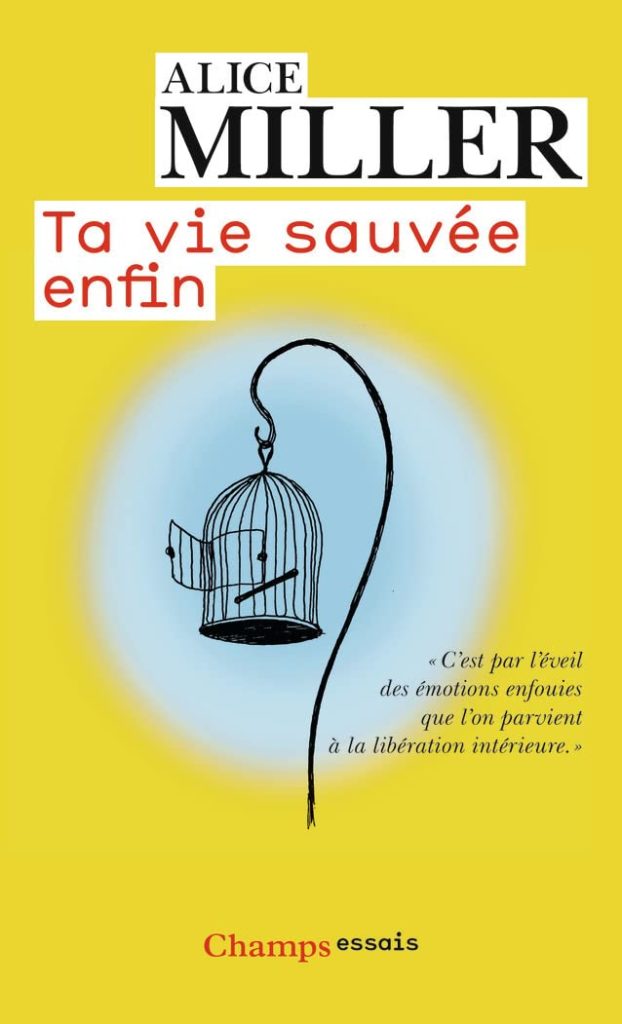
Living your anger so you can finally love yourself
Miller considers this inner work to pass through fully feeling and expressing the anger that parental mistreatment provoked. If someone can accompany that emotional work and show empathy for the former child's suffering, the adult stops tolerating, minimising or excusing the ill-treatment received.
Only then can he discover his talents, his capacities and his true self. Miller calls this person a "lucid witness": someone who shows indignation and empathy for the wounds of the child back then, without excusing the parents or downplaying the suffering.
Her conclusion is blunt: once you have learned to love yourself, you cannot at the same time love your tormentor. That is why travel toys that calm a child on a plane matter less than the tone of the adult beside him.

What this means for parents today
Miller's work is not a manual, but it does set a direction. If we want to stop the transmission of ordinary violence, we have to start by telling ourselves the truth about our own childhood rather than repeating what was done to us.
That means noticing the small daily gestures we dismiss, and treating our own irritation as information rather than as a licence. It also means giving children room to be angry, because a child allowed to express anger does not have to store it. The same patience applies to potty training toys and every other slow, messy learning curve.
Being a lucid witness to a child's feelings, rather than a judge of them, is the practical version of Miller's insight. It costs nothing and changes everything.
My hands-on take
I came to Miller's writing expecting a parenting book and found something closer to a mirror. The line that stayed with me was the one about the child who accuses himself in order to keep his parents perfect. I recognised it instantly, and I recognised it again the first time my own child flinched at a sharp word from me.
What helped me in practice was small and unglamorous. When I feel the old irritation rising, I try to name it silently instead of acting on it, and I remind myself that the small person in front of me is not the enemy. I also stopped defending every choice my parents made, which felt disloyal at first and then simply honest. That honesty is what I want to pass on, far more than any toy or routine.
Frequently asked questions
Does Alice Miller say every mistreated child becomes an abuser?
No. She states the opposite: every tormentor was once a victim, but not every victim is doomed to become one. What tips the balance is whether the suffering is taken seriously or denied.
What counts as ordinary educational violence?
Miller includes slaps, smacks, "little" taps, shouting, threats, blackmail and emotional repression. These are acts that adults often dismiss as normal, yet they register with the child as violence.
Why do mistreated children defend their parents?
A small child needs to see his parents as all-powerful and loving, so he explains their violence by blaming himself. As an adult he may keep defending them, hoping to finally receive a little love.
Do I need therapy to do this work?
Not necessarily. Miller describes inner work that can be done with or without therapeutic support, though a lucid witness who shows empathy for the former child's suffering makes that work easier.
Product Reviews
 Best Toys for Dogs With High Prey Drive |
Best Outdoor Toys for 3-4 Year Olds |
Best Outdoor Toys for 6 Year Olds |
Best Harness for Poodle |
Best LEGO Sets for Adults |
Best Travel Toys for 4 Year Olds on Airplane |
Best Toy Stores in Washington DC |
Best Potty Training Toys |
Best Toys for Tripod Dogs |
Maillot equipe de france







