


A school group clothing order can create a lasting shared memory, but collecting sizes, payments and individual choices should never become a second job for a parent or a teacher. The goal is a simple, readable framework that everyone understands.
The key principle is separation: the group decides only what truly belongs to the group, and each family keeps control of its own order. This keeps personal information out of collective conversations and prevents contradictory versions from spreading.

Done well, the project leaves a clear record of decisions and protects the educational relationship between adults and children.
Quick takeaways
- Let the group decide only the garment, the visual and the allowed colors.
- Keep sizes, quantities and contact details with each family.
- Publish one short page with the referent adult and the closing date.
- Keep all payments strictly between adults.
- Plan a non-purchase way for every child to take part.
- Archive the approved visual and the recap for later reference.
Decide together only what must be decided
The group needs to validate very few things: the garment itself, the visual, and the authorized colors. Sizes, quantities and contact details belong to each participant afterwards. This separation prevents a collective conversation from filling up with personal information and conflicting versions.
A short recap can state clearly what is fixed and what remains each person's choice. For example, the group settles on a shared drawing, while every adult checks the desired size. Any question about the project then receives the same answer, without reopening a vote in every conversation.
It also helps to name one adult referent early, so families know who to ask. Just as you would set simple boundaries when you control visits at home, a few clear rules keep the whole exchange calm and predictable.
Give individual choices a clear frame
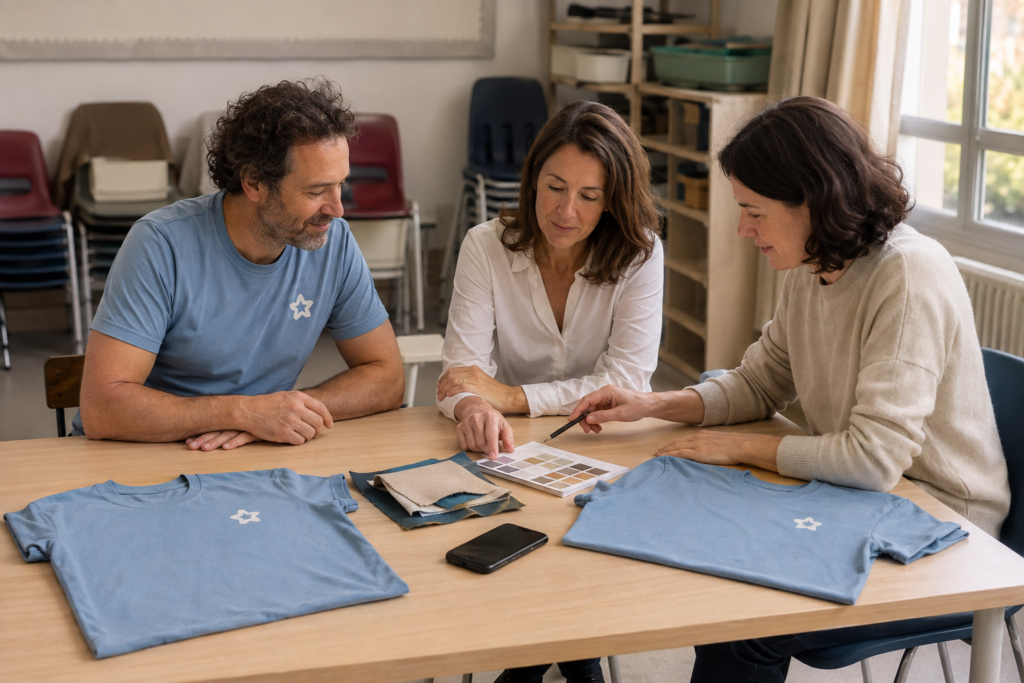
A clear page should show the approved project and explain who may take part. With a group-order service, the organizer prepares the proposal; once it is validated, the collection stays open for ten days. Each person then chooses model, color, size and quantity, pays for their own order and receives their own delivery.
The school still needs to indicate the referent adult and remind everyone of the closing date. A simple deadline reminder works much like the routines you build when you care for baby schedules: consistency matters more than pressure. The same principle of parent child relationships applies to shared family decisions.
Keeping the page short and readable matters, because a long document nobody finishes defeats the purpose. Write for busy parents, not for archivists, and remember that even a girl writing shows how clearly children can express their choices.
| Decision | Who decides | Where it lives |
|---|---|---|
| Garment type | Whole group | Shared recap page |
| Visual and colors | Whole group | Approved visual |
| Size and quantity | Each family | Private order form |
| Payment | Each adult | Order platform |
| Closing date | Organizer | Public page |
| Non-buying activity | Organizer and teachers | Classroom plan |
Protect the educational relationship
A child should never carry the responsibility of a forgotten payment or a commercial decision. Financial exchanges stay between adults, while the group can take part in the creative choice within a defined frame. A successful order is therefore not measured only by the number of garments: it respects roles and leaves an understandable trace of decisions.
This matters because children notice pressure, even quiet pressure. If a family is partner jealous of attention or simply short on money, no child should feel exposed by a clothing form.
Adults set the tone: calm, factual, and focused on the shared project rather than on who ordered what.
Keep participation separate from purchase
Taking part in the collective project must stay distinct from buying. Planning a place for children whose families do not order avoids turning the garment into a condition of belonging. The shared memory then keeps its educational function.
This is the same inclusive reflex you would apply when you interact with children on the autism spectrum: offer a way in that does not depend on one single behavior. The same principle applies when you choose reward toys that let every child take part.
Practical solutions are simple: a drawing workshop, a photo of the whole class, or a display of the approved visual. None of these require a purchase, and each one lets every child contribute.

Make the common frame easy to read
The common frame must stay easy to read for everyone. One page, short sentences, a visible deadline and a named contact beat a long document with hidden conditions. This is basic parenting program thinking: clarity first, details second.
Keep the tone neutral and avoid comparisons between families. A short FAQ at the bottom of the page answers the same three questions again and again, which saves the organizer hours of messages.
Finally, archive the approved visual and the recap somewhere shared, so the decision survives after the order closes. A project that can be explained later is a project that was organized well.
What a good group order looks like in practice
In practice, a good group order looks boring from the outside: few decisions, one page, one deadline, one referent. The creative part stays joyful, and the administrative part stays invisible to children.
If you are comparing suppliers or simply curious about how merchandise and toys are presented to families, browsing a best store guide or a toy stores list can sharpen your eye for clear offers.
Whatever the product, the same rule applies: the framework should serve the group, never the other way around.

My hands-on take
I have run a class T-shirt order twice, and the second time taught me everything the first one did not. The first attempt turned into a group chat where sizes, colors and payment questions all mixed together, and I spent evenings copying information from one thread to another. The second time, we changed three things: we voted only on the drawing and the color, we put everything else on a single page with a deadline, and we named one referent.
What surprised me most was how quickly the conversation calmed down once people knew what was already decided and what was theirs to handle. We also planned a small drawing activity for the children whose families did not order, and honestly, that was the part the kids remembered. My advice: keep the page short enough to read on a phone, and archive the approved visual, because someone will ask about it months later.
Frequently asked questions
Should the school collect everyone's sizes?
No. Sizes and quantities are personal data and belong to each family. The school only needs to share the approved project, the referent adult and the deadline.
What if a family cannot or does not want to order?
Participation in the project must stay separate from the purchase. Plan an activity such as a drawing workshop or a class photo so every child can contribute without buying anything.
How long should the order window stay open?
With a group-order service the collection typically stays open for ten days after validation. Announce the closing date clearly and remind families once, without chasing individuals.
Who handles a forgotten payment?
Adults only. A child should never be responsible for a missed payment or a commercial decision, so financial exchanges stay between the organizer and each family.
Product Reviews
 Best Toys for Dogs With High Prey Drive |
Best Outdoor Toys for 3-4 Year Olds |
Best Outdoor Toys for 6 Year Olds |
Best Harness for Poodle |
Best LEGO Sets for Adults |
Best Travel Toys for 4 Year Olds on Airplane |
Best Toy Stores in Washington DC |
Best Potty Training Toys |
Best Toys for Tripod Dogs |
Maillot equipe de france







