


The rainbow of well-being is a gentle printable activity that helps children from around six or seven years old connect a colour to a feeling and to a part of their body. Each band of the rainbow carries a short phrase linked to one component of physical and emotional health.
The idea is simple: the child points a finger at each colour in turn, reads the phrase written on the band, and then lets the words sink in while paying attention to what the body feels. There is no right or wrong way to do it, and no performance to measure.

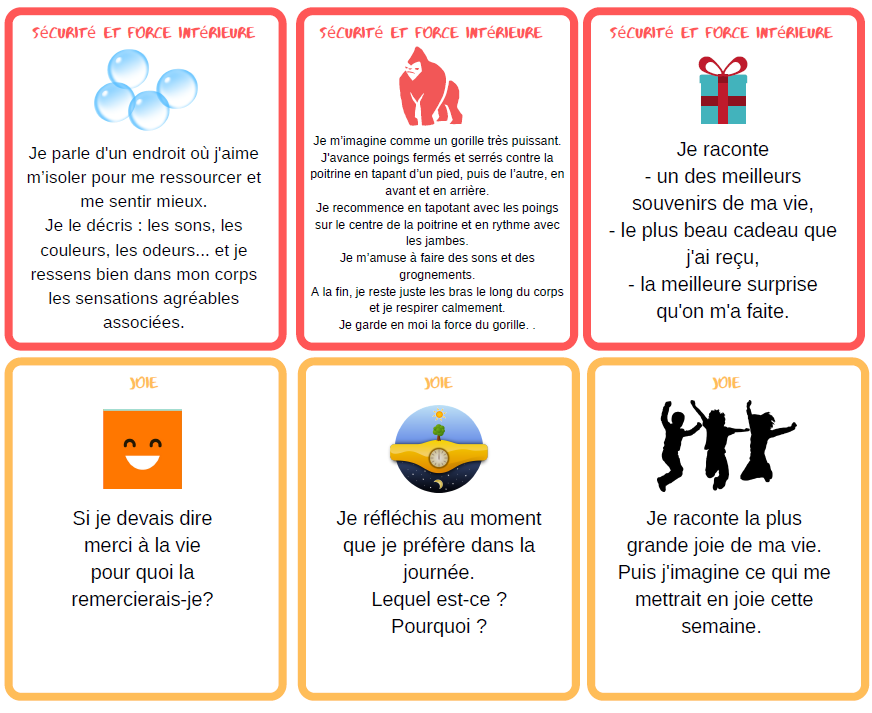
Three cards accompany each colour, so the game can continue after the rainbow itself has been explored. Children can pick a card matching the strength they want to activate and carry out the small action it suggests.
Quick takeaways
- Each rainbow colour links to one part of physical and emotional well-being.
- Children point, read and then pause to notice what the body feels.
- Three cards per colour extend the activity with a small suggested action.
- Cards can be chosen deliberately or drawn at random, depending on mood.
- The activity works with one child, a family or a group of children.
- Regular use helps children call on the tools independently over time.
What the rainbow of well-being actually is
This is a downloadable activity designed for children aged six or seven and above, built around a seven-colour rainbow. Each colour refers to one component of physical and emotional well-being, and the child moves through them one at a time rather than all at once.
The method is deliberately slow. The child puts a finger on a colour, reads what is written on the band, then takes a moment to absorb the sentence while listening to the body. That pause is where the real work happens, because it turns a reading exercise into a small moment of holding a crying child style attunement, where feelings are noticed rather than corrected. For more inspiration, explore blogs about motherhood on supporting children's emotional growth.
Nothing here requires special equipment beyond the printed sheet, and the tone stays playful. If you are curious about how emotional needs shift as children grow, our piece on six-year-old behaviour pairs well with this age range, much like the patience rewarded in LEGO Fortnite XP.

The seven colours and what each one activates
Red activates the child's sense of security. Orange activates joy and good humour. Yellow activates self-confidence. Green activates empathy and kindness. Blue activates honesty and vulnerability. Violet activates creativity. Indigo activates self-awareness through the body.
These are prompts, not rules, and children often gravitate to one colour far more than the others. A child who keeps returning to blue may be working on saying true things out loud, while one who chooses green again and again may be practising kindness toward siblings or classmates. Either way, the vocabulary gives them words for something they already sense.
Why the order matters less than the repetition
You do not have to follow the rainbow from red to violet. Some families start at the colour the child names first, which keeps the activity responsive rather than prescribed. The same flexibility applies when children struggle with popularity or friendship worries, a topic we explore in school popularity pressures. Just as you would protect adult authority when guiding these conversations, you can also treat pregnancy cravings as a gentle reminder to stay attuned to your own needs.

| Colour | Strength activated | When it may help |
|---|---|---|
| Red | Sense of security | Settling after a big change |
| Orange | Joy and good humour | Low mood or a grumpy afternoon |
| Yellow | Self-confidence | Before a test or a new activity |
| Green | Empathy and kindness | After a conflict with a friend |
| Blue | Honesty and vulnerability | When something is hard to say |
| Violet and indigo | Creativity and body awareness | Quiet time or creative play |
How the colour cards extend the activity
Three cards correspond to each colour, and their purpose is to prolong the effect of the rainbow once the sheet has been read. Depending on what the child needs, they can draw a card in the colour matching the strength they want to activate and then do the action described on it.
Drawing at random works too. Choosing a card according to the mood and needs of the moment is a valid way in, and it often surfaces something the child would not have named directly. This is the same principle behind giving a child room to express big feelings safely, which we look at in children changing parents' lives.
Keep the cards somewhere reachable so the child can return to them without asking permission each time. That small bit of access matters more than any elaborate setup.

Using the rainbow with one child, a family or a group
The activity can be offered in a family setting or with a group of children, and it adapts easily to both. In a group, children can take turns reading a colour aloud, which adds a social layer without turning it into a competition.
With one child, the pace can be slower and quieter, and you can leave longer silences after each phrase. If a child becomes tearful or withdrawn during the exercise, our article on comforting a crying child offers a useful reminder that presence matters more than words.
Groups also benefit from a short closing round where each child names a colour they want to keep for the day. It gives the session a clear end and sends everyone away with something concrete.
Why repetition builds real skill over time
The more children use the rainbow of well-being, the more familiar they become with the exercises and tools it offers. Over time they become able to take ownership of them and call on them when they need to, without an adult prompting.
That shift from guided to independent is the whole point. A child who has practised naming a feeling and locating it in the body has a small tool ready for the school day, a difficult evening or a moment of worry. It sits alongside other everyday supports, much like the practical routines we describe in a baby time capsule for marking meaningful moments.
Repetition does not need to be daily. A few times a week, or whenever the mood suggests it, is enough for the phrases to become familiar.

Practical tips for getting started
Print the sheet on sturdy paper so it survives repeated handling, and keep the cards in a small envelope or box. Set the activity up at a calm moment rather than in the middle of a conflict, so the child associates it with steadiness rather than repair.
Read the phrases together the first few times, then step back and let the child lead. Some children prefer to whisper the words, others to say them aloud, and both are fine. If your child is unwell or unsettled, it is worth waiting; a gentle activity like this works best when the body is comfortable, and our guidance on childhood vomiting is a reminder to prioritise physical comfort first.
Finally, model it yourself now and then. A parent who names their own colour and takes a breath shows the child that the tool belongs to everyone, not just to children who are struggling.
My hands-on take
I first tried this with a child who was having a rough patch at school and would not talk about it directly. Reading the colours aloud gave us something to do with our hands while the conversation found its own way, and the blue band about honesty did more work than any question I could have asked.
What surprised me was how often the children came back to it on their own. The sheet lived on a shelf, the cards in a tin, and after a few weeks I would find one of them quietly pointing at a colour before bed. I would suggest keeping the printing simple and not over-explaining the purpose; children tend to find their own use for it faster than we expect.
Frequently asked questions
What age is the rainbow of well-being suitable for?
It is designed for children from around six or seven years old, once they can read short phrases and follow a simple instruction. Younger children can join in with an adult reading the words aloud for them.
Do we need to follow the colours in order?
No. The rainbow can be explored from red to violet, or started at whichever colour the child chooses first. Following the child's lead usually keeps the activity feeling playful rather than like a task.
How often should we use it?
There is no set frequency. Using it a few times a week, or whenever the child seems to need a quiet moment, is enough for the phrases and actions to become familiar over time.
What if my child does not engage with it?
Leave it available and try again another day, ideally at a calm moment rather than during a conflict. Some children prefer to use the cards alone rather than work through the full sheet.
Product Reviews
 Best Toys for Dogs With High Prey Drive |
Best Outdoor Toys for 3-4 Year Olds |
Best Outdoor Toys for 6 Year Olds |
Best Harness for Poodle |
Best LEGO Sets for Adults |
Best Travel Toys for 4 Year Olds on Airplane |
Best Toy Stores in Washington DC |
Best Potty Training Toys |
Best Toys for Tripod Dogs |
Maillot equipe de france







