


Understanding the major sources of anxiety in children is one of the most useful things a parent can do, because it turns vague worry into something you can actually respond to. You cannot remove every fear a child will ever feel, and it is not even desirable to try. What you can do is show them that their worries are respected and understood.
Haïm Ginott, a forerunner of the positive parenting movement, identified five main sources of childhood anxiety and offered practical ways to face each one. This article walks through them in turn, with concrete ideas you can adapt to your own family.

Quick takeaways
- Never use abandonment as a threat, even in jest; prepare children for every separation.
- React to misbehaviour like a mechanic diagnosing a fault, not like a judge assigning blame.
- Say a lot in few words; long explanations can create guilt.
- Let children struggle, make mistakes and take their time without criticism.
- Keep parental conflict away from children while still modelling calm negotiation.
- Name fears and keep routines predictable to confirm emotional safety.
1. Anxiety linked to the fear of abandonment
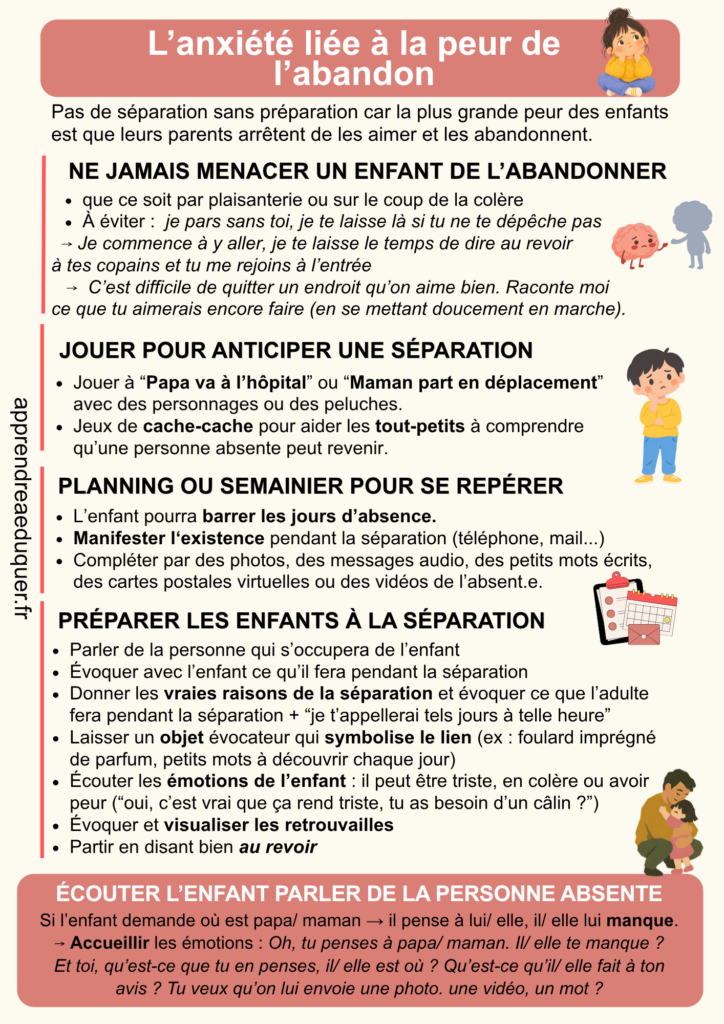
Ginott's key principle here is simple: no separation without preparation. A child's deepest fear is that their parents will stop loving them and leave. That is why abandonment should never be used as a threat, whether in jest or in a moment of anger. Phrases like "I'm leaving without you" or "I'll go on without you" can wake a sleeping anxiety very quickly.
Children cope far better with separation when they are prepared in advance, through words, games, mimes or books. You might invite your child to play "Daddy goes to the hospital" or "Mummy goes on a trip" with toys or soft animals. Games of hide-and-seek help toddlers grasp that an absent person can come back. A weekly planner your child can tick off, photos, voice messages, little notes or short videos all make absence easier to bear.
Preparing a child for separation
Psychotherapist Isabelle Filliozat suggests naming who will look after the child, describing what the child will do, giving the real reasons for the separation and saying what you will be doing. Share your own feelings, listen to theirs, and visualise the reunion together. Say a clear goodbye rather than slipping away, and keep in touch during the absence. If you are the one staying, let the child talk about the absent parent.

2. Anxiety linked to guilt
To prevent excessive guilt, Ginott compares parenting to a good mechanic handling a broken-down car. The mechanic does not blame the owner; he points out what needs repairing. He does not scold the rattles and squeaks; he uses them to make a diagnosis and asks what might be causing the problem. Reacting to a child's misbehaviour in that spirit changes everything.
It helps to reason in terms of needs and attachment rather than punishment. Let your child feel free to think what they like without risking your love or approval. You can say, "You have an opinion, and mine is different. We don't see this the same way." Or simply, "I respect your view, and my opinion is different."
Say a lot in few words. Long, off-topic explanations can stir up guilt rather than resolve it. This is also why rewarding with food so often backfires: it muddies the message and adds a layer of moral weight to something simple. A calm, short response keeps the focus on the behaviour, not on the child's worth. The same principle applies to physical worries, such as sciatica in pregnancy or molluscum contagiosum, where clear, brief information prevents unnecessary anxiety.
| Source of anxiety | What the child feels | Practical response |
|---|---|---|
| Fear of abandonment | Fear of losing parental love | Prepare separations, say a clear goodbye, keep in touch |
| Guilt | Feeling responsible and blamed | Diagnose the need, keep explanations short |
| Adult impatience | Doubt and pressure | Wait, encourage with compassion, allow mistakes |
| Parental conflict | Threat and self-blame | Discuss calmly, keep arguments private |
| Wider fears | Worry about health and change | Name the fear, stay close, keep routines |
3. Anxiety linked to adult distrust or impatience
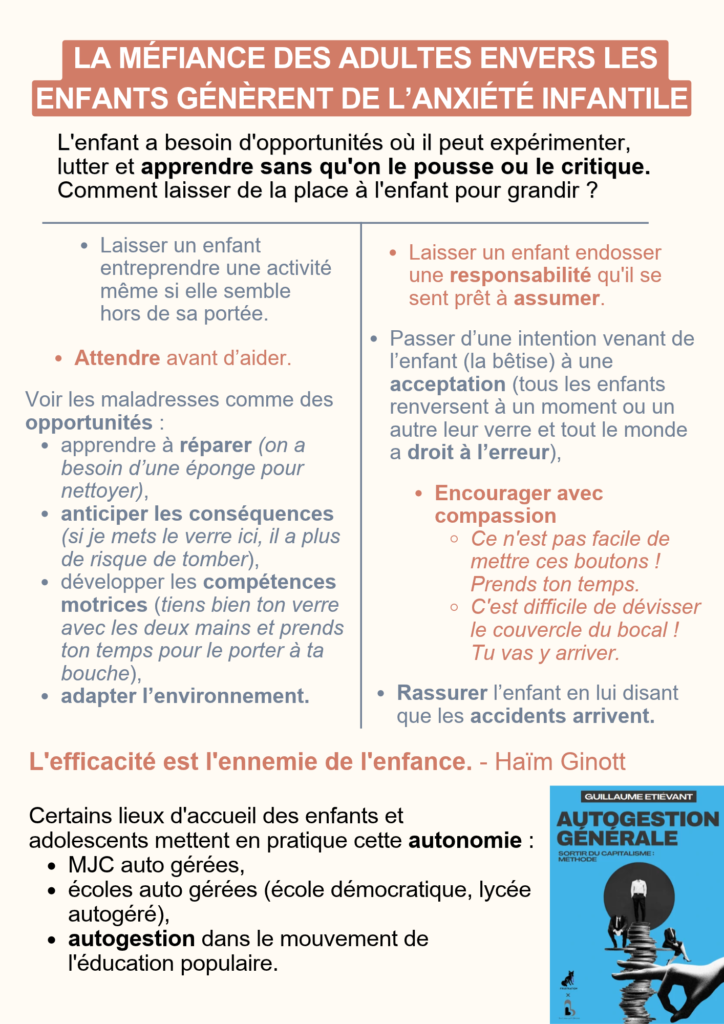
Children need opportunities to experiment, struggle and learn without being pushed or criticised. Ginott advises leaving room for the child to grow: let them start an activity even if it looks beyond them, let them take on a responsibility they feel ready for, and wait. Be tolerant.
Encourage with compassion rather than correction: "It's not easy doing up those buttons!" or "That jar lid is hard to unscrew!" Let children make mistakes and fail. Ginott even writes that efficiency is the enemy of childhood. Some youth centres and self-managed schools put this autonomy into practice, and the popular education movement actively encourages self-management.
Building independence through play
Fine motor tasks are a natural training ground for this patient, hands-off encouragement, and the right fine motor toys let a child struggle productively without an adult taking over. The same patience applies to daily routines: a child who is rushed at every step learns that their own pace is a problem. Slowing down and tolerating a slower result is itself a form of emotional safety.

4. Anxiety linked to parental conflict
When parents argue, children feel both anxious, sensing a threat to their home, and guilty, as if they played a part in the family discord. That anxiety can be reduced through discussion. Parents can handle their differences by talking calmly or by reserving them for private moments.
Ginott notes that while it is useful for children to know that parents can have disagreements to negotiate, it does them no good to see their parents attacking each other. Keeping conflict away from children is not about pretending everything is perfect; it is about protecting them from the sense that their world is unstable. A brief, calm explanation that adults are working something out is usually enough.
If your child seems constantly drained or unwell alongside this worry, it is worth looking at the wider picture, as with a tired child who may need more support than a single conversation can offer. Emotional security and physical wellbeing are closely linked.

5. Anxiety linked to fear and the wider world
Children also pick up anxiety from the world around them, including the fears adults carry and the stories they hear. A child who cries at the doctor's office, for instance, is often responding to tension rather than pain, and a calm, prepared approach helps more than reassurance alone. You can read more about this in crying at the pediatrician.
Everyday worries also surface around health, school and friendships. A child who is unwell may become more clingy, and a parent recovering from illness or surgery can unsettle routines; understanding cesarean recovery or similar experiences helps you explain changes in plain language. Stories are a powerful tool here, since maths through stories and other narrative approaches show how framing a subject well can turn dread into curiosity. Choosing calming toys can also give children a reassuring outlet for everyday worries, while parents should stay alert to darker online trends such as the Blue Whale challenge.
What matters most is that the child feels accompanied rather than alone with the fear. Naming the worry, staying close and keeping routines predictable all confirm emotional safety.


My hands-on take
In my own home, the abandonment advice was the one that changed things fastest. I used to slip out quietly when leaving my daughter with her grandmother, thinking it would spare her a scene. It did the opposite: she would search the house and become clingy for days. Once I started saying a proper goodbye, telling her exactly when I would be back and leaving a little note she could keep, the tears shrank to almost nothing.
The mechanic idea also stuck with me. When a glass gets knocked over now, I try to ask what happened rather than who did it, and I keep my explanation to one or two sentences. It feels slower in the moment, but there is far less sulking afterwards, and my child is more willing to tell me the truth.
Frequently asked questions
Can I really remove all my child's anxiety?
No, and it is not desirable to try. The goal is to help children face their fears while showing that you respect and understand them.
Is it harmful to joke about leaving my child behind?
Yes. Even as a joke, phrases about leaving can wake a sleeping fear of abandonment very quickly. Prepare separations instead.
How do I handle misbehaviour without causing guilt?
Treat it like a mechanic diagnosing a fault: identify what needs repairing rather than blaming the child, and keep your explanations short.
Should children ever see their parents argue?
It is useful for them to know disagreements can be negotiated, but harmful to watch parents attack each other. Keep conflict calm or private.
Product Reviews
 Best Toys for Dogs With High Prey Drive |
Best Outdoor Toys for 3-4 Year Olds |
Best Outdoor Toys for 6 Year Olds |
Best Harness for Poodle |
Best LEGO Sets for Adults |
Best Travel Toys for 4 Year Olds on Airplane |
Best Toy Stores in Washington DC |
Best Potty Training Toys |
Best Toys for Tripod Dogs |
Maillot equipe de france







