


La Dictature des petites couettes is a clever picture book about the fashion rules and beauty standards that reach children from a very young age. Olga and her friends decide to organise a beauty contest, complete with pretty dresses, little pigtails and little stars.
When Gabriel and the Cat ask to take part, everyone feels a bit awkward. Boys can't be beautiful, can they? Between the boys and the girls, a beauty war is declared.

Quick takeaways
- A witty picture book about beauty contests and who is allowed to be beautiful
- The dark blue cover deliberately avoids the usual pink-for-girls code
- Gabriel and his cat challenge the girls' beauty standard with humour
- The ants' punchline shows that every beauty standard is relative
- Use it to talk about image, gender stereotypes and respect for children's choices
- The ending opens a real reflection rather than a moral lesson
A sparkling, punchy picture book
La Dictature des petites couettes is a sparkling and punchy book. From the cover, it fills your eyes: the dark blue draws you in and sets the tone straight away. Here, nobody is going to talk only about pink for girls; all of that is going to be questioned.
In this mischievous album, Ilya Green stages a group of friends playing dress-up. Ana, Olga and Sophie find lovely dresses and argue about who is the prettiest. Do the stars make you superior, or is it the little pigtails? Can you be beautiful with costume cat ears on? And what if they held a beauty contest to find out who is the most beautiful?
Why the cover matters
The choice of dark blue rather than the usual pink is a quiet statement. It signals to children and parents alike that this story will play with expectations rather than confirm them, which is exactly what makes it such a good starting point for parental education conversations.
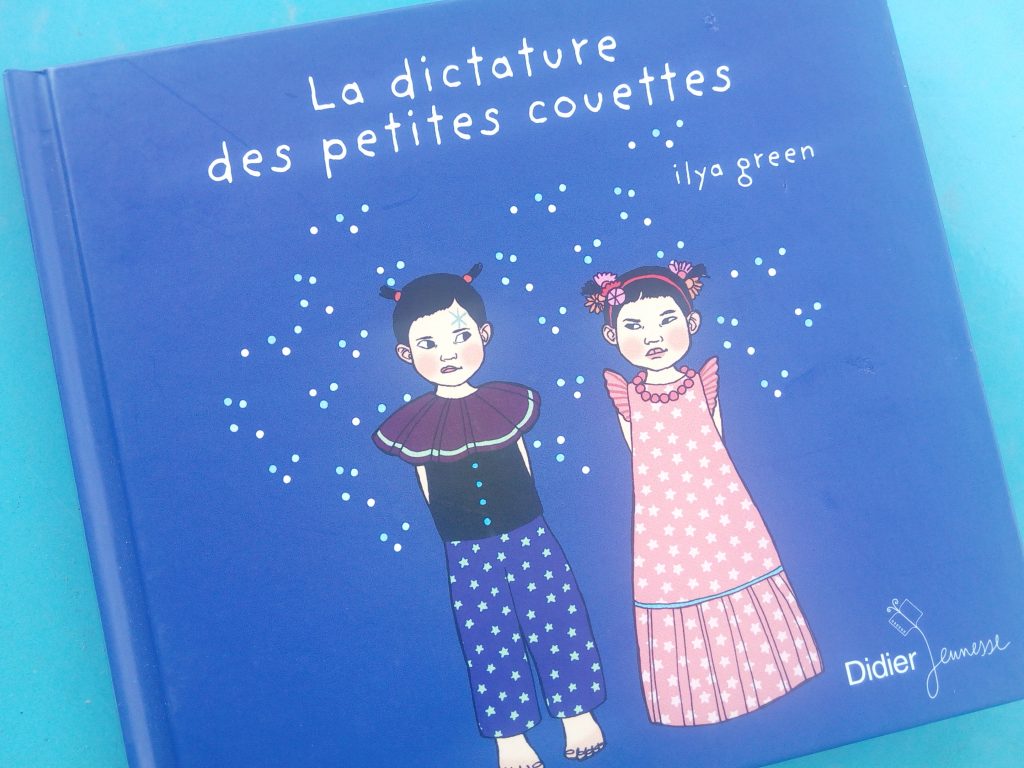
Gabriel and the Cat want to join in
Gabriel, the girls' friend, and his cat want to take part in the beauty contest too. But are boys allowed to enter a beauty contest? Can they be beautiful even without little pigtails? And could a cat covered in fur take part?
Gabriel and the cat decide that yes, they can. Everyone has their own tastes, and everyone has the right to be beautiful. The girls agree, on condition that they impose their own beauty standard: pink, purple, glitter, dresses, stars and, of course, little pigtails.
That scene is a gift for parents who want to talk about how psychomotor skills and play intertwine: dressing up, painting a face and choosing accessories are all ways children test who they are allowed to be. It also pairs well with simple gross psychomotor skills games at home.

| Element | Who sets the rule | Question to ask children |
|---|---|---|
| Pretty dresses | The girls | Who decided dresses are for girls? |
| Little pigtails | The girls | Can a boy wear pigtails if he wants to? |
| Pink and glitter | The girls | Do you like it, or do you wear it to please others? |
| Cat ears and fur | Gabriel and the cat | Can a cat be beautiful in its own way? |
| Little antennae | The ants | Whose standard of beauty is the right one? |
| Being yourself | Everyone | What makes you feel good about how you look? |
The ants deliver the punchline
Since impartial judges are needed, the ants passing by will do nicely to decide who is the prettiest, or the handsomest, as Gabriel adds. Except that the ants are not at all impressed by the fashion show the girls and Gabriel put on.
"You are far too big to be beautiful," they say. "To be beautiful, you have to be very small and very black. And have little antennae. Like this!"
The twist lands perfectly, because it shows children that every standard of beauty is relative. The ants simply apply their own criteria, just as the girls did. It is a gentle way to introduce the idea that the gifted children in any classroom will each read beauty differently.

More than it seems at first glance
This album says much more than it appears to at first sight. Ilya Green handles, with humour, our relationship to image, the relativity of beauty standards and the way others look at us. The writing, on the border between poetry and the familiar speech of children, and the line drawings serve this creative and original story perfectly.
It is a good way to start a discussion with children about the criteria of beauty and about the differences between girls and boys. Why would it be strange for a boy to enter a beauty contest? Why do the girls absolutely want to give him pigtails and paint the cat pink so that they are "beautiful"?
What the book is not saying
The idea is not to judge girls who dress up or who love glitter, nor to make boys love pigtails at any cost. It is about respecting children's choices outside the norms and beliefs that can slow down, or even block, the full flourishing of their potential.

Stereotypes shrink the possible
The stereotypes present in toys, books and other material aimed at children help to restrict their imagination and to strictly mark out the field of possibilities according to sex. This album questions those limits with humour, and its ending invites a real reflection.
The same logic applies to the toy box: a LEGO compatible brands set or a doll's pram carries a message about who is supposed to play with it. Opening that box is part of the same conversation the book starts.
For parents who want to go further, it helps to remember that children notice these messages early, and that small choices at home, from the toys for newborns onward, shape what they believe is allowed.

A book that recalls another favourite
This album reminded me of another one we loved very much, both in the way the story is brought in, with children playing and arguing, and in the theme it tackles: gender stereotypes and the freedom to be yourself. That other book is an ode to children's imagination and their ability to overcome small conflicts.
Both titles work well read aloud, because the arguments and the resolutions sound like real children. They give a family a shared vocabulary for talking about fairness, taste and choice.
La Dictature des petites couettes by Ilya Green, published by Didier Jeunesse, is available in libraries, bookshops and online stores. It also sits nicely beside practical parenting reads, from learning English to pool games for the summer holidays, and even alongside advice on how to get pregnant for growing families.


My hands-on take
I read this one aloud on a rainy afternoon, expecting a quick story and getting a twenty-minute debate instead. My youngest wanted to know why the cat had to be painted pink at all, and my eldest insisted the ants were simply being fair. I did not have a prepared answer, which turned out to be the best part.
What I appreciated most is that the book never tells children what to conclude. It sets up an argument, lets the characters be a little unreasonable, and then lets the ants be unreasonable in a different way. Since then, when a "that's for girls" comment comes up at home, I just ask who made that rule, and the conversation usually goes further than a lecture would.
Frequently asked questions
What is La Dictature des petites couettes about?
It is a picture book by Ilya Green in which a group of friends organise a beauty contest and argue about who is the prettiest. When a boy and his cat ask to join, the story questions beauty standards and gender stereotypes with humour.
What age is this book suitable for?
It works well as a read-aloud for young children and as a first discussion starter about image and stereotypes. The humour and the twist ending keep it light enough for repeated readings.
Does the book tell girls not to wear dresses or glitter?
No. It avoids judging girls who love dressing up and does not push boys to wear pigtails. The point is to respect children's own choices rather than impose norms.
How can parents use it at home?
Read it together and pause on the questions the characters ask: why a boy in a contest feels odd, why the cat is painted pink, and why the ants disagree. Let your child answer first.
Product Reviews
 Best Toys for Dogs With High Prey Drive |
Best Outdoor Toys for 3-4 Year Olds |
Best Outdoor Toys for 6 Year Olds |
Best Harness for Poodle |
Best LEGO Sets for Adults |
Best Travel Toys for 4 Year Olds on Airplane |
Best Toy Stores in Washington DC |
Best Potty Training Toys |
Best Toys for Tripod Dogs |
Maillot equipe de france







