


Defying anxious thoughts in children works best through empathy and play rather than logic. Anxious thoughts can devour and exhaust a child: "What if mummy dies tomorrow?", "The sun will explode and we'll all die", "What will my friends say when they see me in this jumper?", "I'll never manage it, it's too hard". Underneath the anxiety sit very important themes such as abandonment and safety.
It helps to remember that anxious thoughts dislike being contradicted and resist logic and reasoning. No child frightened by a monster under the bed has ever been reassured by a parent who insisted ten times that monsters don't exist. Anxious children tend to be very good at arguing, and they compensate for the weak rationality of their arguments with intensity and repetition.

Quick takeaways
- Accept the fear with empathy before trying to reason with it.
- Ask gentle questions instead of arguing or repeating that monsters don't exist.
- Assess the risk honestly rather than insisting there is none.
- Use a two-column table to list worries and their challenges.
- Play Fortunately/Unfortunately to reverse disaster scenarios.
- Try "what if it didn't happen?" in a light, respectful tone.
Start by accepting the fear with empathy
The first step is to accept the child's anxious thoughts and welcome them with empathy. Try to understand in depth what the child is feeling. To a child who asks "and what if you die?", you might answer "that would be horrible", "that sounds like a thought that makes you very scared", or "thank you for sharing your frightening thoughts with me". Humiliating a child for being afraid never works, and it only teaches them to hide the fear.
Next, evaluate the anxious child's beliefs by gently asking "what would happen to you that is so awful if you were wrong?" and then "and then, what would happen that is so terrible?". This slow unravelling often shrinks a fear that felt enormous. Then recognise and assess the risk, because insisting that there is no risk at all leads an anxious child to multiply precautions. Something like "it would be truly awful, but the probability is so low that I take the risk" or "is it worth being tempted?" keeps you honest without feeding the worry.
Defying is not arguing
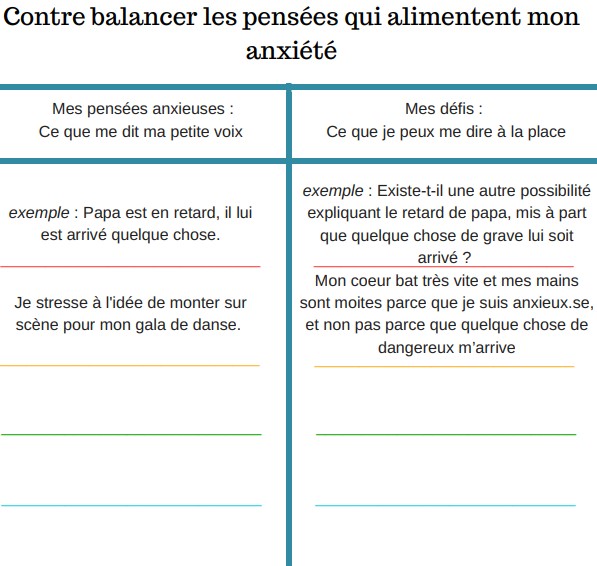
Defying anxious thoughts is not the same as arguing with them. Instead, you sidestep the irrationality by asking questions: "Is there another possibility that explains your dad being late, apart from something terrible having happened to him?" This invites the child to build an alternative story in their own words, which lands far better than a lecture.
You can also adopt another point of view, saying "I'm not scared" in a calm, compassionate tone and inviting the child to explain why they are. The contrast is not a contest; it shows that a different reaction exists. Then invite the child to create their own challenges, for example "last week, how did you manage to enjoy your judo class?". Small memories of coping become evidence they can reuse, much like the steady routines that help a baby settle at the table baby at the table.
Finally, reflect on our own anxious thoughts: which "what ifs" loop in your head? "My daughter is late. What if she's been kidnapped?" Children absorb our tone long before our words, so noticing our own spirals is part of the work, in the same spirit as the self-criticism many mothers carry mothers who judge.
| Step | What it sounds like | What to avoid |
|---|---|---|
| Accept with empathy | "That sounds like a thought that makes you very scared." | Mocking or humiliating the fear |
| Evaluate the belief | "What would happen that is so awful if you were wrong?" | Debating the facts |
| Assess the risk | "It would be awful, but the probability is very low." | Insisting there is no risk at all |
| Defy with questions | "Is there another explanation for dad being late?" | Arguing or lecturing |
The thought-challenge table
The psychologist invites the anxious children he sees to list, in table form, all the anxious thoughts that come back again and again, then to think about the best way to counter each one. The table has just two columns: Anxious thought and Challenge. Keeping it short and visible matters more than making it perfect.
Fill it in together, in the child's own words, and revisit it when a familiar worry returns. Over time the child learns that a thought can be questioned without being a betrayal of their feelings. The same patient, repeated practice is what builds most skills in childhood, whether it is handling money talk at home breastfeeding savings or learning to cope with a first shave first shave.
Why a table helps
Writing a worry down moves it out of the child's head and onto paper, where it can be examined calmly. It also gives you a shared reference to return to on difficult evenings, instead of starting from scratch each time.

The Fortunately / Unfortunately game
In this game, based on the picture book Fortunately by Remy Charlip, one person (often the adult) starts the story with something happy. The other player follows with something unfortunate. The two players alternate sentences beginning with "Fortunately" and "Unfortunately" until the story ends on a happy note.
This game offers an outlet for the anxious child's need to build disaster scenarios. Because the catastrophe is invited and then reversed, the child practises bending a story back towards safety. Paired with reading the book, it helps children contradict their negative thoughts without ever feeling corrected. It is a light, shared activity in the spirit of the simple crafts and games that keep children engaged, such as homemade treats homemade Christmas sweets or a rainy-day building session toys under $50.

The "what if it didn't happen?" game
This game challenges anxious thoughts more directly, provided you play it in a light and respectful tone. For example, to an anxious child who asks whether their parents are going to have a car accident, you might answer: "And what if it didn't happen?" The point is to laugh together at heavy fears, never at the child.
With this playful approach, anxious children put their imagination at the service of their confidence rather than their anxiety. Keep the game brief, watch the child's face, and stop if the joke lands wrong. A calm, warm setting helps, much as a predictable routine supports young children elsewhere baby in daycare. If fears about the body or growing up come up, answer simply and factually hyperthyroidism in children, and keep the door open for questions rather than shutting them down.

My hands-on take
I have tried the "what if it didn't happen?" game on a tense evening, and the hardest part was keeping my tone light instead of slipping into reassurance. When I managed it, my child actually laughed, and the worry lost some of its weight. What surprised me most was how quickly I fell into arguing, listing reasons why the fear was impossible, exactly the approach that never works.
Since then, I keep a small notebook where we jot down a worry and one challenge to it, in my child's own words. Some weeks the page stays empty; other weeks it fills up. The table is not a cure, but it gives us somewhere to put the fear together, and that shared moment seems to matter more than any perfect answer I could give.
Frequently asked questions
Why doesn't reasoning work with an anxious child?
Anxious thoughts resist logic, and anxious children often argue intensely and repeatedly. Reassuring them ten times that the fear is impossible rarely lands, so empathy and questions work better than debate.
What is the thought-challenge table?
It is a simple two-column table: one column lists the anxious thought, the other lists the challenge to it. Filling it in together helps the child examine a worry calmly instead of carrying it alone.
How do the two games help?
Fortunately/Unfortunately lets a child build a disaster and then reverse it, while "what if it didn't happen?" gently interrupts the scary scenario. Both use imagination to build confidence rather than feed anxiety.
Product Reviews
 Best Toys for Dogs With High Prey Drive |
Best Outdoor Toys for 3-4 Year Olds |
Best Outdoor Toys for 6 Year Olds |
Best Harness for Poodle |
Best LEGO Sets for Adults |
Best Travel Toys for 4 Year Olds on Airplane |
Best Toy Stores in Washington DC |
Best Potty Training Toys |
Best Toys for Tripod Dogs |
Maillot equipe de france







