


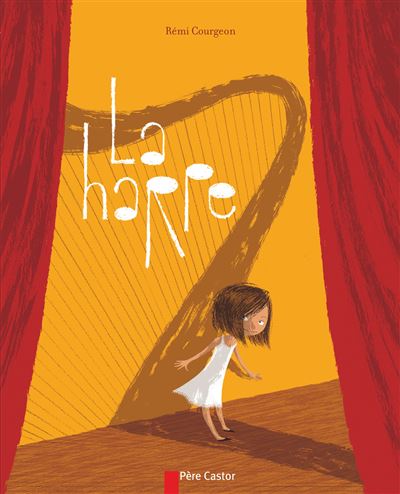
A children's book on self-esteem can open a conversation that many parents struggle to start. This one follows Louise, a little girl who dreams of cinema and fame but secretly believes she is hopelessly ordinary.
When her family moves house, she finds a hidden harp in the attic and starts to play. Each time her fingers touch the strings, something shifts: the girl in the mirror looks beautiful, confident and anything but ordinary.

Quick takeaways
- Louise feels ordinary, yet discovers a treasure inside herself
- The harp works as a metaphor for practice-based confidence
- Big changes like a move or a new sibling can shake self-esteem
- The story shows that effort, not magic, creates real success
- The mirror centre spread invites children to talk about self-image
- Recommended from age four, ideal for shared reading
A Story of Big Changes and Small Dreams
Louise is living through a lot at once: a baby brother on the way, a move to a new house, and the loss of her friends. Her head is full of dreams of stardom and the silver screen, yet those dreams stay firmly in the realm of fantasy. In her own eyes, she is terribly ordinary, more ordinary than ordinary.
This is exactly the emotional landscape many children recognise. Big transitions pile up, and confidence quietly slips. If your family is going through a similar period, our baby care guide and our advice on baby luggage can make the practical side of a move feel far less overwhelming.
Why the Ordinary Feeling Matters
Children rarely say out loud that they feel unremarkable. The book gives them a character who feels it for them, which is often the first step towards naming their own experience.

The Harp in the Attic: A Metaphor for Confidence
In her new, large house, Louise discovers a trapdoor leading to the attic. There she finds a harp and begins to play. Every time she slides her fingers across the strings, she feels transcended, as though something larger than herself takes over.
As her mastery of the instrument grows, so does her self-image. Watching herself in the mirror while playing, she finds herself beautiful, and no longer ordinary at all. Music becomes the mirror in which she finally sees her own worth.
Parents can borrow this idea without any instrument at all: a child who practices something regularly, whether drawing, running or building, gains the same quiet proof of competence. Simple cause and effect toys can offer younger children that same satisfying sense of "I made this happen".

| Element of the story | What it teaches | How to use it at home |
|---|---|---|
| Louise feeling ordinary | Naming a difficult feeling | Ask your child what makes them feel small |
| The harp in the attic | Practice builds confidence | Pick one skill to practise weekly |
| The mirror spread | Self-image can change | Pause and discuss what your child sees |
| The recital without her harp | Confidence lives inside | Praise effort, not lucky objects |
| Stage fright before playing | Fear is normal and manageable | Share a nerves story of your own |
The Recital, the Fear, and the Real Treasure
Her teacher, Mrs Van Houtten, invites her to play at the conservatory's end-of-year celebration. Louise is delighted, until she realises she cannot bring her own harp along. Fear sets in: how can she manage without the harp that turns her into a confident, radiant girl?
She trains hard, and despite intense stage fright, her performance is a great success. In the end, she needs neither magic nor a role to shine. Louise discovers that she can simply be herself, and that she carries a great treasure inside her.
Practice Over Magic
The message is clear and useful: effort and repetition build real confidence, while props and lucky objects only borrow it. Encouraging steady practice, however small, does more for a child than any charm. If your child needs a confidence boost during a difficult season, our stress management tips for new mothers translate well to family life in general.

A Sober Album That Lets the Message Breathe
The album is deliberately understated: short sentences, full-page illustrations, and colours that evoke a theatre or an opera house, with golden yellow and red curtains. Ornament would be pointless here; the restraint is what lets this strong message about self-love come through.
Beyond that central theme, children are also exposed to the healing power of music and to the importance of training and practice. The centre spread is particularly successful: it is literally shaped like a mirror, showing Louise and her harp on one side and the exact reflection on the other, text included.
That mirror page is a wonderful prompt for conversation. Ask your child what they see when they look at themselves, and let the answer surprise you. For a lighter moment afterwards, a shared activity such as roasting chestnuts or browsing toy stores can keep the mood warm and playful.

Reading It Together: Age Range and Practical Use
The book is recommended from age four, which makes it a good fit for the preschool years when self-image first takes shape. Read it slowly and pause on the mirror spread; children often want to go back to it several times.
You can also pair the story with everyday confidence rituals: letting your child choose an outfit, finish a small task alone, or perform something for the family. Our guide to nursery school choices is useful if a school transition is on the horizon, and our children's fashion ideas show how small choices can support a child's sense of self.
Finally, remember that the book offers no magic fix, and neither should we. Confidence is built through repetition, warmth and the freedom to be imperfect.

My hands-on take
I read this one with a child who had just changed schools and kept describing herself as "the boring one". We did not rush through it. We stopped on the mirror page for a long time, and she traced the reflection with her finger before asking whether the girl in the picture was really the same person.
What worked for us afterwards was small and concrete: one weekly activity she could measure, and a rule that we praise the effort out loud rather than the result. Weeks later she told me she was "a bit less boring now", which from her is practically a standing ovation. The book did not do that on its own, but it gave us the words to start.
Frequently asked questions
What age is this book suitable for?
It is recommended from age four. The short sentences and full-page illustrations suit preschoolers, while the theme of self-image still resonates with slightly older children.
Does the book require any knowledge of music?
Not at all. The harp works as a metaphor, and children who have never seen an instrument will still follow Louise's journey without difficulty.
Is it a good book for a child going through a move?
Yes. Louise faces a new house, a new baby brother and lost friends, so the story gives children language for the upheaval of a family transition.
What can parents discuss after reading it?
The mirror spread is the natural starting point. Ask your child what they see in themselves, and talk about how practice and effort can change how we feel about our abilities.
Product Reviews
 Best Toys for Dogs With High Prey Drive |
Best Outdoor Toys for 3-4 Year Olds |
Best Outdoor Toys for 6 Year Olds |
Best Harness for Poodle |
Best LEGO Sets for Adults |
Best Travel Toys for 4 Year Olds on Airplane |
Best Toy Stores in Washington DC |
Best Potty Training Toys |
Best Toys for Tripod Dogs |
Maillot equipe de france







