


Maternal burnout is what happens when the endless responsibilities of raising a family slowly use up a mother's entire energy capital. It is not a flaw in her character but a response to a demanding environment.
This article looks at the stressors that lead there, the social reasons maternal work goes unrecognised, and the three stages of exhaustion, detachment and self-doubt that mark the descent.

Quick takeaways
- Maternal burnout grows from workload, unpredictability and lack of control.
- Missing recognition and support are central drivers, not personal weakness.
- Cultural beliefs about praise and criticism keep mothers' work invisible.
- Stage one is emotional and physical exhaustion with no time to recharge.
- Stage two is emotional distancing and a loss of empathy and idealism.
- Stage three brings denial of accomplishments and falling productivity.
What Drives a Mother to Burnout
Exhaustion sets in when maternal responsibilities gradually wear down the whole of a person's energy reserves. A psychologist writing on the subject uses the word "work" to describe the everyday acts of many mothers, because that is genuinely what they are: continuous, unpaid and often invisible labour.
Several stressors combine to push a mother toward burnout. There is simple work overload, and a lack of control over situations and events. There is unpredictability, with days that never unfold as planned and no way to prepare for the next demand.
On top of this come an absence of reward or recognition for work accomplished, and a lack of physical and emotional support from a partner or wider social circle. A high personal value placed on doing the job well, combined with no real training for the responsibilities involved, completes the picture. Any parent juggling a household will recognise the pressure, much like the dilemma of going to work or staying home after a birth.

Why Mothers Get So Little Recognition
Maternal burnout has its roots not in women themselves but in their social environment. So why is there so little recognition for mothers? Four cultural reasons stand out in Western thinking.
Limited Understanding and Unspoken Rules
First, men sometimes hold a narrow view of what motherhood actually involves, shaped by a model that values the man at work and the woman "idle" at home, by pay gaps that make the mother's income the one that stops, and by weak incentives for fathers to take long parental leave.
Second, "doing your job well is normal" means good work earns silence while any slip earns a flood of criticism, judged by subjective standards. Third, there is a belief that too much praise breeds pride, vanity and laziness, perhaps reflecting a fear that mothers might stop doing what they are expected to do. Finally, complimenting is seen as weakness: criticising is easier because it places the critic in a position of dominance. The same dynamic can sour a mother's confidence in her own choices, whether about a mother's love or everyday decisions, from keeping a child warm to choosing toys for independent play.
| Stage | What it looks like | What helps |
|---|---|---|
| One: exhaustion | Constant tiredness, no time to recharge | Protected rest, shared chores |
| Two: distancing | Detachment, lost empathy, lost idealism | Honest talk, emotional support |
| Three: denial | Self-doubt, falling productivity | Recognition, realistic standards |
| Everyday stressors | Overload, unpredictability, no control | Planning, clear boundaries |
| Social factors | Little praise, easy criticism | Naming the work mothers do |
The Three Stages of Maternal Burnout
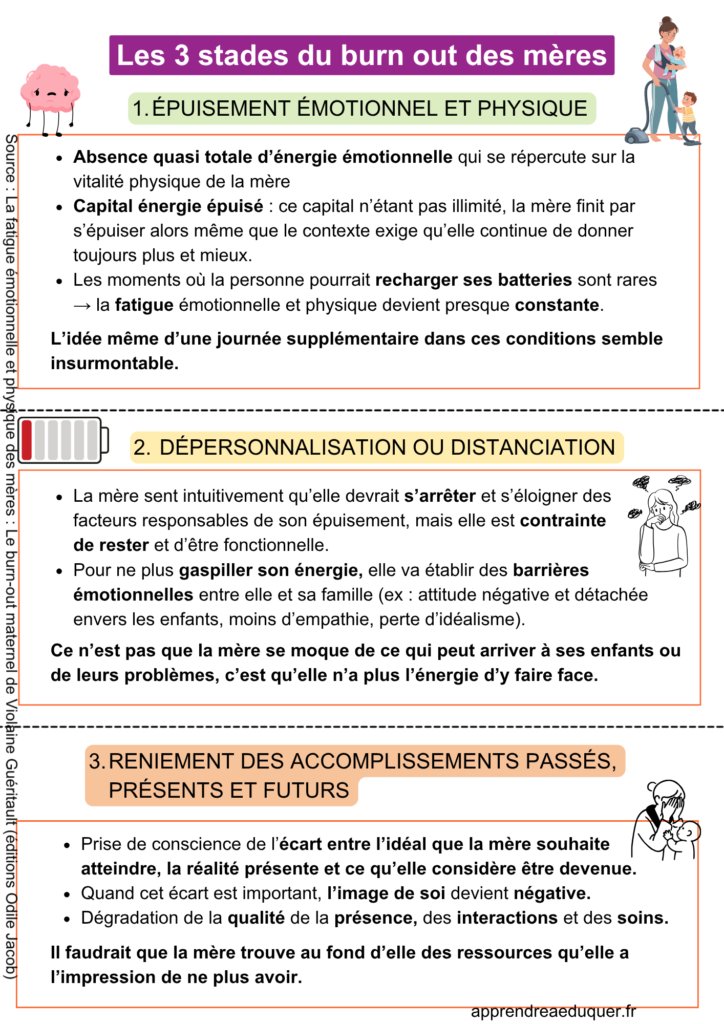
Burnout is described as a multidimensional process with three main components that appear as successive stages: emotional and physical exhaustion, depersonalisation or distancing, and a denial of past, present and future accomplishments alongside falling productivity. The model was first applied to professional settings, but it fits what thousands of mothers live through daily.
Stage One: Emotional and Physical Exhaustion
This stage is marked by an almost total absence of emotional energy that spills over into physical vitality. The energy capital is spent because a mother must give her time to others continually and unconditionally, and that capital is not unlimited. Moments to recharge are so rare that the fatigue becomes almost constant, and the idea of one more day like this feels insurmountable. Empty of energy, she must protect herself from the surrounding pressure, and the second stage begins.

Distancing and the Loss of Idealism
At this point a mother no longer has the strength or motivation to make the effort her task demands. She senses intuitively that she should stop and step away from what is exhausting her, yet she is forced to stay and keep functioning.
To stop wasting energy, she builds emotional barriers between herself and the people and situations that drain her. These limits show up as a negative, detached attitude toward anything that consumes her resources. She may more or less consciously stop feeling empathy: a person treated as an object has no particular needs, so caring for them without emotional investment becomes easier. This distancing often brings a loss of idealism. One mother put it plainly: it is not that she no longer cares what happens to her children, only that she has no energy left to face it. Small comforts and routines, from language development play to a warm warmest coats for the school run, can become the practical anchors that keep connection alive. Simple Montessori toys and shared household chores can offer low-effort ways to stay engaged.

Denial of Accomplishments and Falling Productivity
When the environment has led a person through the first two phases, she gradually becomes aware of the gap between the ideal she wanted to reach, her present reality, and what she believes she has become. That gap is painful, and it feeds the third stage.
She begins to deny her past, present and future accomplishments, and her productivity drops. What she once managed easily now feels beyond her, and she may conclude that she is failing at the very role she gives everything to. Recognising this pattern is the first step toward change: naming the stages helps a mother see that her exhaustion is a response to circumstances, not a personal defect. Practical support, honest conversation with a partner, and protected rest are not luxuries but the way back. Even small family routines, like sorting unused toys together or choosing toys for 3 year olds that encourage independent play, can free up a little breathing room.
My hands-on take
I remember a stretch when every morning started with a mental count of what I had already failed to do before breakfast. Nothing dramatic had happened; the days were just relentless, and there was never a moment that belonged to me. What helped most was not a grand solution but small ones: handing one fixed chore to my partner without negotiating it each time, and saying out loud when I was running on empty instead of pretending I was fine.
I also learned to notice the distancing stage in myself. When I caught myself going through the motions without really being there, I treated it as a signal rather than a verdict. Naming it took some of the shame out of it, and that made it easier to ask for help.
Frequently asked questions
Is maternal burnout the same as ordinary tiredness?
No. Ordinary tiredness eases with rest, while burnout builds when energy is spent continually with no chance to recharge. It develops through stages and affects emotions as well as the body.
Why do mothers feel guilty about burnout?
Because the culture around them treats doing the job well as normal and criticises any slip. That makes exhaustion feel like a personal failure rather than a response to real pressure.
Can a partner make a difference?
Yes. Practical and emotional support from a partner is one of the protective factors named in the model. Sharing the load and offering genuine recognition both reduce the drain.
What is the first step out of burnout?
Recognising the stages and naming what is happening. From there, protecting rest, asking for help and adjusting expectations become possible.
Product Reviews
 Best Toys for Dogs With High Prey Drive |
Best Outdoor Toys for 3-4 Year Olds |
Best Outdoor Toys for 6 Year Olds |
Best Harness for Poodle |
Best LEGO Sets for Adults |
Best Travel Toys for 4 Year Olds on Airplane |
Best Toy Stores in Washington DC |
Best Potty Training Toys |
Best Toys for Tripod Dogs |
Maillot equipe de france







