


Emotional connection with children means helping them feel understood and assured that we are beside them in difficult moments such as anger, frustration or stress. It is less about fixing the feeling and more about being present while the feeling passes.
In their book on discipline without drama, Daniel Siegel and Tina Payne describe connection as a four-step path: comfort, validate, listen and reflect. Each step is simple, but together they change how a child experiences a hard moment.

A loving, well-meaning touch, whether discreet like holding a hand or stroking a head, or more demonstrative like a hug, can quickly lower the emotional temperature. Without even opening your mouth, you already say a great deal.
Quick takeaways
- Connection means making children feel understood and accompanied in hard moments.
- Comfort first: a loving touch can lower emotional temperature fast.
- Validate the emotion, but never authorise hitting, screaming or breaking things.
- Listen without interrupting and decode the feelings behind the words.
- Reflect by mirroring feelings, then solve the problem together once calm returns.
- Small daily moments build the trust that makes discipline easier.
Why Logic Fails During Big Emotions
The problem with appealing to logic when a child is flooded by emotion is that it assumes the child is able to hear and answer rationally. Statements like “she cannot invite the whole school to her birthday” or “he did not mean to hurt you, it was an accident” rarely land well in the middle of a storm.
The logical part of a child’s brain is not only disconnected when the child is hurt or angry, it is still developing throughout childhood. Expecting reasoning in that moment sets everyone up for frustration.
This is why connection comes first and correction comes later. If you want more background on how adults shape these everyday reactions, the education in Finland model offers a useful reminder that calm relationships teach more than lectures.
Step One: Comfort Through Loving Touch
Comfort is the first move. A hand on the shoulder, a gentle stroke of the head or a full hug signals safety before any words are exchanged. This physical reassurance can bring the emotional temperature down quickly.
Comfort is not about rewarding bad behaviour; it is about settling the nervous system so the child can eventually think again. Keep your tone low and your body calm, because children read our state before they hear our words.
Some children dislike being touched when upset, so offer rather than impose. A quiet presence nearby can be just as comforting, and it respects the child’s temperament while still saying “I am here”.
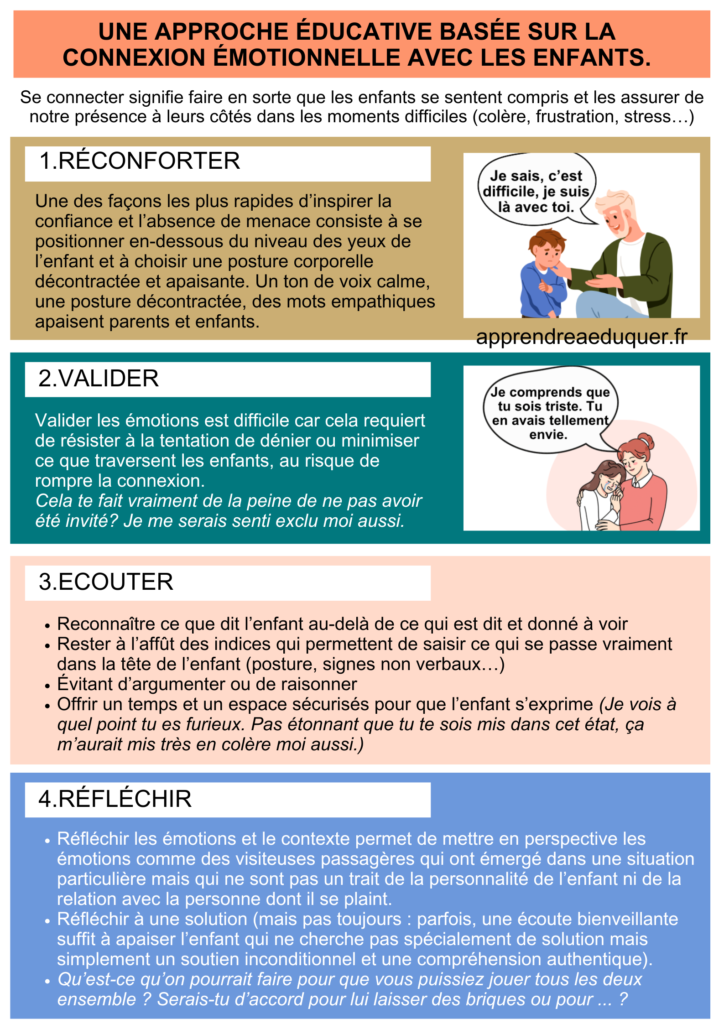
| Step | What it looks like | What to avoid |
|---|---|---|
| Comfort | Hand on shoulder, hug, calm presence | Arguing or lecturing |
| Validate | “You are really disappointed” | Allowing hitting or breaking |
| Listen | Full attention, “tell me more” | Jumping in with solutions |
| Reflect | Mirroring feelings, then problem-solving | Solving before the storm passes |
Step Two: Validate the Feeling, Not the Behaviour
Validation means naming and accepting the emotion: “You are really disappointed” or “That felt unfair”. It tells the child the feeling makes sense, even when the behaviour that followed does not.
Validation of emotions is not permission to hit, kick, scream at someone or break things. Sometimes it helps to move the child away from the situation first. We do not authorise inappropriate behaviour by identifying with the child’s emotions.
For parents navigating other intense childhood moments, such as dangerous teenage trends or baby biting breastfeeding, the same principle holds: acknowledge the feeling, then set the limit clearly and kindly.
Step Three: Close Your Mouth and Listen
Once emotions have been validated, it is often better to stop talking and truly listen to what the child has to say. Our adult job is to decipher the emotions hidden behind the words.
Listening means giving full attention without jumping in with solutions or corrections. A short “tell me more” or a simple nod keeps the child talking and helps them make sense of their own experience.
This is also where everyday routines support connection, whether through a calm songs before bedtime ritual or a quiet moment after school. Children open up when the atmosphere feels unhurried and safe.

Step Four: Reflect in Two Different Ways
Reflecting can mean mirroring the child’s feelings back to them, so they see that you understood: “So you felt left out when they chose someone else”. This mirroring helps children recognise and name their own emotions.
Reflecting can also mean using your intelligence to think through the problem together and find solutions. Once the storm has passed, you can ask what might help next time and let the child contribute ideas.
This problem-solving stage works best when the emotional work is done. It is also a good moment to consider broader family questions, from taking a child to child weight, with the same calm, connected tone.
Building the Habit Day by Day
Connection is not a technique reserved for crises; it grows through small daily moments of attention. Reading together, playing on the floor or simply sitting close after a long day all build the trust that makes hard conversations easier.
When children feel connected, they are more able to cooperate, and parents feel less like referees. The goal is not perfect calm but a reliable pattern of repair after difficult moments.
If you are preparing for a new baby or a big change, resources such as baby in the womb, infant umbilical hernia or surviving children jet lag can help you plan for calmer transitions.

My hands-on take
I remember trying to reason with my daughter in the middle of a meltdown about a broken drawing. Every logical sentence I offered made her louder. What finally worked was sitting down, putting a hand on her back and saying nothing for a minute. Only then could she tell me what had really upset her, which was not the drawing at all.
Since then I have tried to comfort and validate before explaining anything. It is not always easy, especially when I am tired, but the repair afterwards matters more than getting it right the first time. Connection has become less a technique and more a habit I keep practising.
Frequently asked questions
Does validating emotions mean accepting bad behaviour?
No. You can accept the feeling while still setting a clear limit on hitting, screaming or breaking things. Sometimes it helps to move the child away from the situation first.
Why can’t I just explain the logic to my child?
When a child is hurt or angry, the logical part of the brain is disconnected and still developing. Reasoning usually works better once the emotion has settled.
What if my child does not want to be touched?
Offer comfort rather than impose it. A calm presence nearby can be just as reassuring and respects the child’s temperament.
When should we look for solutions?
After the emotional work is done. Once the child is calm, you can think through the problem together and invite their ideas.
Product Reviews
 Best Toys for Dogs With High Prey Drive |
Best Outdoor Toys for 3-4 Year Olds |
Best Outdoor Toys for 6 Year Olds |
Best Harness for Poodle |
Best LEGO Sets for Adults |
Best Travel Toys for 4 Year Olds on Airplane |
Best Toy Stores in Washington DC |
Best Potty Training Toys |
Best Toys for Tripod Dogs |
Maillot equipe de france







