


Conditional love — the quiet message of "I love you if" — is one of the most common patterns in parenting, and its effects follow children into adulthood. When affection depends on performance, obedience or good behaviour, children learn to measure their worth against someone else's approval.
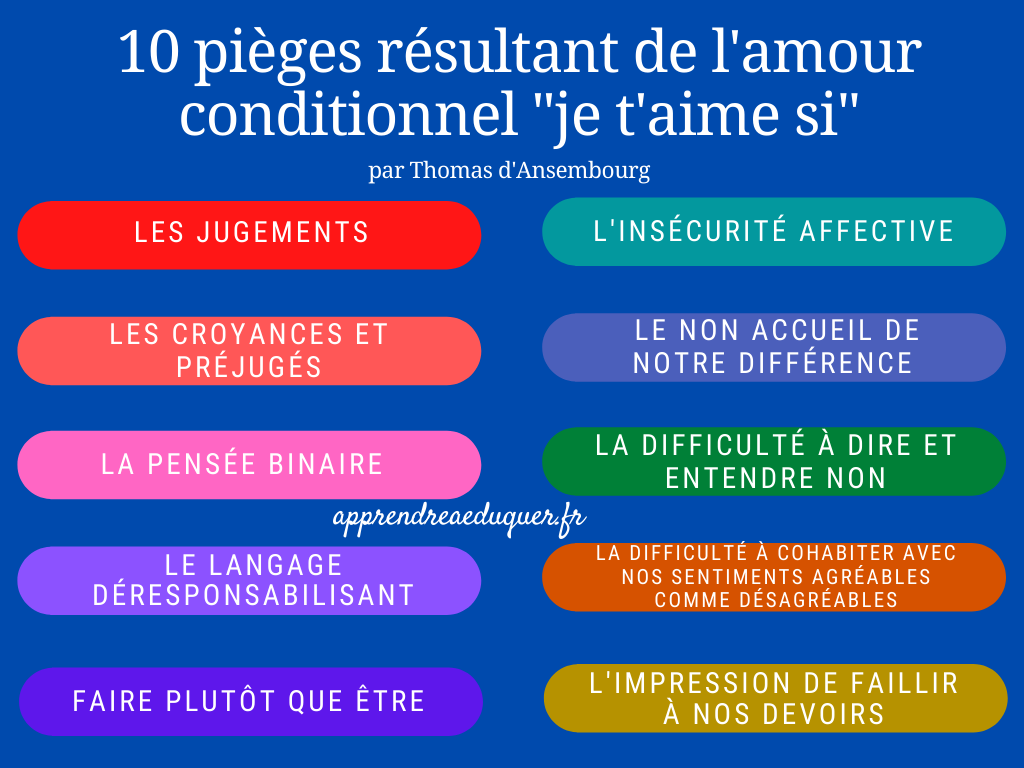
Drawing on the work of Thomas d'Ansembourg, a therapist and trainer in Nonviolent Communication, this article walks through ten traps that conditional love leaves behind. It then offers practical ways to step out of them, replacing duty with choice and guilt with genuine empathy.

Quick takeaways
- Conditional love teaches children to earn approval rather than trust their own worth.
- Judgments, beliefs and either/or thinking close down honest communication.
- "Must" and "should" hide the real needs and choices behind our actions.
- Difficulty saying no and guilt toward others often start in childhood conditioning.
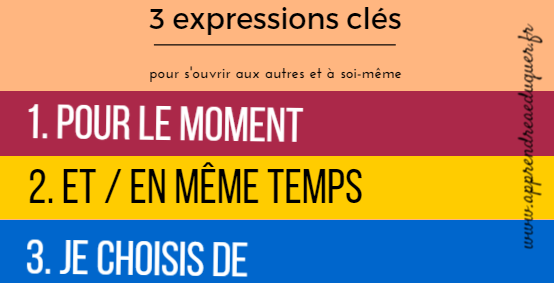
- Replacing duty with "I choose to" restores responsibility and empathy.
- Adding "for the moment" leaves room for growth instead of fixed verdicts.
Judgments, beliefs and binary thinking
The first trap is judgment. Judgments about ourselves, about others, about a situation or about life itself get in the way of real communication. A parent who thinks "she always acts like this, she will never change" has already closed the conversation before it begins. The same applies to beliefs and prejudices, which can target ourselves, other people or life in general — "I am not capable of this" or "he won't love me if I don't do what he asks".
The all-or-nothing habit
Binary thinking expresses itself through sharp divisions. Our upbringing trains us in a logic of exclusion: you are either intellectual or practical, a poet or an engineer, difficult or wise. Yet a person can be traditional in some areas and innovative in others, and can care for themselves and for others at the same time. D'Ansembourg suggests leaving the closed "either/or" behind for a complementary "and/and" perspective — a shift that also helps when independent play toys invite a child to explore both quiet and active modes.
Irresponsible language and doing instead of being
A fourth trap is irresponsible language, which hides behind roles, models and the phrase "that's how we've always done it". Statements like "it must be done", "it is my duty as a good parent" or "children are supposed to" remove the speaker from the equation. The fifth trap is doing rather than being: when love feels earned, we come to believe we are loved for what we do, not for who we are. "Should I do at least this, or that?" and "is what I did enough?" become constant internal questions.
These patterns matter even in ordinary moments. A child who is praised only for results may read a family board game night as another test, which is why family board games work best when winning is clearly beside the point. The same applies to everyday care: even applying after sun can become a performance if it is framed as a task to be graded rather than a moment of care.

| Trap | What it sounds like | A practical response |
|---|---|---|
| Judgment | "She will never change" | Describe the behaviour, not the person |
| Beliefs and prejudice | "I am not capable" | Ask what evidence you actually have |
| Binary thinking | "Either practical or creative" | Try "and" instead of "or" |
| Irresponsible language | "It must be done" | Say "I choose to" |
| Doing over being | "Is what I did enough?" | Name the effort, not the result |
| Affective insecurity | "What will people think?" | Check whose voice is speaking |
| Rejecting difference | "Everyone does it this way" | Ask what your own needs are |
| Difficulty with no | "I said yes but meant no" | Practise a calm, short refusal |
Insecurity, difference and the word no
Conditional love tends to leave a child short on self-esteem and dependent on other people's gaze. That is the sixth trap: affective insecurity, expressed in questions like "what will people think of me?" or "am I doing enough?". The seventh trap is a refusal of our own difference and specificity — "everyone else does it this way, so doing otherwise is wrong". A child rewarded only for obedience learns that their own needs and feelings are abnormal and should not be listened to.
Saying and hearing no
The eighth trap is the difficulty of saying and hearing no. Saying yes when we think no leaves us guilty toward ourselves; saying no when we mean no leaves us guilty toward the other person, as if we were unkind. Hearing a no makes us feel we should never have asked. Practising small, calm refusals — even around something as simple as stocking stuffer toys chosen together — gives everyone room to negotiate without guilt.
Mixed feelings and the weight of duty
The ninth trap is the difficulty of living with pleasant and unpleasant feelings at once. We struggle to accept contradictory emotions and judge ourselves for them: "I cannot be happy that my couple is doing well, since my best friend is divorcing or my father is seriously ill." D'Ansembourg notes that we often feel guilty when we are torn between feelings and needs that are hard to hold together.
The tenth trap is the impression of failing in our duties. We feel guilty when our responsibilities and those of others become confused, because we were raised to feel vaguely responsible for everyone else's feelings and needs. Two honest questions help: what am I really responsible for, and what is the other person responsible for? Everyday care routines, from hair washing to bedtime, are good places to notice where our responsibility actually ends.
From duty to choice: changing the language
The way out begins by replacing the notion of duty with the notion of choice and need. D'Ansembourg describes duty as a dry, austere expression of what is really a movement of the heart: a deep need for responsibility, reciprocity and sharing, a need to give love and to contribute to others' well-being. We do not work out of duty but out of love of material security and comfort, or because we want to contribute to our community — even if the job is not the one we dreamed of.
Language is the practical lever. Remove "it must be" and try "I choose to" or "I deeply care about". Adding "for the moment" keeps in mind that everything moves: I have not got there yet, but I will. This reframing supports the patience that kindergarten applications and other milestones demand, and it keeps the focus on the relationship rather than the outcome.
Choosing connection over conditions
None of this means abandoning limits. It means setting them from a place of clarity rather than conditional approval. When a parent says "I choose to stay calm now" instead of "I must be a good parent", the child hears a person making a choice, not a judge keeping score. That modelling is what teaches children to name their own needs without shame.
It also changes how we respond to everyday friction, whether that is a difficult mealtime or a long journey. A calm, chosen response travels better than a conditional one, and a few flight toys packed with intention can turn a stressful trip into shared time. The same steady approach helps when bedtime excitement runs high or when you are weighing sports for children. Over weeks and months, these small shifts build the self-esteem and empathy that conditional love quietly erodes.

My hands-on take
I noticed these traps most clearly during a phase when I was constantly asking myself whether I was doing enough as a parent. Every bedtime that went badly felt like a verdict on me rather than a hard evening. What helped was writing down the sentence "I choose to be here now" and saying it silently before responding, instead of running through a list of shoulds.
The other change was learning to say a short, calm no without a paragraph of justification. At first it felt cold; after a few weeks it felt honest, and the conversations that followed were shorter and kinder. I still catch myself judging, still hear "it must be" in my head, but I now notice it sooner — and noticing, it turns out, is most of the work.
Frequently asked questions
What is conditional love in parenting?
It is affection that depends on a child's behaviour, performance or obedience — the message "I love you if". The child learns that approval must be earned, which can weaken self-esteem over time.
Does setting limits mean conditional love?
No. Limits and boundaries are part of care; the difference lies in whether affection is withdrawn when a child fails. You can hold a firm limit while making it clear that the relationship is not at stake.
How can I change the way I speak to my child?
Start with small swaps. Replace "it must be done" with "I choose to", and add "for the moment" when something is not yet achieved. These phrases keep responsibility visible and leave room for progress.
Is it too late to change these patterns?
No. These habits were learned, so they can be unlearned through repeated small choices. Naming your own needs honestly and apologising when you slip both model the change you want to see.
Product Reviews
 Best Toys for Dogs With High Prey Drive |
Best Outdoor Toys for 3-4 Year Olds |
Best Outdoor Toys for 6 Year Olds |
Best Harness for Poodle |
Best LEGO Sets for Adults |
Best Travel Toys for 4 Year Olds on Airplane |
Best Toy Stores in Washington DC |
Best Potty Training Toys |
Best Toys for Tripod Dogs |
Maillot equipe de france







