


Children's books that spark wonder can turn an ordinary afternoon into something memorable. The emotional experience of admiration and awe lifts the everyday into the extraordinary and makes life richer, full of tiny moments of happiness. This feeling rests on the ability to find, recognise and take pleasure in wonder at every form of beauty and at whatever touches our sensibility.
Whether it is a beautiful landscape, a piece of music, a work of art or a particular talent in another person, appreciating beauty and excellence lets a human being connect to something larger than themselves. Knowing how to appreciate beauty, excellence and skill in every field lets children experience a sense of the grand and the marvellous. One of the most important words to use with our children is simply: LOOK! followed by FEEL!

Quick takeaways
- Wonder is a habit of attention that adults can model with a simple "Look!"
- What Do You See? shows how a change of gaze can change a child's experience
- The Tiniest Things invites slowness, poetry and contemplation of small details
- Nothing Is More Beautiful turns lists of words into tender, funny poems
- Read slowly and ask what a child notices rather than what a story means
- Extend books into walks, music and everyday rituals
Why Wonder Matters for Children
A little stubbornness and a willing optimism are enough to bring out the most beautiful thing in ourselves and in the world: our way of seeing and looking at the events that touch us. Wonder is not a luxury or a personality trait reserved for dreamy children. It is a habit of attention that can be encouraged, the same way we work on self improvement through small daily routines.
Children who learn to notice details also learn to pause. That pause is where curiosity, creativity and calm begin to grow, and it supports the kind of open-ended play we see in games for children's creativity.
Look, then feel
The simple prompt "Look! What do you see?" does more work than a long explanation. It invites a child to slow down and to trust their own eyes.
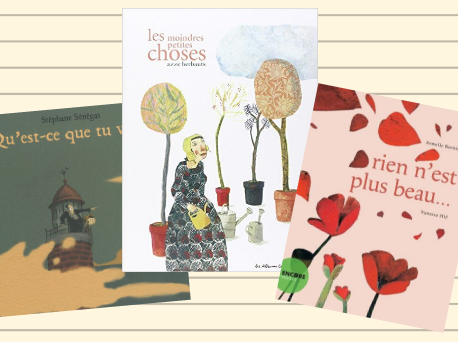
1. What Do You See? A Story About Changing Your Gaze
What Do You See? by Stéphane Sénégas is a picture book that invites children to look beyond what is right in front of them and to marvel at a thousand small treasures that usually go unnoticed. A little boy spends his holidays with his uncle Horace, a lighthouse keeper. The boy is far from delighted: no TV, no bike, no friend, nothing could be more boring.
When Horace takes him to the top of the lighthouse, he asks: "What do you see?" The boy answers: "Why, is there something to see?" As the holidays go by, the boy realises there is plenty to do after all: simple things that bring a lot of joy.
I loved this album for its illustrations and its finely drawn message: Look! Because a gaze can change a life. It pairs well with visual acuity games that train children to spot details, and with the playful spirit behind music activities, where listening closely matters as much as seeing.

| Book | Central theme | Best for |
|---|---|---|
| What Do You See? | Changing your gaze | Children who say "I'm bored" |
| The Tiniest Things | Slowness and poetry | Calm bedtime or quiet time |
| Nothing Is More Beautiful | Word play and poetry | Creative writing and imagination |
| All three | Appreciating beauty | Family read-aloud routines |
| All three | Noticing details | Walks and outdoor time |
2. The Tiniest Things: A Book That Invites Slowness
The Tiniest Things by Anne Herbauts is a sublime book outside time and outside the frame, inviting slowness and poetry. Mrs April has a small garden. When Mrs April thinks, the garden grows... She tells herself she is far too tiny for these tiniest things, and the world around her is gigantic.
Even before opening it, the book gives off a feeling of softness and poetry, as if time were suspended and we were invited simply to contemplate the beauties of the world, to savour small moments of happiness and to enjoy being alive. We drift along with Mrs April's daydreams: we let our minds wander, marvel, rest and meditate; we take time to savour every word and observe the details of every illustration.
The "tiniest things" that give this beautiful work its title are our everyday life when it unfolds, leaves the frame and takes flight, outside time, to become in the moment something unsayable and deeply moving. This is a book about overflow: about the beauty of the world that exceeds words, about children's wonder, about our vulnerability before these emotions, where the minuscule sits beside the gigantic.

3. Nothing Is More Beautiful: A Word Game for Young Poets
Nothing Is More Beautiful by Armelle Barnier is a jumble of images and words. Each double page lists and illustrates everything we find most beautiful, most frightening, biggest, smallest, warmest, coldest, slowest. The words are then mixed up to make tender and funny poems.
Here is an extract: "Nothing is more frightening... than a meeting of horrible witches, than a nightmare in the dark, than an angry bad dragon, than a ghost that rattles at night. In fact, nothing is more frightening than a meeting of nightmares of an evening dragon."
I like this album because it invites imagination with tender, poetic and joyful words and illustrations. Everyone can complete the list and create their own jumble of words, or find a new list: nothing is funnier, nothing is more colourful, nothing is softer. It is a genuine invitation to poetry and creativity, and a lovely bridge to the imaginative worlds children build with Transformers movie toys or any figure they invent stories for.

How to Bring Wonder into Everyday Family Life
These three books work best when they are not treated as lessons. Read them slowly, let a page sit open, and follow the child's pace rather than the plot. Ask "what do you notice?" instead of "what does it mean?" and accept any answer, even a shrug.
You can extend the experience outside the book. A walk to the park, a look at the sky or a few minutes listening to a favourite song all become material for wonder when an adult points at them and stops too. The spirit is close to the one behind preparing the school route: small, repeated rituals that turn routine into something a child can anticipate and enjoy.
Older siblings can join in by keeping a "most beautiful" list of their own, and quieter children often open up when the question is about a picture rather than about themselves. If you are looking for gentle gifts to support this habit, browsing toys under $20 or a local shop such as toy stores can help you find simple, open-ended objects that leave room for imagination rather than dictating it.

My hands-on take
In our house, the lighthouse book became a small ritual. My youngest used to announce that every walk was boring before we had even left the gate, so I started borrowing the uncle's question: "What do you see?" At first he rolled his eyes. Then he began pointing at things I had walked past for years, a cracked tile shaped like a face, a cat asleep in a window box.
The poetry book worked differently. We kept a notebook of "nothing is more..." lines, and the sillier they were, the better. What I learned is that wonder does not need a special outing or a perfect afternoon. It needs an adult willing to stop first, and a book that gives everyone permission to look a little longer.
Frequently asked questions
At what age can children enjoy these books?
They work well from the preschool years through early primary school, but the right age depends on the child. Younger children will respond to the illustrations, while older ones can discuss the ideas and try the word games.
Do I need to explain the message of each book?
No. The message lands best through the pictures and through conversation. Asking what your child notices is usually enough, and silence while looking is part of the experience.
Can these books help a child who finds it hard to slow down?
They can be a gentle starting point. Reading one page at a time, without rushing to finish, gives a restless child a model of pausing that can carry over into other moments.
How do I choose between them?
Pick What Do You See? for a child who needs convincing that ordinary places are interesting, The Tiniest Things for quiet contemplation, and Nothing Is More Beautiful for a child who loves words and jokes.
Product Reviews
 Best Toys for Dogs With High Prey Drive |
Best Outdoor Toys for 3-4 Year Olds |
Best Outdoor Toys for 6 Year Olds |
Best Harness for Poodle |
Best LEGO Sets for Adults |
Best Travel Toys for 4 Year Olds on Airplane |
Best Toy Stores in Washington DC |
Best Potty Training Toys |
Best Toys for Tripod Dogs |
Maillot equipe de france







