


Negative labels to avoid with children are among the most powerful tools adults hold, because words can build a child up or quietly tear them down. Calling a child clumsy, lazy, stubborn or a monster is hurtful, and these humiliating, devaluing messages leave marks wherever they come from: parents, teachers, relatives or other children.
Words matter enormously. A single phrase can either value a child completely or undermine them completely, which is why choosing our words carefully every day matters so much. This article explains what labels are, why adults reach for them, what damage they do, and how to swap them for something far more useful.

Quick takeaways
- Labels describe the child; describe the behavior instead.
- Repeated labels become self-fulfilling prophecies.
- Difficult behavior usually signals an unmet need.
- Some children need professional or medical support, not a label.
- Swap “you are lazy” for “the toys need tidying.”
- Agree on neutral phrases across all caregivers.
What Labels Do to Children
A label is a shortcut: instead of helping a child understand the consequences of their actions, we sum them up in one word. The child then absorbs the negative words and the emotions attached to them, without ever developing a sense of personal responsibility. Over time, labels act as a self-fulfilling prophecy: tell a child often enough that they are lazy or stubborn, and they will integrate it as a personality trait and behave accordingly.
Labels are a form of classification that traps a child in a fixed category. They force children to define themselves by what they are not and by what they lack, rather than getting to know who they actually are. Even well-meant labels limit growth, because they describe a person instead of a situation.
Why the Words Stick
Children build their self-image partly from what adults reflect back to them. A repeated label becomes the mirror they look into, which is why a passing remark said in frustration can outlast the moment that caused it. Keeping everyday language descriptive rather than judgmental protects that fragile self-image, much as a calm, predictable routine does during other sensitive stages, like bedtime songs routine or the early days of potty training progress.

Why Adults Reach for Labels
Parents who feel powerless want answers to their questions, and a label looks like a convenient one. It often serves to categorize children who pose difficulties and acts as a “magic” explanation, practical because it saves us from looking for the real motives behind inappropriate behavior.
Yet children who are difficult, or rather who put us in difficulty, mostly have unmet needs that need filling, or particularities that call for professional support, sometimes medical, such as autism spectrum disorder, ADHD, dyslexia and other learning differences. A label closes the conversation; curiosity opens it.
What Labels Cost Everyone
Adults’ expectations toward a labeled child can be so strong that they influence both the adult and the child. The nature and investment of the educator vary according to their prejudices, favorable or unfavorable, and the adult’s prediction changes their own behavior in a way that raises the likelihood the event happens. It is a kind of prophecy that comes true simply because it was made. Labels create a form of determinism and sap the morale of adults and children alike, and a child who behaves “badly” is often simply a discouraged child: that is the vicious circle.
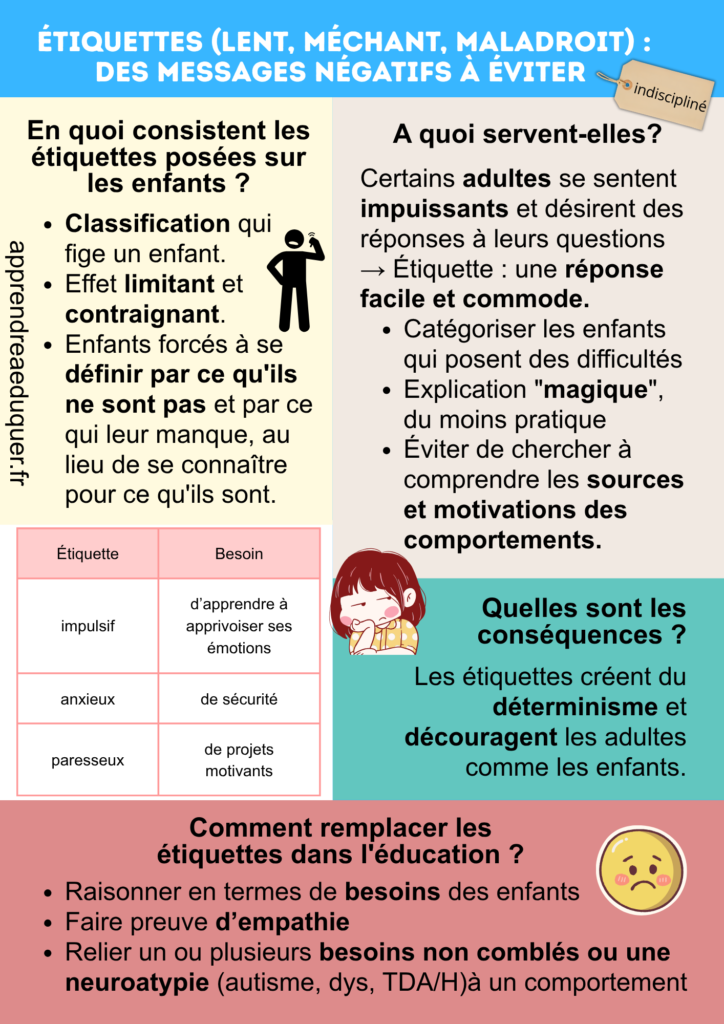
| Label to avoid | What it hides | What to say instead |
|---|---|---|
| Clumsy | A need for practice or space | “Let’s slow down and try again.” |
| Lazy | Fatigue or lack of clarity | “What’s the first step you can do?” |
| Stubborn | A need for autonomy | “You want to decide; let’s choose together.” |
| A monster | Big feelings without tools | “You’re angry; let’s calm down first.” |
| Shy | A need for time and safety | “Take your time; I’m here.” |
How to Replace Labels With Needs
It is more constructive to reason in terms of children’s needs than to hang devaluing labels that spotlight inappropriate behavior. Every behavioral difficulty can be connected to one or more unmet needs, and the parent’s empathy is what decodes the need underneath the difficulty. Meeting a child’s developmental needs is a parental responsibility.
In practice, this means describing what you see instead of who you think the child is, naming the feeling, and offering a next step. “You knocked the cup over” invites problem-solving; “you’re so clumsy” invites shame. The same shift helps in everyday friction points, whether you are managing eating out or helping a child through a demanding afternoon.
Rethinking the “Difficult” Child
When behavior keeps repeating, look for the need behind it: rest, connection, autonomy, predictability or sensory comfort. Some children also need tailored support, and understanding how their environment shapes them, from baby in womb development onward, reminds us that behavior is communication. Play and appropriate stimulation give children safe outlets, which is why choosing sensory toys toddlers or simply toys for two year olds suited to their stage can reduce the frustration that fuels outbursts.

Everyday Swaps That Work
Replacing a label does not mean ignoring behavior. It means separating the child from the act and keeping the message about the situation. Instead of “you’re lazy,” try “the toys are still on the floor and they need putting away.” Instead of “you’re a monster,” try “you’re very angry right now; let’s find a way to show it safely.”
Modeling this language also teaches children how to talk about themselves. A child who hears “you made a mistake, let’s fix it” learns that mistakes are events, not identities. The same principle of preparing and explaining works in other anxious moments, such as school trip nerves or a first baby bath time, where reassurance beats judgment.
Keep It Consistent
Consistency across adults matters: when one caregiver labels and another doesn’t, the message blurs. Agree on a few neutral phrases as a family, and use them even when you are tired. Small, repeated choices in language do more for a child’s self-esteem than occasional grand speeches.

My hands-on take
I noticed my own labeling habit during a rushed morning when I heard myself say “you’re always so slow” for the third time in a week. Nothing changed except my child’s face. So I tried describing instead: “shoes on, bag by the door, we leave in five minutes.” It felt clumsy at first, but the morning got calmer, and so did I.
What helped most was writing down three neutral phrases and sticking them on the fridge, then using them even when I was tired. I still slip up. When I do, I name it out loud and repair it, because showing a child how to recover from a harsh word may be as valuable as avoiding it in the first place.
Frequently asked questions
Are positive labels harmless?
Even flattering labels can limit a child, because they define a fixed identity rather than a moment. Praise the effort or the action, not the person.
What if my child really is struggling at school?
Look for the underlying need or difficulty and seek appropriate support. A label may feel like an answer, but an assessment and tailored help are more useful.
How do I stop labeling when I’m frustrated?
Pause, describe what you see, and name the next step. Practicing a few neutral phrases in advance makes them easier to reach for in the moment.
Does this mean I never set limits?
No. Limits are essential; the change is in how you phrase them. Keep the limit clear while keeping the child’s character out of it.
Product Reviews
 Best Toys for Dogs With High Prey Drive |
Best Outdoor Toys for 3-4 Year Olds |
Best Outdoor Toys for 6 Year Olds |
Best Harness for Poodle |
Best LEGO Sets for Adults |
Best Travel Toys for 4 Year Olds on Airplane |
Best Toy Stores in Washington DC |
Best Potty Training Toys |
Best Toys for Tripod Dogs |
Maillot equipe de france







