


Building gender equality in childhood starts with one simple distinction: a difference is not the same thing as an inequality. Girls and boys are not identical, and nobody is asking parents to pretend they are. The real issue is when a difference in tastes or habits turns into unequal access to resources, rights or opportunities.
That shift rarely happens on purpose. It comes through stereotypes we absorb without noticing, and through small everyday messages children receive long before they can question them. Understanding how the mechanism works is the first step toward loosening its grip.

Quick takeaways
- Difference is not inequality; hierarchy is what makes it unfair.
- Stereotypes feed discrimination, which creates the inequality that confirms the stereotype.
- Gendered assumptions affect health, careers and how children are read by adults.
- Watch your language, your praise and the media your child consumes.
- Share tasks and emotions equally so children see fairness in action.
- Keep talking as your child grows; questions change with age.
Why equality in childhood matters
Inequality, as defined by observers of social trends, exists when a person or group holds resources, practices or access to services that are socially ranked above what others can reach. The key word is hierarchy. Without hierarchy, you simply have differences. Owning a cat rather than a dog is not an inequality, unless a society decided that dog owners deserved a special status and, say, exclusive access to restaurants.
In our societies, measurable gaps between girls and boys, women and men, do exist. Girls make up the vast majority of students in paramedical courses, while boys dominate industrial science and technology streams. Men hold most senior management positions; women hold most executive assistant roles. In the media, most invited experts are men.
The honest question is whether these patterns reflect natural preference or cultural and social factors. If culture plays a part, then parents have room to act, much as they do when helping a child learning to speak or shaping early habits day by day. The same applies to everyday choices, from Christmas recipes shared in the kitchen to how you answer pacifier questions.

Difference, stereotype, discrimination, inequality
Working on inequality does not mean denying differences. It means refusing to let differences produce unequal resources, rights or treatment. The knot sits in stereotypes, which feed discrimination, which produces inequality, which in turn keeps the stereotype alive.
A stereotype is a ready-made characterisation of a group: girls love dance but not football, boys love football but not dance. It can be an abusive generalisation of a statistic, an essentialisation (you are a girl, so you must naturally love dance), or a plain unfounded belief. A discrimination is treating someone differently because of the group they belong to.
How the loop closes
Take the stereotype that women have less authority. A recruiter holding it favours male candidates for management posts. Fewer women end up in those roles, which appears to confirm the original belief. Left unchallenged, stereotypes reinforce themselves, and everyone loses: women censor themselves or are censored, and organisations lose diversity and collective intelligence. The same logic shapes how adults read children, sometimes harshly, which is why calm responses beat punishments like slapping a child. The same care applies to everyday choices, from choosing children's sunglasses to picking science toys.

| Situation | Common reflex | Equality-friendly response |
|---|---|---|
| Child picks a toy | Steering toward "boy" or "girl" toys | Offer the full range and follow interest |
| Child cries | "Boys don't cry" | Name the emotion and comfort |
| Praise | Commenting on a girl's looks | Praise effort, ideas and choices |
| Household tasks | Fixed roles for each parent | Rotate tasks and explain why |
| Media content | Accepting stereotypes silently | Name them and discuss together |
Unexpected consequences for health
Gender stereotypes affect health too, for women and men alike. A woman consulting for chest pain is more readily sent to a psychologist, with the pain read as stress or anxiety, while a man with identical symptoms is sent to a cardiologist. Men therefore benefit from better prevention of heart attacks than women do.
Suicide is another revealing case. More men than women die by suicide, which leads people to assume men attempt it more often. In fact, women attempt more; men die more, partly because they use means associated with male stereotypes, such as firearms. The stereotype hides the reality of female distress.
These examples matter for parents because they show how deeply gendered expectations run. They shape not only what children play with but how their symptoms, emotions and abilities are read by the adults around them, from the doctor's office to the classroom.
What parents can actually do
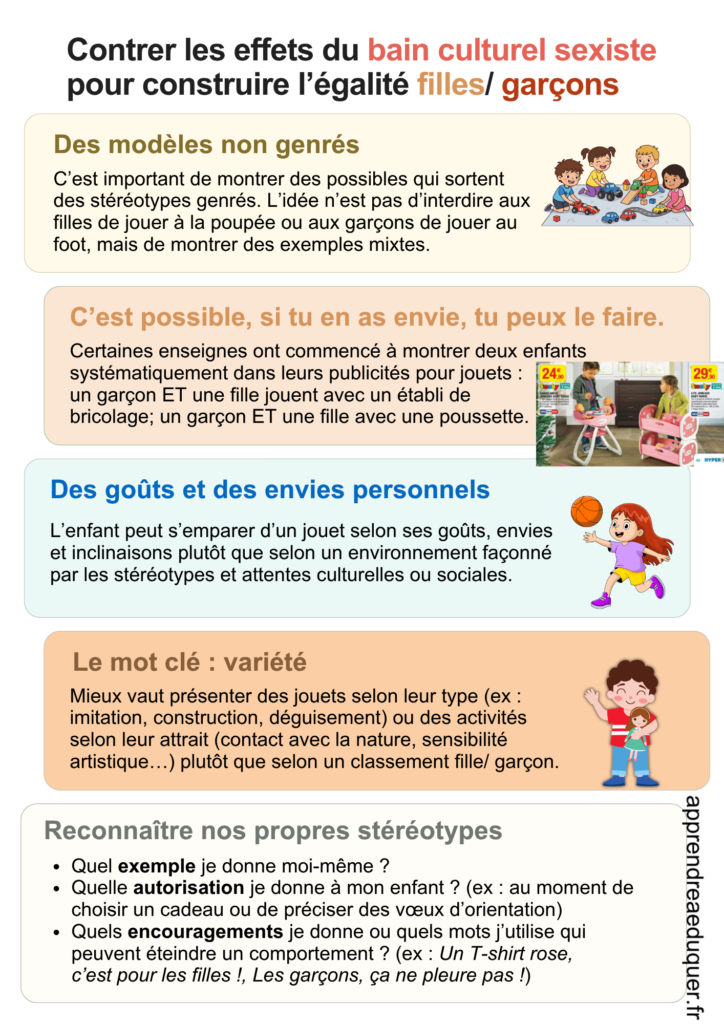
Start with language and attention. Notice when you comment on a girl's appearance before her ideas, or praise a boy for being tough when he is frightened. Children pick up these signals quickly. Offering a range of toys, stories and activities without gendering them widens what a child feels allowed to try, whether that means stories about mathematics or building sets — and the same open-minded approach pays off when you browse Christmas gift ideas.
Watch the media and the environment. Books, cartoons and catalogues still sort children into pink and blue with remarkable consistency. Naming that out loud, without lecturing, teaches children to question what they see. The same critical eye helps when choosing everyday items, from shoes for school uniform to the games you keep at home.
Model and explain
Children learn more from what adults do than from what they say. Sharing household tasks, letting both parents handle repairs and cooking, and explaining why a remark was unfair all build the habit of fairness. It also helps to name emotions in boys as freely as in girls, and to encourage girls to take up space, speak up and lead. Staying alert to childhood flu complications matters too, since a child who feels unwell has less energy to explore and speak up.

Keeping the conversation going
Equality is not a one-off lesson but a long conversation that grows with the child. A five-year-old needs simple words about fairness; a ten-year-old can discuss why certain jobs are associated with one sex. Keeping the door open means children will bring their questions to you rather than absorbing them silently elsewhere.
It also means being patient with yourself. Every parent has absorbed the same stereotypes, and catching yourself mid-sentence is part of the work. What matters is the direction of travel: fewer assumptions, more freedom for each child to be who they are, and a clear message that difference never justifies unequal treatment.

My hands-on take
I remember catching myself telling my daughter how pretty she looked before asking what she had built that afternoon. Nothing dramatic, but it was the third time that week. I started deliberately asking about the construction first, and the conversation changed completely: she wanted to explain her tower, her bridge, her plan for the next one.
What helped most was not a big family meeting but small swaps. I stopped sorting toys into boxes by colour, let both children choose their own clothes, and started saying out loud when a cartoon or a catalogue felt unfair. My son now points it out before I do, which is probably the best sign that the message landed.
Frequently asked questions
Does building equality mean treating girls and boys exactly the same?
No. It means refusing to let differences in taste or temperament become unequal access to resources, rights or opportunities. Children can be different and still be treated fairly.
At what age should parents start?
From the very first years, because children absorb messages about gender long before they can discuss them. Simple choices about toys, language and chores are already part of the work.
What if my child strongly prefers stereotyped toys?
Interest is not the problem; restriction is. Let the child enjoy what they enjoy while keeping other options open, so the preference stays a choice rather than a limit.
Can one family really change anything?
Yes, at the scale that matters most: one child's sense of what is possible. Small, consistent messages at home shape how children read the wider world.
Product Reviews
 Best Toys for Dogs With High Prey Drive |
Best Outdoor Toys for 3-4 Year Olds |
Best Outdoor Toys for 6 Year Olds |
Best Harness for Poodle |
Best LEGO Sets for Adults |
Best Travel Toys for 4 Year Olds on Airplane |
Best Toy Stores in Washington DC |
Best Potty Training Toys |
Best Toys for Tripod Dogs |
Maillot equipe de france







