


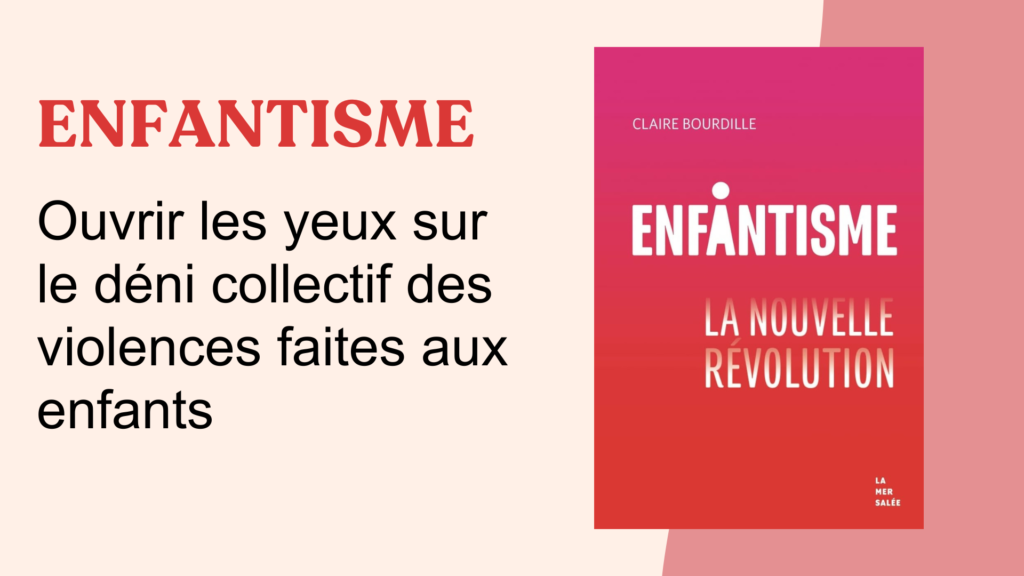
Enfantisme is a framework that asks adults to look honestly at a collective denial of violence against children. It comes from the work of Claire Bourdille, founder of the Collectif Enfantiste and author of a book on what she calls a new revolution. The collective is a group of activists working to mobilise society around childhood and to denounce every form of violence endured by babies, children and teenagers.
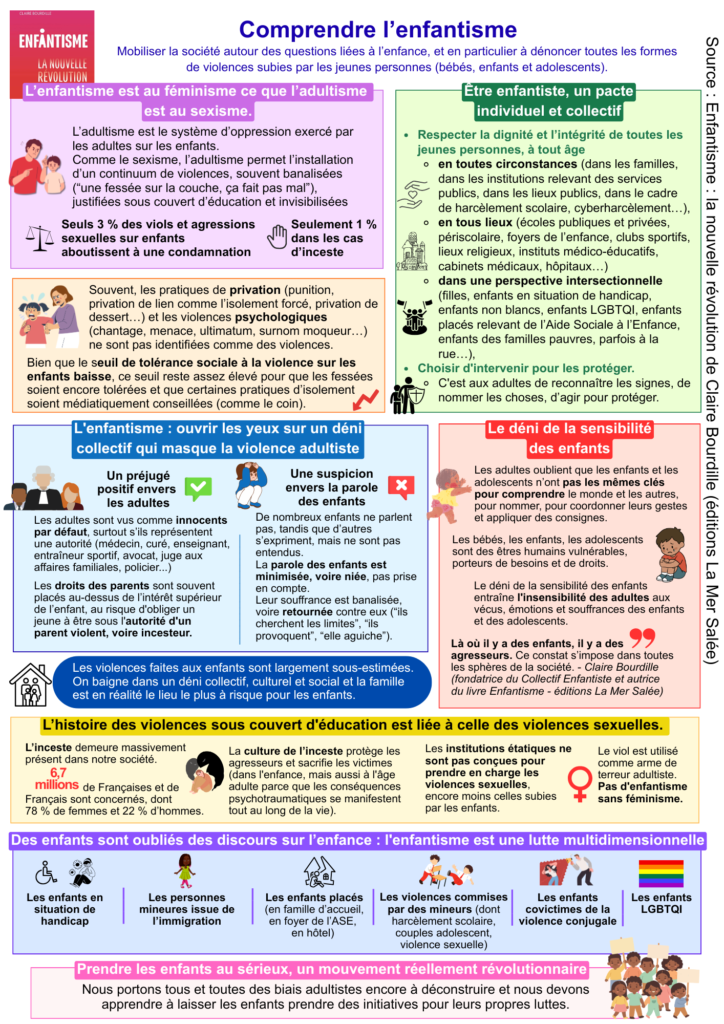
Her starting point is uncomfortable. In France, she notes, eight parents out of ten have used ordinary educational violence, the famous slap that supposedly "educates". She asks adults to imagine the violence of receiving a slap themselves, then to imagine what it means for a child. She also cites a figure that should stop any parent cold: three children per CM2 class are victims of incest.

Quick takeaways
- Enfantisme names adultism: the power system adults hold over children.
- Ordinary educational violence is still widely tolerated and trivialised.
- Deprivation and psychological violence are rarely recognised as violence.
- Children's words are systematically doubted; adults get a positive prejudice.
- The enfantiste pact asks adults to respect dignity everywhere and to intervene.
- Vulnerability stacks up: disability, gender, poverty and placement increase risk.
Understanding adultism: adult domination shapes us all
Bourdille names adultism as the system of oppression exercised by adults over children. For her it is a form of discrimination and a power relationship based on age and on the adult-minor status, working in favour of adults and against young people. In practice, every adult without exception dominates children. She draws a parallel: enfantisme is to feminism what adultism is to sexism.
Like sexism, adultism allows a continuum of violence to settle in, often trivialised ("a smack on the nappy doesn't hurt") and justified in the name of education. It is also made invisible, even by the people supposed to protect children. She points to the fact that only 3% of rapes and sexual assaults on children lead to a conviction, and only 1% in cases of incest. This blindness also shows up when grandparents follow different rules, and it echoes the backlash seen in Ana Morgade's reflection after being criticized for her pregnancy.
Violence that is not recognised as violence
Deprivation practices are rarely identified as violence: punishment, being deprived of a connection through forced isolation in the "corner", being deprived of dessert. Psychological violence is just as invisible, including blackmail, threats, ultimatums and mocking nicknames. The social tolerance threshold is falling, she notes, but it remains high enough that smacking is still tolerated and some isolation practices are still recommended in the media.
The enfantiste pact: dignity in every circumstance
Bourdille invites everyone to become enfantiste through an individual and collective pact. The first commitment is to respect the dignity and integrity of all children, in every circumstance: within families, in public institutions, in public places, in teenage couples experiencing domestic violence, and in cases of school bullying or cyberbullying. It applies in all places too, from public and private schools to after-school care, children's homes, sports clubs, religious venues, medical-educational institutes, surgeries, hospitals and the digital world. This same spirit of respect can guide families as they choose places together.
The pact is deliberately multidimensional, because vulnerability stacks up. It asks adults to take account of every factor: girls, children with disabilities, non-white children, LGBTQI children, children placed in child welfare, children from poor families and sometimes children living on the street. The second commitment is to choose to intervene in order to protect them, rather than staying silent when something feels wrong. In settings like sports clubs, it also helps to ask the right questions about how children are treated.
For parents, this often starts with small daily habits, such as explaining a rule instead of imposing it, and apologising when we get it wrong. It also means noticing when our own frustration, not the child's behaviour, is driving the reaction.
| Situation | Adultist reflex | Enfantiste response |
|---|---|---|
| Child reports harm | Doubt the child, protect the adult | Listen first, take the words seriously |
| Child is crying loudly | "He's provoking me" | "He's overwhelmed, I stay calm" |
| Rule needs enforcing | Impose it without explanation | Explain it and stay firm without violence |
| Adult loses patience | Justify a slap as education | Repair, apologise and name the emotion |
| Child is isolated as punishment | Send them to the corner | Choose a calm-down space with connection |
Enfantisme: opening our eyes to a collective denial
Adult domination produces a systematic suspicion towards children's words, along with a minimisation or even denial of their suffering. It can go as far as blaming the child: the idea that children look for limits and therefore deserve slaps, or that they provoke adults and are therefore responsible for sexual assault. Against this, adults benefit from a systematic positive prejudice, especially when they represent an authority such as a doctor, a priest, a teacher, a sports coach, a lawyer, a family judge or a police officer. This same blind spot shows up in everyday habits, like when parents constantly confuse their children's names.
Parental rights are also often placed above the best interests of the child, protecting "the parental bond" first and at the risk of forcing a young person to remain under the authority of a violent or incestuous parent. The source text breaks off at this point, but the argument is clear: the presumption of adult good faith is exactly what allows abuse to continue.
Why the adult's word wins
This is where the collective denial becomes practical. When a child reports harm, the first reflex is often to doubt, to ask whether they misunderstood, or to protect the adult's reputation. An enfantiste approach reverses that reflex: listen first, take the words seriously, and let an investigation establish the facts rather than dismissing them in advance. The same attentiveness matters at home, which is why choosing child friendly dog breeds deserves careful thought too.
The ideology behind adultism
Adultism rests on an ideology according to which adults possess superior faculties and legitimacy, which is said to justify an arbitrary hierarchy of ages and the exercise of unilateral social, political or educational power over the youngest. From this come authority, inequalities, discrimination and violence. Bourdille's definition matters because it moves the debate away from individual "bad parents" and towards a shared cultural background that almost everyone has absorbed.
Recognising this does not mean treating parents as villains. It means accepting that good intentions are not enough, and that education about children's rights belongs in the same conversation as education about respect in general. A parent who understands the mechanism can interrupt it, in the supermarket queue as much as at the family dinner table.

What parents can do, starting today
Change begins with language. Replacing "he's provoking me" with "he's overwhelmed and I'm tired" shifts the responsibility back where it belongs. Naming psychological violence for what it is, including threats and humiliating nicknames, is the next step, because a practice that has no name is very hard to question.
It also helps to build a small circle of adults who share these commitments, so that intervening for a child is not a solitary act. Finally, protecting children means protecting the most vulnerable among them first, and refusing the idea that some children's suffering matters less than others.
My hands-on take
I remember the first time I caught myself saying "stop crying or I'll give you something to cry about". I had heard it as a child and never questioned it. Reading about adultism made me realise the sentence was not about my son at all; it was about my own overload at the end of a long day. Since then I have tried to name the emotion out loud, both mine and his, and to repair quickly when I fail.
What helped most was lowering the bar. I do not aim to be a perfect non-violent parent; I aim to notice the reflex and interrupt it a little sooner each time. That small shift has changed the atmosphere at home far more than any rule I have ever set.
Frequently asked questions
What does enfantisme mean?
Enfantisme is a framework and activist movement that asks adults to recognise adultism, the power system adults hold over children, and to commit to respecting children's dignity and integrity in every place and circumstance. It is presented as a parallel to feminism in relation to sexism.
Is a smack really considered violence?
In this framework, yes. Ordinary educational violence such as smacking is described as trivialised and justified in the name of education, even though the social tolerance threshold is slowly falling. The point is not to shame parents but to question a practice that is still widely accepted.
What is the difference between adultism and enfantisme?
Adultism is the system of domination itself, based on age and adult-minor status. Enfantisme is the response: a commitment to see that system, refuse its reflexes and actively protect children, including the most vulnerable among them.
How can a parent start applying this at home?
Start with language and repair. Notice when you blame the child for your own frustration, explain rules instead of imposing them, and apologise when you get it wrong. Naming psychological violence, such as threats or humiliating nicknames, is a useful next step.
Product Reviews
 Best Toys for Dogs With High Prey Drive |
Best Outdoor Toys for 3-4 Year Olds |
Best Outdoor Toys for 6 Year Olds |
Best Harness for Poodle |
Best LEGO Sets for Adults |
Best Travel Toys for 4 Year Olds on Airplane |
Best Toy Stores in Washington DC |
Best Potty Training Toys |
Best Toys for Tripod Dogs |
Maillot equipe de france







