


Quick takeaways
- Praise labels the child; encouragement helps them evaluate themselves.
- Focus on effort, process, feelings and strategies, not fixed traits.
- Descriptive comments on what you see beat judgements like "pretty".
- After failure, ask how to improve next time rather than stopping at effort.
- Teach children to ask for help when effort alone is not enough.
- Use questions ("how did you do it?") to open conversation.
Why "you are intelligent" doesn't really encourage
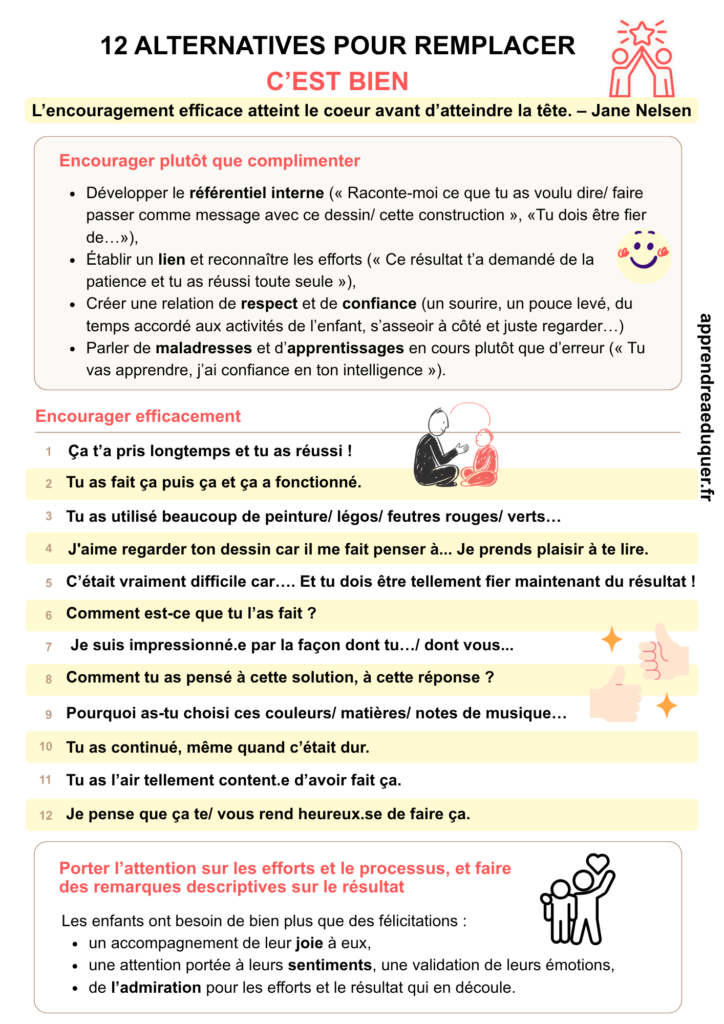
Jane Nelsen, author of Positive Discipline, describes five ways to encourage a child effectively: build their internal reference point ("I did it", "I'm proud of myself"), give real dedicated time, offer a gesture of affection that builds connection, create a relationship of mutual respect and trust, and change how you view mistakes, seeing them as clumsiness and learning rather than "naughtiness". As she puts it, effective encouragement reaches the heart before it reaches the head.
Carol Dweck, the American psychologist, makes a related point: children benefit from a growth mindset rather than a fixed one. Calling a child by adjectives, however flattering, does not convince them they can act, take initiative or influence how they are seen. In her research in the United States, a single clumsily worded compliment that stressed fixed intellectual ability ("well done, you're so intelligent") rather than the thinking process was enough to make some children unsure of themselves, to the point of lying to match their "intelligent" status.

Effort alone is not the whole answer
When a child is stuck, effort by itself does not always help. The goal is not to push them to try harder with strategies that don't work, but to teach them to ask for help and to know where to look for the right resources at the right time.

Focus on effort, process, emotions and strategies
Where you place your attention matters. Commenting on effort and process, and making descriptive remarks about the result (the colours, the shapes, the child's intention), has a different effect from judging the result ("what a pretty drawing") or sticking a label on the child ("gifted", "clever"). Children need far more than congratulations: support for their own joy, attention to their feelings and validation of their emotions, and admiration for the effort and the achievement that follows.
It helps to encourage the strategies used when something succeeds, and to point towards more suitable, effective strategies when something fails. This is the same patient, observant approach you need in the early months, much like the first days with baby when everything is new and everyone is learning. The same care applies to talking about politics and other tricky topics.
How we react to failure shapes a child's mindset. Even when we stress effort after a poor maths grade, stopping at effort without moving on to what can be learned tends to encourage a fixed mindset: "not everyone can be good at maths, you do well in other subjects" versus "how can we improve this result? What do you need? What would help you progress?" This is also why it's worth thinking about talking about masturbation calmly and without judgment.
| Instead of saying | Try saying | Why it works |
|---|---|---|
| You're so intelligent | You worked hard and tried several times | Focuses on process, not a fixed trait |
| What a beautiful drawing | You used lots of red and green here | Descriptive, invites the child to explain |
| Well done, you won | You kept going even when it was hard | Names the effort the child controls |
| You're good at maths | How could you improve this result? | Opens the door to strategy and help |
| You're a natural | Tell me how you did it | Builds self-evaluation and pride |
How to tell encouragement from a compliment
Nelsen invites us to separate encouragement from praise by asking ourselves a few questions. Does what I'm saying push the child to self-evaluate, or make them dependent on someone else's judgement? Am I being respectful or condescending? Am I seeing things from the child's point of view or only my own? Would I say this to a friend? If something went wrong, am I guiding them towards "how to do it next time" and the lessons to draw from it?
And finally: am I engaging both the child's head and heart, so they can think "thanks to my intelligence and my efforts, I can contribute to the world"? That last question matters when children start comparing themselves to others, a stage that brings its own worries, from body image questions like a chubby child to the small daily dramas of family life such as children catching us in an awkward moment.
Watch your own reactions
Children read our faces faster than our words. A sigh at a failed attempt speaks louder than any sentence, so it is worth noticing your own reflex before you open your mouth.

15 phrases to replace "c'est bien"
These suggestions put the ideas above into practice, expressing encouragement rather than praise. Try a few and see which feel natural to you.
You did it all by yourself. You did this, then this, and it worked. You used a lot of paint, LEGO or red and green felt-tips. It took you a long time and you succeeded! That was really difficult because… and you must be so proud of the result now. Tell me how you did it, I'm interested. You've done that, what will you do next? How did you think of that solution? Why did you choose those colours, materials or notes? You kept going even when it was hard. I get the feeling you're really happy you managed it, how do you feel? You seem to love doing that, I think it makes you happy. You couldn't do this last week or last month and now you can. You've understood that your efforts and practice are a reason to be proud. I really enjoy reading, listening to or looking at what you make.
Descriptive comments work especially well with creative projects, and they pair naturally with the slow pleasure of illustrated children's books or the vocabulary-building you get from expanding children's vocabulary together. For building projects, a phrase like "tell me how you did it" opens a conversation about the process rather than the result, much as you might discuss the cost of a LEGO before a big purchase. Just as you'd check reliable information such as having your period while pregnant when a question comes up, these phrases help you respond thoughtfully in the moment.

Making encouragement a daily habit
None of this means banning compliments or becoming a robot. Warmth matters, and children still need to hear that you delight in them. The shift is towards noticing what they did and how they felt, rather than handing them a permanent label they then have to live up to.
It also helps to keep the focus on what is within their control. Effort, choice of strategy, asking for help and trying again are all things a child can act on; "being clever" is not. That sense of agency is what carries them through new experiences, whether that is a first fifteen month old exploring the world or an older child facing a subject they find hard.
Expect to slip back into old habits, especially when you are tired. A simple pause before speaking, and a genuine question about how they did it, is often enough to turn a compliment into encouragement.

My hands-on take
I started paying attention to this after noticing how my own reactions landed. My child would hold up a drawing and I would say "it's lovely", and the conversation would simply stop. When I began describing what I actually saw, the reds and greens, the tiny figure in the corner, something changed: they started explaining, correcting me, adding details. The drawing became something to talk about rather than something to be judged.
The harder part was failure. My reflex was to reassure quickly, which often sounded like "never mind, you're good at other things". Pausing and asking "what would help next time?" felt awkward at first, but it kept the door open. I still get it wrong, especially at the end of a long day, but the questions have become easier with practice, and my child now sometimes asks them of themselves.
Frequently asked questions
Should I stop complimenting my child altogether?
No. Warmth and delight still matter. The aim is to add encouragement, focusing on effort, process and feelings, rather than replacing every kind word with a technique.
What if my child fails despite trying hard?
Acknowledge the effort, then move to what can be learned and what help might be needed. Stopping at "you tried hard" can leave a child feeling that ability is fixed.
Does this apply to teenagers too?
Yes. Questions about how they approached something and how they feel tend to land better than labels, and they support the growing need for autonomy.
How do I start without overthinking it?
Pick two or three phrases that feel natural and use them when you notice a real effort. Consistency matters more than variety.
Product Reviews
 Best Toys for Dogs With High Prey Drive |
Best Outdoor Toys for 3-4 Year Olds |
Best Outdoor Toys for 6 Year Olds |
Best Harness for Poodle |
Best LEGO Sets for Adults |
Best Travel Toys for 4 Year Olds on Airplane |
Best Toy Stores in Washington DC |
Best Potty Training Toys |
Best Toys for Tripod Dogs |
Maillot equipe de france







