


Showing love to a child is not the same thing as feeling love for that child, and the gap between the two matters more than most parents realise. A parent can carry enormous tenderness inside and still leave a child unsure, because what builds security is not what we feel but what the child actually perceives.
This article looks at why affection has to be visible, audible and physical, what happens when it stays hidden, and how to adapt the way you express it as your child grows. It also covers the quiet trap of conditional love and the small daily gestures that carry the most weight.

Quick takeaways
- Children perceive love through what they see, hear and feel, not through what parents feel inside
- A baby's wellbeing depends on affection as well as food, changes and rest
- Emotional neglect is a form of violence, even when no physical harm occurs
- Demonstrations of love travel through the five senses from birth onward
- Teenagers still need to be understood, supported and accepted
- Conditional love teaches a child to perform for approval rather than rest in it
Why feeling love is not the same as showing it
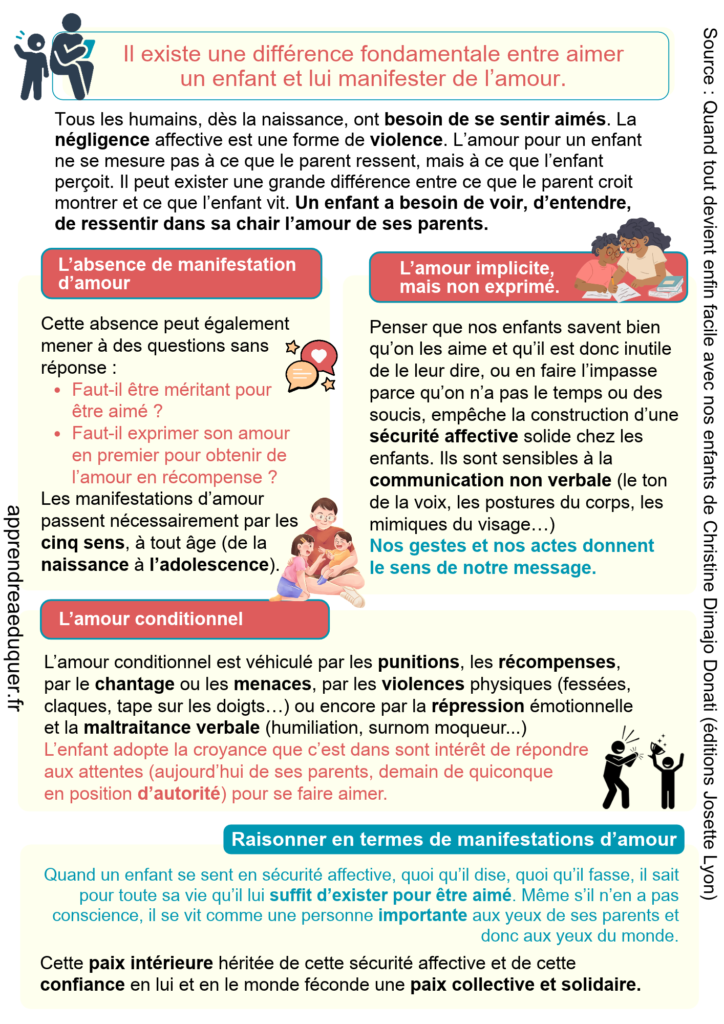
Love for a child is not measured by what the parent feels and gives, but by what the child perceives. There can be a wide gap between what a parent believes they are showing and what the child actually experiences at home.
The reason is simple: a child is not equipped to decode the silent, virtual messages adults think they are sending. Children need to see, hear and feel affection in their bodies before they can trust it. When that evidence is missing, even devoted parents can raise a child who feels uncertain.
Three common reasons for the gap
This mismatch usually has one of three origins: an absence of any demonstration of love, love that is implicit but never expressed, or love that has become conditional. Naming which one sounds familiar is often the first useful step.
The story that shows what affection does
A well-known account from a Romanian orphanage in the 1950s is often used to illustrate the point. For hygiene reasons, nurses caring for premature babies were not allowed to hold them, rarely spoke to them and touched them as little as possible. Mortality in the orphanage was very high.
What puzzled staff was that the two babies whose cots stood near the door survived consistently. It turned out that a night nurse stroked those two infants and said goodbye to them tenderly every morning as she left her shift.
The lesson is that a baby's survival depends not only on food, changes and rest, but also on visible demonstrations of love. Every human being needs to feel loved from birth, and emotional neglect is a form of violence. The same principle applies to older children, including those you might read about in fatherhood tweets or watch grow through the always together years of family life.

| Age stage | What the child needs | Everyday example |
|---|---|---|
| Baby | Warmth, voice, touch, smell | Holding close while feeding and talking softly |
| Toddler | Play, encouragement, comfort | Getting down to their level during play |
| School age | Interest, recognition, listening | Asking about their day and staying curious |
| Teenager | Understanding, support, acceptance | Listening to their plans without judging |
| Any age | Steady, unconditional affection | Warm words even after a disagreement |
When love is simply never expressed
Many parents assume their children know they are loved and that saying it is therefore unnecessary. Others skip it because there is no time or because worries crowd everything else out. Either way, the result is the same: the child is left without a solid foundation of emotional security.
An absence of demonstrations can create a permanent sense of insecurity, as though love were not spontaneous and constant but depended on behaviour or circumstances. It also leaves children with unanswered questions: must I earn love? Should I show affection first to receive it in return? Do I have to give in order to get?
Demonstrations of love travel through the five senses. A baby feels loved when they hear soft voices, feel warm skin, touch and knead while feeding, taste, smell their parents close by and exchange tender looks. When the senses are engaged, the child is put in contact with a strong feeling of protection and security.
How expressions of love change with age
As children grow, they need different signs of affection: cuddles, shared laughter, joys heard and shared, play sessions, verbal and non-verbal encouragement, comfort and being listened to. A newborn needs closeness and warmth, which is exactly why toys for newborns are secondary to your voice and your arms.
Even teenagers still have a vital need to be understood, supported, loved and accepted. That can mean listening to their plans for the future or simply playing sport alongside them. Our job is to adapt our demonstrations to each child's age, character and needs.
Play is one of the most natural vehicles for this at any age. Simple creativity games or psychomotor games let you show interest in your child without a single serious conversation, and they work just as well when your child is unwell and needs the calm approach described in when your son.
When the body says one thing and the words another
There is often a gap between what the body communicates, through facial expressions, tone of voice and gaze, and what the words say. Children are especially sensitive to non-verbal communication: tone, posture and facial expression.
Contrary to what most people assume, it is our gestures and actions that give our message its meaning. Loving a child means showing attention, interest and respect in every act of daily life, even when we disagree with what the child does or does not do.
This matters because many adults who struggle with self-esteem were not mistreated physically, but simply did not receive enough tenderness, recognition, attention and kindness from their parents. The form our love takes is worth being vigilant about, whether you are raising a baby or choosing outdoor toys and watching how your child plays with them.
The trap of conditional love
When a child is loved conditionally, they are loved for what they do rather than for who they are. This drift is very often unconscious in the parent, who sincerely does not notice that their demonstrations of affection rise and fall with the child's behaviour.
Children read this pattern quickly and start performing for approval instead of resting in it. The alternative is to keep affection steady while still setting limits, so that the child learns that the relationship is not at stake every time something goes wrong.
In practice, this means separating the correction from the connection: address the behaviour, then return to warmth. It is the same steady presence that matters through family milestones and celebrations, the kind of shared experience described in rural houses or the everyday rituals that hold a family together.


My hands-on take
I learned this the slow way. For years I assumed my children simply knew, and I told myself that keeping the household running was its own proof of love. Then one evening my eldest asked, quite plainly, why I never said it. I had been feeling it constantly and showing almost none of it.
What changed was small and unglamorous. I started saying it at the door, in the car, at bedtime, and I stopped waiting for a good moment to be warm. I also noticed how often my face was doing something different from my words, especially when I was tired. The children responded to the warmth long before they responded to any lecture, which told me everything about which one actually lands.
Frequently asked questions
Does my child really need to hear that I love them?
Yes. Children cannot decode unspoken feelings, so affection has to be visible and audible. Saying it out loud, alongside physical warmth, gives them something concrete to hold on to.
Can a lack of affection really affect a child that deeply?
The Romanian orphanage account is often cited to show that survival itself depends on more than physical care. Emotional neglect leaves a lasting sense of insecurity, which is why demonstrations of love are treated as a basic need rather than a bonus.
What does conditional love look like in daily life?
It shows up when warmth rises and falls with behaviour, so the child learns to perform for approval. The fix is to keep affection steady while still addressing the behaviour that needs correcting.
How should I show love to a teenager?
Listen to their plans, take an interest in what matters to them and spend time side by side, for example playing sport together. Teenagers still need to feel understood, supported and accepted.
Product Reviews
 Best Toys for Dogs With High Prey Drive |
Best Outdoor Toys for 3-4 Year Olds |
Best Outdoor Toys for 6 Year Olds |
Best Harness for Poodle |
Best LEGO Sets for Adults |
Best Travel Toys for 4 Year Olds on Airplane |
Best Toy Stores in Washington DC |
Best Potty Training Toys |
Best Toys for Tripod Dogs |
Maillot equipe de france







