


Respectful parenting is often misunderstood as a style in which parents never say no to their children. In practice, the opposite is closer to the truth: a respectful relationship depends on adults who can state a clear, honest no when something matters to them.
The question is not how many times we refuse a request, but whether our answers come from a real person with real values and limits. Children do not need a fixed quota of refusals. They need parents who are present, credible and willing to stand behind what they say.

Quick takeaways
- Respectful parenting is not about avoiding no; it is about being authentic.
- Children need a wholehearted yes to their place in the family.
- A clear no protects your integrity and the family's equal dignity.
- Expect frustration and receive it without taking it personally.
- Ask for thinking time when a request makes you uncomfortable.
- Avoid conditional no's that carry two contradictory messages.
Do Children Really Need to Hear No?
Children certainly need to hear a wholehearted yes: yes to their place in the family, yes to their existence, and yes to the experiences and opportunities for growth they bring into our lives. That foundation of acceptance matters more than any count of refusals.
At the same time, the usual question of whether parents should say no is framed poorly. Children do not require a set amount of no; they require the authentic presence of their parents. They learn best in interaction with real adults who speak from their emotions, their personal limits and their values rather than from rigid rules or cultural expectations.
This is why everyday moments of care and attention matter so much, whether you are managing co-sleeping routines or simply sitting with a child after a difficult day. Presence, not perfection, is what children read.
Parents Are Human Beings With Real Limits
The familiar phrase that children “test limits” is misleading. When a child shows persistent opposition, aggression beyond the early years, or physical and verbal violence, it is worth asking whether the adults around them are playing a role rather than being themselves.
That role leads adults to speak without embodying what they say, expressing ready-made rules instead of personal values. Children then work hard to find out whether a genuine, vulnerable, loving human being stands behind the performance. They are testing our willingness to be authentic, present and credible, as many honest motherhood blogs remind us.
Why an Honest No Protects the Whole Family
If we want to be authentic with the people we love, we must regularly tell them no for a simple reason: the need to affirm ourselves and say yes to our own integrity. Saying no now and then keeps us whole, prevents compromise and resentment, and preserves equal dignity within the family. Parents who are raising a child alone may find this especially demanding, and support around going back to work or daily logistics can help them hold their ground. The same steady care applies when a child asks for long healthy hair.
| Situation | Helpful response | What to avoid |
|---|---|---|
| Child asks for something you dislike | Pause, check your feelings, answer honestly | Answering from habit or outside pressure |
| You feel unsure | “I need time to think about it” | Giving a rushed yes or no |
| Child reacts with anger | Stay calm, allow the disappointment | Censoring or taking it personally |
| Your no is ignored | Repeat the same clear limit | Adding a second, softer message |
| You snapped unfairly | Acknowledge it briefly and repair | Pretending nothing happened |
Saying No With a Clear Conscience
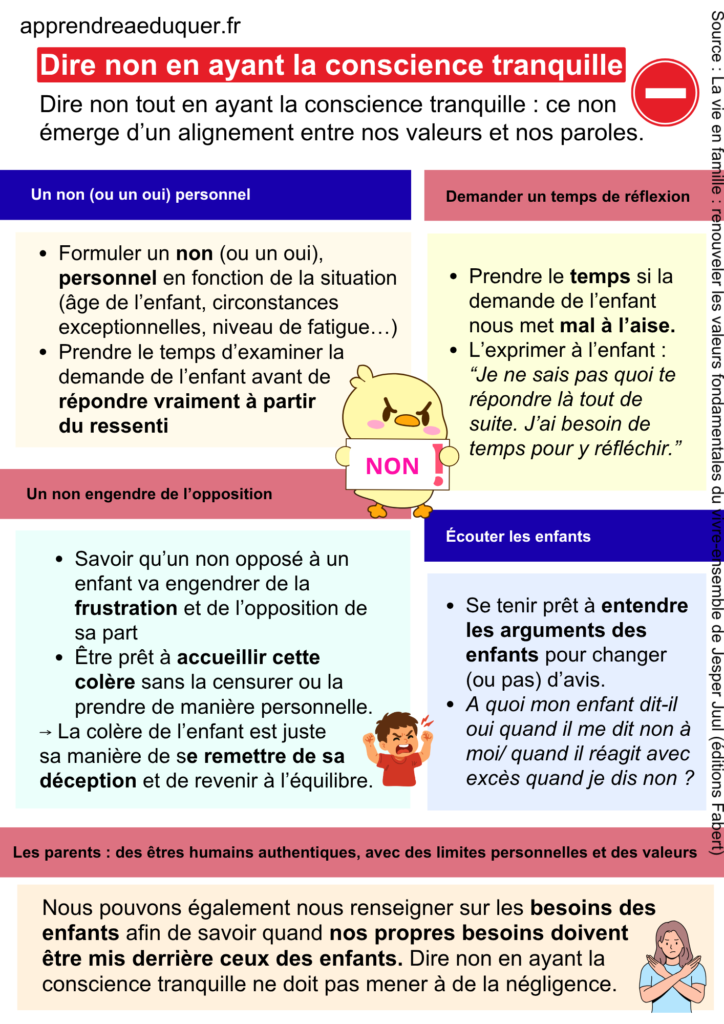
A no spoken with a quiet conscience rests on several pillars. The first is a personal answer shaped by the situation, the child's age, exceptional circumstances and your own level of fatigue, given after you have genuinely considered the request and checked what you feel inside.
The second is expecting frustration and opposition. A refusal will disappoint a child, and that anger is simply how they recover from disappointment. Receive it without censoring it and without taking it personally.
The third is asking for time when a request makes you uncomfortable, and saying so out loud: “I don't know what to answer right now. I need time to think about it.” The fourth is staying open to children's arguments and being willing to change your mind, or not.
It also helps to learn about young children's needs so you know when your own needs should wait behind theirs, whether that means attending a funeral together or turning a sleeping baby onto their back. A calm no must never slide into emotional neglect, and respectful parenting excludes spanking and punishment. If a child seems persistently unwell or exhausted, it is worth looking at tiredness and illness rather than treating every behaviour as defiance.

When Your No Is Not Heard or Respected
Some parents say they say no constantly yet never feel heard. The explanation often lies in a conditional no, delivered in a tone that means: “I'm saying no, but only if it doesn't make you too sad or make you think I'm a bad parent.” Two messages arrive at once, and the child receives a contradiction.
The task for modern parents is to take responsibility for their own feelings, thoughts and values so that every family member can do the same. Many parents have become dependent on their children's approval, and children have ended up carrying responsibility for the family's wellbeing. The opposite of adult dictatorship is child dictatorship; the alternative is equal dignity and personal responsibility.
Building that responsibility takes years, and it starts with small, concrete skills such as potty training or learning to learn English online together, where a child practises autonomy inside clear boundaries.

Making Respectful Limits Practical
Respectful limits work best when they are predictable and explained in plain language. A short sentence such as “I can't play now, I'm cooking, I'll sit with you after” gives a child something solid to hold on to, far more useful than a long justification.
It also helps to notice which refusals are truly yours and which are inherited rules you do not believe in. When a no comes from your own values, your voice, face and body agree, and children sense that consistency quickly. Choosing calm, screen-free time together, perhaps with cheap board games, gives everyone a shared space where limits feel natural rather than punitive.
Finally, repair matters. If a no came out sharper than you intended, say so simply and move on. Children learn from watching adults own their tone, not from adults who never slip.
My hands-on take
In my own home, the hardest part was not deciding whether to say no but learning to say it without apologising for it. I used to soften every refusal with explanations until my child could not tell whether I meant it. What changed things was a simple habit: when a request caught me off guard, I started saying I needed a moment to think. That pause gave me time to check whether my reluctance came from real values or from fear of the reaction.
I also learned to let the disappointment happen. Sitting nearby while my child was upset, without arguing or giving in, felt uncomfortable at first, but it usually passed faster than the long negotiations we used to have. Saying no with a quiet conscience is still a work in progress for me, but it has made our home calmer and my words more believable.
Frequently asked questions
Does respectful parenting mean never saying no?
No. Respectful parenting means answering from your real values and limits rather than from ready-made rules. A clear, honest no is part of an authentic relationship.
Why does my child react so strongly to being told no?
Frustration and anger are normal responses to disappointment and are how children recover from it. Receiving those feelings calmly, without censoring them, helps the child move through them.
What is a conditional no?
It is a refusal delivered with a hidden second message, such as “no, unless it upsets you or makes you see me as a bad parent”. The child receives a contradiction and may stop taking the limit seriously.
Can I change my mind after saying no?
Yes, if a child offers a good argument. Staying open to discussion shows that your answers come from a thinking person, not from arbitrary authority.
Product Reviews
 Best Toys for Dogs With High Prey Drive |
Best Outdoor Toys for 3-4 Year Olds |
Best Outdoor Toys for 6 Year Olds |
Best Harness for Poodle |
Best LEGO Sets for Adults |
Best Travel Toys for 4 Year Olds on Airplane |
Best Toy Stores in Washington DC |
Best Potty Training Toys |
Best Toys for Tripod Dogs |
Maillot equipe de france







