


How we talk to children shapes far more than their behavior in the moment: it shapes how they see themselves, how they handle fear and how willing they are to try again after a mistake. A few everyday phrases, repeated without thinking, can quietly work against the very things we want to teach.
This article looks at common phrases parents use on autopilot, from "Hurry up!" to "It's nothing!" and "Calm down!", and offers practical alternatives. None of these swaps require special equipment or a perfect day. They simply ask us to slow down, describe what we see and treat a child's emotions as real.

Quick takeaways
- Replace "Careful!" with a personal worry and a question about a safer solution.
- Give short, positive instructions instead of rushed commands like "Hurry up!"
- Name and accept emotions rather than minimizing them with "It's nothing."
- Describe mistakes factually and invite the child to repair them.
- Skip "if... then" bargaining; redirect and act calmly instead.
- Stay present during big emotions; logic cannot land until the storm passes.
"Careful, you'll fall!" and other negative warnings
A negative instruction tends to plant a negative image in a child's mind, and it can pull them toward exactly the action we fear. Instead of shouting a warning from across the room, move closer, name your own worry in personal language ("I'm afraid that...") and ask the child whether they have a solution for making their play safer.
This turns a command into coaching, and the child builds real competence rather than simply obeying. Concrete questions work better than vague cautions: "When we play with a stick we need space so nobody gets hurt. Is there enough space here? Where could you play more safely?" or "Is this branch strong enough? How can you check?"
Redirect before you forbid
Before a child runs toward someone, remind them to make sure the other person has seen them coming. If a game with a foam dart gun keeps targeting a sibling, redirect first ("Not at your brother, aim at the target") and only then remove the toy if needed. For hands-on practice with safe risk, Montessori climbing toys give children a controlled place to test their balance.

"Hurry up!" is not a name
As one parenting writer wryly reminds us, no child is actually called "Hurry up!" Rushed commands create pressure without giving information, and they often arrive when everyone is already tense. A simple instruction in positive language, delivered with a smile and a wink, does far more: "Shoes, coats! We leave for school in five minutes!"
Notice what changed. The child gets a clear sequence, a clear timeframe and a tone that invites cooperation instead of scolding. If mornings regularly collapse, it may help to look at the whole routine rather than the last thirty seconds of it. rainy day activities planned for slow weekends can also take pressure off weekday schedules. Even large families can keep mornings calm with clear, positive instructions.
Say what you need, not what they are doing wrong
Replacing "Stop dawdling!" with "I need your shoes on now" keeps the focus on the practical step. Children respond better to a short, doable request than to a label about their character. A small back to school reward can reinforce cooperation once the routine is done.
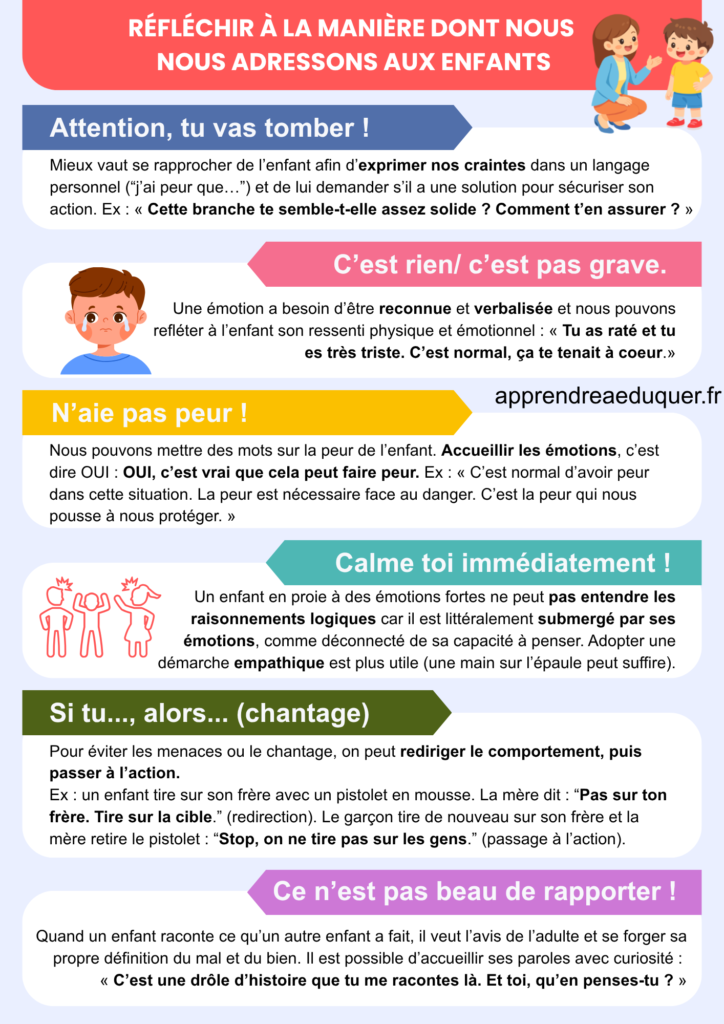
| Instead of saying | Try saying | Why it works |
|---|---|---|
| Careful, you'll fall! | I'm worried about that. What's your plan to stay safe? | Builds problem-solving instead of fear |
| Hurry up! | Shoes, coats! We leave in five minutes. | Clear, positive, time-bound |
| It's nothing! | You fell and it scared you. That's normal. | Validates the emotion |
| You're so clumsy! | I see flour on the floor. What do you need? | Describes facts, invites repair |
| Calm down! | I'm here with you. You're really upset. | Offers presence, not logic |
| If you're good, you'll get a gift | Let's aim at the target instead. | Avoids bargaining, teaches limits |
"It's nothing" and "Don't be scared"
When a child gets hurt or feels sad, we often minimize the pain with good intentions: to spare them a unpleasant emotion and to quiet our own worry. But an emotion needs to be recognized and put into words. Reflect what the child felt: "You fell and you got scared. That's normal, it really is scary." Saying "It's nothing!" denies the intensity and blocks the release.
One mother's story makes the point: after falling and scraping her knee, a grandmother admitted that we tell children "it's nothing" all the time, but it really does hurt. Adults, too, need their suffering understood and acknowledged. Fear is a genuine alarm signal, real or perceived, and it shows in the body: a stiff posture, a frozen face, a withdrawn movement.
Words that welcome fear
Try "I can see this scares you," "You think about it often, don't you?" or "It's normal to be afraid here; fear is what pushes us to protect ourselves." Welcoming an emotion starts with saying yes to yourself and to the child. The same respectful language helps when a child is unwell; see childhood fever care for calm ways to respond.

"You're so clumsy!" and other labels
Children notice when their clumsiness has consequences; pointing it out loudly only damages self-esteem and gives no clue how to improve or repair. Describe the facts objectively, without commentary or judgment, then invite the child to fix things with an open question: "Oh, I see flour on the floor. What do you need to clean it up?"
Motor skills take time, and trial and error are part of learning. Fine-motor practice at home supports that process, and fine motor toys can make daily practice feel like play rather than a test. The goal is a child who sees a mess as something to solve, not as proof of failure.
Stop the tantrum? Start with presence
No child in human history has calmed down simply because a parent said "Calm down!" A child flooded with emotion cannot process logic; they are disconnected from their thinking capacity. Stay close and patient, offer empathy through a hand on the shoulder or a steady look, and put words to what they feel.

"If you do this, then you'll get that"
"If... then..." formulations are a form of bargaining: "If you get a good grade, you'll get a present," "If you don't eat your vegetables, no dessert," "If you hit your sister, you'll be punished." In these cases children move not for themselves but to please, to avoid disappointment, to keep the peace or to earn a reward.
The alternative is redirection followed by action: state the limit, offer a valid option, and act calmly if the limit is crossed. This is also how we teach that hands are made for exploring, not for punishment, since exploration is how children's intelligence is built. Education means teaching and building skills. For families navigating bigger transitions, happy family after divorce offers useful perspective on consistency.
Build skills, not compliance
Every one of these swaps points the same direction: fewer commands, more description; fewer judgments, more questions. It is slower in the moment and far more effective over years. Parents who want to keep the tone light can borrow ideas from funny things children say to remember that humor often defuses tension better than a threat. For hands-on ways to support skill-building, see these best toys.

Putting it into practice day by day
You will not manage every phrase perfectly, and you do not need to. Pick one pattern, such as negative warnings or "hurry up," and work on it for a week. Notice how your child responds when the request is short, positive and specific.
It also helps to prepare the environment so fewer conflicts arise: toys within reach, a visual morning routine, a calm corner for big feelings. best bath toys and similar practical choices reduce friction at transition times. And when the day has been hard, repair matters more than perfection: "I shouted this morning. I'm sorry. Let's try again."
My hands-on take
I started paying attention to my own autopilot phrases after a very ordinary morning: I said "hurry up" four times in two minutes and my child simply froze. The next day I tried the shoes-and-coats line instead, with the five-minute warning, and the whole exit took less drama. It felt almost too simple, but the shift was real.
The harder one for me was "it's nothing." When my child scraped a knee, my instinct was to reassure fast. Saying "you fell and it scared you" felt slower and riskier, yet the crying ended sooner and we moved on. I still slip, especially when I am tired. What helps is repairing afterward and choosing one phrase at a time to practice.
Frequently asked questions
Why do negative warnings sometimes backfire?
A negative instruction can create a mental image of the feared action and pull a child toward it. Moving closer and asking a safety question keeps the child thinking and in control.
Is it wrong to tell a child "it's nothing"?
The intention is kind, but the phrase can deny what the child actually felt. Reflecting the emotion back ("that was scary") helps the feeling pass rather than stay bottled up.
What can I do when my child is mid-tantrum?
Stay close, stay calm and put words to the emotion. Reasoning rarely works while a child is flooded; presence and empathy come first, and the thinking can follow later.
Do rewards and threats ever help?
They can produce short-term compliance, but the child acts to please or avoid punishment rather than for themselves. Clear limits plus redirection build lasting skills.
Product Reviews
 Best Toys for Dogs With High Prey Drive |
Best Outdoor Toys for 3-4 Year Olds |
Best Outdoor Toys for 6 Year Olds |
Best Harness for Poodle |
Best LEGO Sets for Adults |
Best Travel Toys for 4 Year Olds on Airplane |
Best Toy Stores in Washington DC |
Best Potty Training Toys |
Best Toys for Tripod Dogs |
Maillot equipe de france







