


Sibling fights can drain the energy of even the calmest household, yet they are one of the most predictable parts of family life. Instead of reacting in the heat of the moment, parents can learn to anticipate the situations that spark conflict and adjust the conditions around them.
This article explores four practical ideas: noticing when clashes tend to happen, leaving room for children to withdraw, spending regular one-on-one time with each child, and solving problems together rather than imposing a verdict. None of these ideas requires special equipment or a perfect routine — just observation and a little planning.

Quick takeaways
- Track when fights happen most: tiredness, meals and transitions are common triggers.
- Adjust routines to separate children during high-risk moments like cooking dinner.
- Give each child free time and a personal corner where they are left undisturbed.
- Schedule short, daily one-on-one time with each child to fill their attention needs.
- When conflict erupts, describe what you see and ask how to make things better.
- Solve problems with all children involved so the solution suits everyone.
Notice the difficult moments before they explode
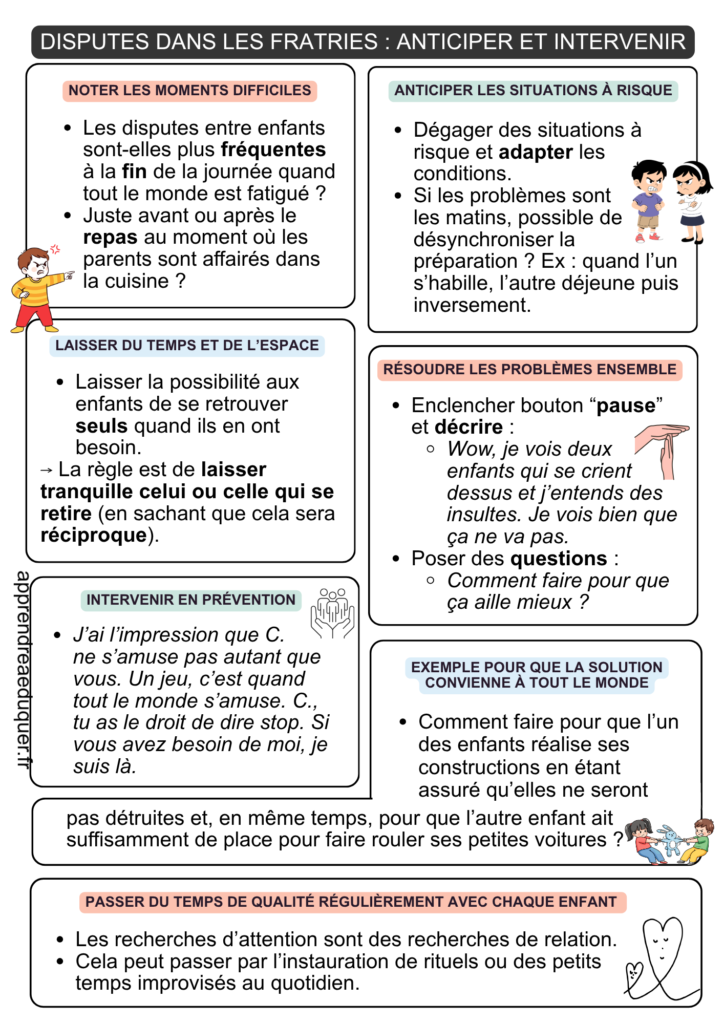
Start by asking simple questions about timing. Are sibling fights more frequent at the end of the day, when everyone is tired? Do they flare up just before or after a meal, when parents are busy in the kitchen? Writing these patterns down, even loosely, turns vague frustration into something you can actually work with.
Once you have identified the risky situations, you can adapt the conditions around them. During meal preparation, for instance, you might occupy and separate the children: one sets the table while the other helps chop vegetables. If mornings are systematically difficult, try desynchronising the routine — one child gets dressed while the other has breakfast, then swap. In the evening, quieter activities can help everyone wind down.
Small adjustments, fewer flashpoints
These changes are not about controlling children, but about removing the friction that fuels Montessori method style independence and cooperation at home. A predictable rhythm gives children a sense of security, and security reduces the need to fight for attention.

Leave time and space to withdraw
Every child needs the possibility of having their own space and of being alone when they feel the need. That means two things: free, unstructured time, and a personal corner they can reach without being disturbed. It does not have to be a whole bedroom — a cushion, a desk or a quiet corner can be enough, and the best deal toys can help furnish that retreat affordably.
The other half of the equation is the rule itself. Each child should understand why this time alone matters for the others, and the deal is simple: whoever withdraws is left in peace, knowing the same courtesy will be returned. Children accept this far more readily when they see it as a reciprocal arrangement rather than a punishment.
Respecting a child's need to step away also supports emotional regulation, much like the calm moments described in baby's first outings, where a predictable environment helps little ones feel safe. When children know they can retreat, they no longer need to fight to protect their territory. The right toys for psychomotor skills can also give that quiet corner a purposeful, calming focus.
| Strategy | When to use it | What it looks like |
|---|---|---|
| Spotting triggers | Before conflicts start | Note the time, place and context of recurring fights |
| Personal space | When a child seems overwhelmed | A quiet corner and a rule to leave them in peace |
| One-on-one time | Daily, ideally | A short ritual or improvised moment with each child |
| Joint problem-solving | During or after a conflict | Describe what you see, then ask how to improve things |
Spend regular quality time with each child alone
Some fights are not really about the toy or the television remote. They are bids for attention from parents — and bids for attention are, in fact, bids for relationship. When a child cannot get that connection easily, they may resort to strategies that are inappropriate but effective, which is part of why easy things can feel so hard to change.
You can anticipate this by dedicating uninterrupted stretches of time to each child individually, as regularly as possible, ideally daily. It might be a fixed ritual, such as a story at bedtime or a walk on Saturday, or small improvised moments slipped into the day. What matters is that the time is genuinely uninterrupted and clearly belongs to that one child.
Rituals beat grand gestures
A short, reliable moment repeated every day is worth more than an occasional big outing. It gives each child a guaranteed slot of parental attention, which reduces the need to compete for it. If you are looking for shared activities to fill those moments, illustrated stories are a gentle option, and our selection of illustrated children's books offers plenty of inspiration. Safety matters too, as the tragic balloon death of a four-year-old reminds us.

Solve problems together instead of arbitrating
When a conflict erupts, a parent can press the pause button rather than rush to judge. Describe what you see without blaming anyone: "Wow, I see two children shouting at each other and I hear insults. I can see things are not going well." Then ask an open question: "How can we make this better?"
Take a concrete example. How could one child build their constructions while being sure they will not be destroyed, and at the same time give the other child enough room to roll their little cars? The goal is to find one or several ideas that suit all the children and the parents, not to impose a verdict from above.
Why this works
Describing rather than accusing lowers the tension, and asking rather than ordering hands the problem back to the children. They practise negotiation, empathy and compromise — skills that serve them well beyond the living room. For a deeper look at when to step in, see this guide on parenting interventions during sibling disputes.

Build a home that prevents friction
Prevention is not a single trick but a combination of habits: knowing your flashpoints, protecting personal space, filling attention buckets and coaching children through conflicts. Together, these four ideas improve the quality of family life far more than any punishment could.
It also helps to think about the environment itself. A home with clearly organised toys, accessible storage and enough room to play side by side reduces the number of disputes over shared items. If you are rethinking a play area, our guide to foam block toys shows how modular designs can create distinct zones for different children.
Finally, remember that siblings who fight are also siblings who are learning to live together. The aim is not a house without conflict, but a house where conflict is handled with a little more skill each time. For families navigating the arrival of a new baby, resources on breastfeeding after one year and other early-years topics can help you plan routines that keep everyone grounded.
My hands-on take
In our house, the biggest discovery was how predictable the fights were. Once I started paying attention, I realised the worst clashes almost always happened in the twenty minutes before dinner, when I was cooking and both children wanted the same thing at the same time. Simply giving each of them a small job in the kitchen changed the atmosphere more than any lecture ever did.
The second change was protecting a short one-on-one moment each day. It is not always long — sometimes just ten minutes of drawing together — but it is reliable, and that reliability seems to matter more than the duration. I still step in when voices rise, but I now try to describe what I see and ask how we can fix it, rather than deciding who started it. It is far from perfect, yet the house feels calmer.
Frequently asked questions
How do I know which moments are most likely to cause sibling fights?
Look for patterns rather than single incidents. Note the time of day, what is happening around the family and how tired everyone is, then compare a few days to spot recurring triggers.
What if my child refuses to respect a sibling's quiet time?
Remind them of the reciprocal deal: whoever withdraws is left in peace, and the same will apply to them. Stay consistent, and model the rule yourself by not interrupting either child.
Does one-on-one time have to be long?
No. A short, reliable moment repeated daily is more valuable than an occasional long outing, because it gives each child a predictable slot of attention.
What should I say when a fight breaks out?
Describe what you observe without blaming anyone, then ask an open question such as "How can we make this better?" This invites the children to find a solution together.
Product Reviews
 Best Toys for Dogs With High Prey Drive |
Best Outdoor Toys for 3-4 Year Olds |
Best Outdoor Toys for 6 Year Olds |
Best Harness for Poodle |
Best LEGO Sets for Adults |
Best Travel Toys for 4 Year Olds on Airplane |
Best Toy Stores in Washington DC |
Best Potty Training Toys |
Best Toys for Tripod Dogs |
Maillot equipe de france







