


Nonviolent communication cards offer a gentle, low-pressure way to bring a whole new language of empathy and honesty into family life. Immersing yourself in this approach takes practice and patient soaking-in, much like learning a foreign language, and a small deck of cards can be the very first tool on that road.
Each card carries a single sentence to sit with, and the accompanying booklet sums up the theory behind the process. Together they invite you to notice what a phrase stirs in your body and heart, then carry that awareness into the everyday moments of parenting.

Quick takeaways
- A deck plus booklet offers a gentle first step into nonviolent communication.
- The process is compared to learning a new language that needs patient practice.
- Eight card categories cover needs, empathy, honesty, anger, gratitude and more.
- Draw a card to inspire the day, prepare a talk or repair a relationship.
- If a card does not resonate, that is fine; read it over several days instead.
- The set suits beginners and experienced practitioners alike.
What this nonviolent communication deck contains
The set pairs a deck of cards with a concise booklet. The author reminds readers that practising nonviolent communication requires patient impregnation: the process is a way of thinking and speaking, an attitude to life that nurtures kindness and a taste for cooperation. Through this new language, she explains, we learn to turn our energy against into energy for, and to welcome what another person is living through.
Drawing a card each day can be the first step towards communicating without judging, connecting with emotions and needs, showing empathy and looking for win-win solutions. The booklet restates the theoretical basics in a brief but complete way, covering self-empathy, honesty, empathy, the importance of needs, the expression of anger and gratitude, along with a few sample dialogues in the nonviolent style.
Who it is for
The deck suits both beginners and people already familiar with the process who want tools to embed it in daily life. If you are raising a child with a lot or simply want calmer family exchanges, a concrete prompt can help more than abstract theory. Patience and empathy matter at every stage, whether you are pregnant or choosing back to school rewards.

The eight categories of cards
The cards are sorted into eight families: basic notions, needs, empathy, saying no, gratitude, self-empathy, honesty (or assertiveness) and anger. Each category gives you a different doorway into the same attitude, so you can pull the theme that matches the moment rather than working through everything at once.
Having needs and empathy as separate piles is useful, because parents often leap straight to solutions. A card that names a need slows that reflex down. Likewise, a card about saying no can support the gentle limit-setting that matters so much in the early years, when the first three years shape so much of how a child learns to relate. These parent child scientific facts show why that early bond deserves such care.
Why the range matters
Anger and gratitude sitting side by side is a reminder that both belong in family life. Naming what frustrates you and naming what you appreciate are two halves of the same honest conversation, and the deck keeps both within reach. The same steady attention helps when you wonder how to make hair grow strong and healthy.

| Category | What it invites | Good moment to draw |
|---|---|---|
| Basic notions | Grounding in the process | Starting out |
| Needs | Naming what matters | After a conflict |
| Empathy | Welcoming the other's experience | Before a hard talk |
| Saying no | Gentle, clear limits | Setting boundaries |
| Gratitude | Noticing the good | Family meals |
| Self-empathy | Checking in with yourself | End of a long day |
| Honesty | Speaking assertively | Tricky conversations |
| Anger | Transforming energy against into energy for | Moments of frustration |
Ways to use the cards
The author suggests several uses: to get an answer to a question about yourself or a relationship, to receive a message that inspires the day, to find help with a difficult interaction, to recharge and recentre, to express a suffering, or to repair a relationship where someone was hurt.
Once you have drawn a card, the invitation is to soak up the wisdom of its sentence, notice how it resonates, and observe what it stirs in body and heart. If the card does not speak to you, that is fine too. You can read it over several days to absorb the message, use it as training before a difficult conversation, or let it nourish daily life and relationships.
These uses map neatly onto parenting pressures. A card drawn before a bedtime struggle can echo the patience you need when your child takes hours to settle, and one drawn before a hospital appointment can steady your tone.

Bringing the practice into family routines
A daily draw works best when it is tied to a habit you already have, such as a morning coffee or the moment after the children are asleep. Keep the deck somewhere visible, and let the booklet sit beside it so you can check a concept without turning it into homework.
With children, the cards can become a shared ritual. Reading a gratitude card aloud at dinner, or an empathy card before a tricky conversation, models the language you hope to hear back. This is especially helpful for children who need support with language development, since hearing feelings and needs named out loud builds vocabulary as well as connection.
Keep it light
There is no score and no correct interpretation. If a week goes by without a draw, simply begin again. The aim is impregnation, not performance, and a relaxed approach is more likely to last.
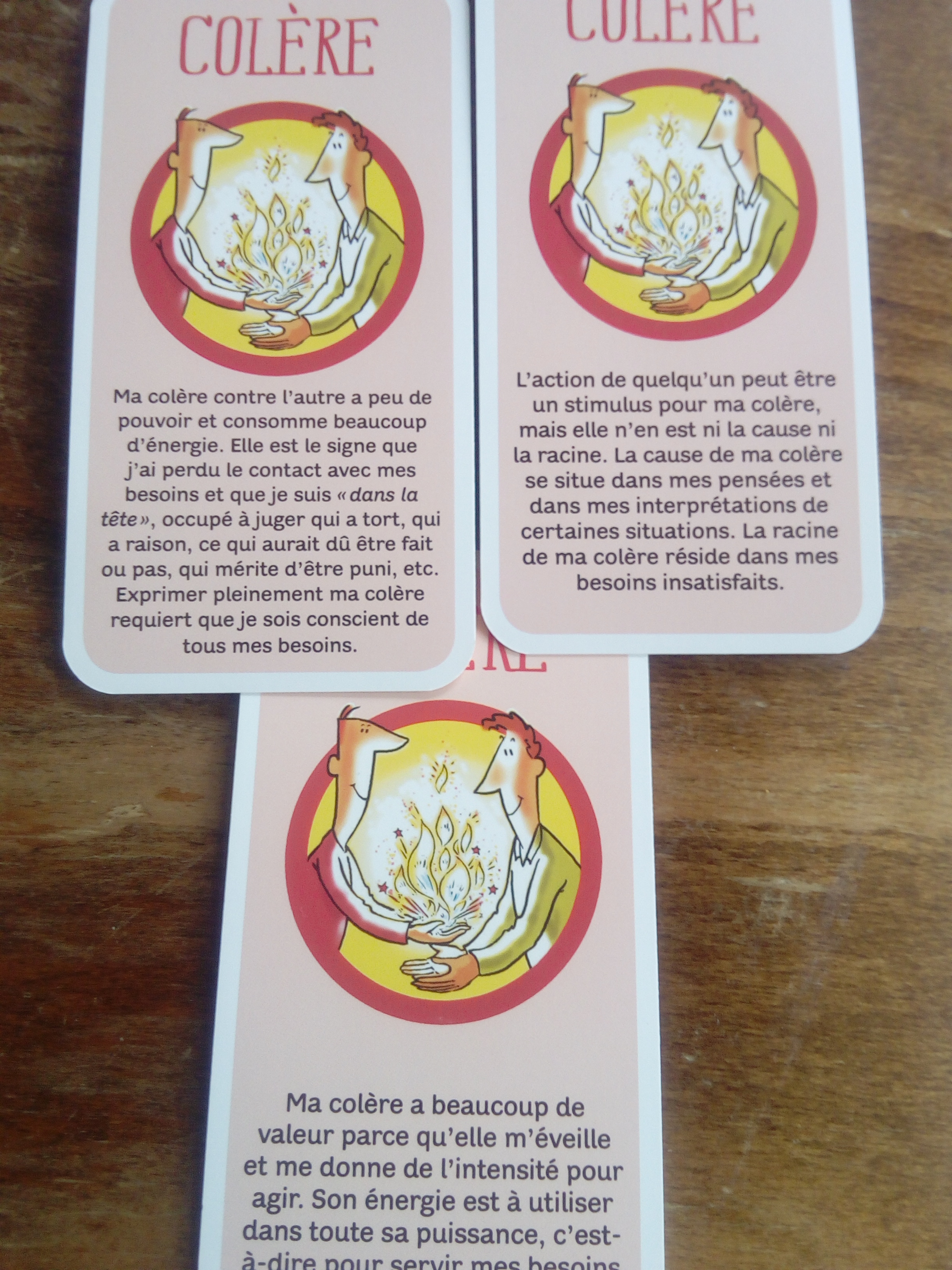
Why a physical deck helps the learning stick
Learning a new language of communication is slow, and slow is the point. A physical deck gives you a tangible pause: you stop, pick a card, read one sentence, and breathe. That small interruption is often enough to shift you from reacting to responding, which is the heart of the whole process.
The booklet's summaries mean you do not have to hold every concept in your head. When a card about anger appears, you can flip to the relevant page and refresh the theory in a minute. Over time, these short repetitions build the reflex of checking in with emotions and needs before speaking, and that reflex travels with you into every ordinary family moment. Just as with common parenting questions, small daily habits add up.



My hands-on take
I keep our deck on the kitchen windowsill, where I make coffee before anyone else is awake. Some mornings I pull a card and it lands flat, and I put it back without guilt. Other mornings a single sentence about needs stops me mid-thought and I carry it into breakfast.
What surprised me most was how the cards changed my tone rather than my words. Reading one aloud to my child before a difficult conversation gave us both a script to lean on, and it made the apology easier when I got it wrong. The booklet is the part I return to most, because a quick page refreshes the theory without turning practice into a chore.
Frequently asked questions
Do I need prior training in nonviolent communication?
No. The booklet restates the basics briefly but completely, and the deck is designed for beginners as well as people already familiar with the process.
What if a card does not seem to speak to me?
That is completely fine. You can set it aside, or read it over several days and see whether its meaning shifts as you sit with it.
Can I use the cards with my children?
Yes. Reading a gratitude or empathy card aloud can become a shared family ritual and helps children hear feelings and needs named.
How often should I draw a card?
There is no set rule. A daily draw suits many people, but returning after a gap is just as valid, since the aim is patient practice rather than performance.
Product Reviews
 Best Toys for Dogs With High Prey Drive |
Best Outdoor Toys for 3-4 Year Olds |
Best Outdoor Toys for 6 Year Olds |
Best Harness for Poodle |
Best LEGO Sets for Adults |
Best Travel Toys for 4 Year Olds on Airplane |
Best Toy Stores in Washington DC |
Best Potty Training Toys |
Best Toys for Tripod Dogs |
Maillot equipe de france







