


Long-term memory is the storehouse where information settles for good, and understanding how it works changes the way children and teenagers study. Three levers keep coming back: repetition, motivation and indexing, or the association of ideas.
None of them requires special tools or long lectures. What matters is that children hear these ideas early, in simple words, so they can use them on their own during homework and revision.

Below is a plain-language explanation of each lever, with practical ways to apply it at home and in the classroom.
Quick takeaways
- Reading alone does not create lasting memory; active repetition does.
- Transforming information (diagrams, summaries, drawings) makes repetition more effective.
- Self-questioning with flashcards or heading-based questions beats re-reading.
- Humour, exaggeration and pleasure make content memorable.
- Linking new ideas to prior knowledge builds threads the brain can pull later.
- The three levers work best combined in short, focused sessions.
Why repetition builds lasting memories
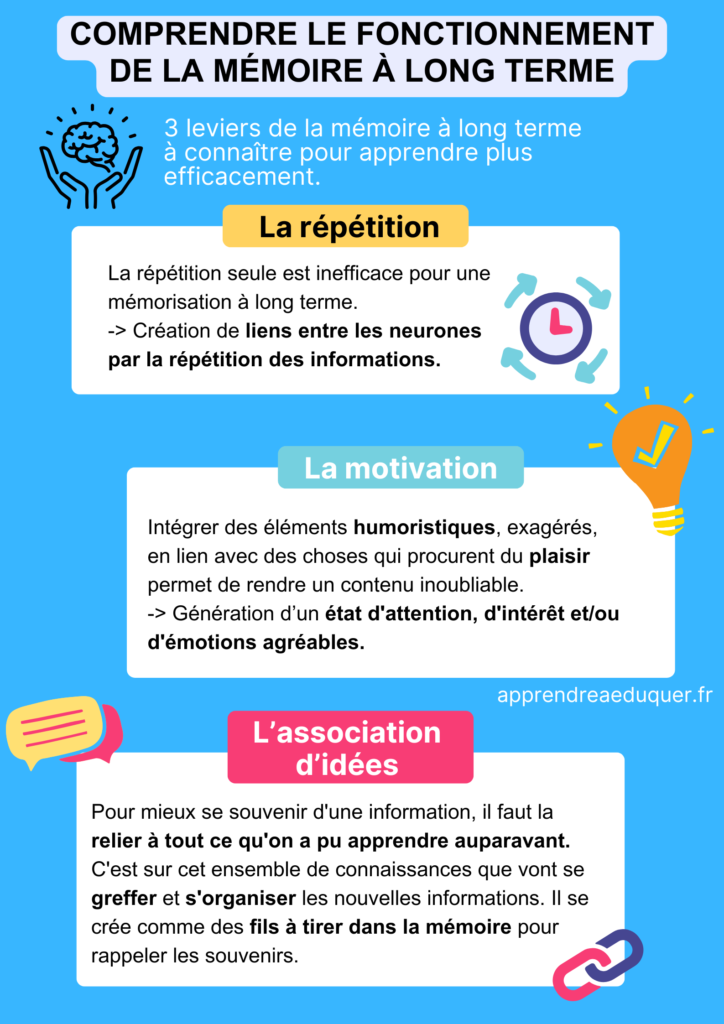
Reading a lesson once is ineffective for long-term memory. Repetition means going back over the same information several times, and it works even better when the information is transformed rather than copied. Turning a text into a diagram, or describing an image out loud, forces the brain to work with the content instead of just passing over it.
Self-questioning is more useful than simple re-reading. Children can use flashcards, or turn the chapter's titles and subheadings into questions, with the lesson content as the answer. This habit pairs well with the way reading and writing develop in children, since both rely on active use of language rather than passive exposure.
Small changes, better retention
Varying the format keeps repetition from becoming mechanical. A child who redraws a map from memory, explains a concept to a sibling, or rewrites a summary in their own words is repeating the information while reshaping it. For younger children, short and playful formats work best, similar to the approach behind educational children's apps that combine learning and fun. The same principle applies to stories about the sea, which reward repeated reading, much like the timing of Double VIP Points rewards planning ahead.
Motivation: attention, interest and emotion
Motivation is not just willingness to work; it is a state of attention, interest and emotion. When a lesson carries humour, exaggeration or a link to something the child enjoys, the content becomes far harder to forget. A funny example or an over-the-top comparison gives the brain an emotional hook to hold on to.
This does not mean turning every lesson into a show. It means adding a personal or amusing detail here and there, so the material stands out from the ordinary. The same principle applies outside school: a child who is absorbed in building something, such as a set stored carefully following LEGO storage, is practising sustained attention that transfers to study time. Curiosity works the same way, whether a child is wondering how LEGO Ideas sets get approved or asking whether a remedy really helps, as explored in does homeopathy work for babies and children.
Emotion as a memory anchor
Pleasant emotions are powerful anchors. A story that made a child laugh, or an example connected to a favourite activity, is recalled more easily than a neutral list. Parents can ask teachers what amused their child that week and revisit it at home.
| Lever | What it means | Practical example |
|---|---|---|
| Repetition | Reviewing information several times, ideally transformed | Turn a text into a diagram or use flashcards |
| Motivation | Attention, interest and emotion around the content | Add a funny or exaggerated example |
| Indexing | Connecting new ideas to prior knowledge | Ask what the child already knows before a lesson |
| Combined | Using all three in one session | Self-quiz with a funny example linked to an old lesson |
Indexing: linking new ideas to old ones
To remember information better, it has to be connected to everything learned before. New knowledge grafts onto the existing body of knowledge and organises itself around it, creating threads that can be pulled later to bring memories back. A child who already knows a little about a topic learns the next layer much faster.
This is why general knowledge and varied experiences matter so much. Museum visits, conversations at dinner and hands-on play all build the base onto which school lessons attach. Even choosing toys with care, as explained in independent play toys, contributes to the rich mental background that makes new information easier to index. The same applies to everyday activities like picking cheap carnival costumes, which spark conversations and memories.
Questions that create threads
Before starting a new chapter, ask the child what they already know about the subject. This simple step activates prior knowledge and gives the new material something to attach to. Afterward, ask how it connects to something they learned earlier.

Putting the three levers into practice
Repetition, motivation and indexing work best together. A revision session that combines self-questioning, a funny example and a link to a previous lesson covers all three at once. Ten focused minutes of this kind beat an hour of passive re-reading.
The environment matters too. A calm, well-organised space with few distractions helps attention settle, and even small routines, like tidying toys after play, support the habit of order that studying requires. Parents preparing a study corner may find ideas in foam block toys for flexible, quiet play nearby.
What to say to children
Explain the levers in simple words: "Your brain keeps what you use again, what interests you and what connects to what you already know." Teenagers can then choose their own revision method, which builds autonomy. The goal is not more hours of work but smarter use of the hours already spent.
My hands-on take
I started explaining these three levers to my own children during homework time, and the shift was noticeable. Instead of telling them to read the lesson again, I now ask them to close the book and tell me what they remember, or to turn a heading into a question. It takes less time and they complain far less.
What surprised me most was how much the motivation lever mattered. Adding one silly example to a history lesson made my son recall the whole sequence a week later. I also began asking what they already knew before starting a new topic, and that small question seems to open a door. None of this requires special materials, just a change in how we talk about studying at home.
Frequently asked questions
Is re-reading a lesson useful for long-term memory?
It is one of the least effective methods on its own. Re-reading feels familiar but does not force the brain to retrieve information. Self-questioning or transforming the content works much better.
How can parents make homework more motivating?
Add humour, personal examples or links to things the child enjoys. Emotion and interest make content stand out and stick. Keep it light rather than turning every session into entertainment.
What does indexing mean in practice?
It means connecting new information to what the child already knows. Asking "what do you already know about this?" before a lesson is a simple way to activate that base.
Can these principles be used with young children?
Yes, in simplified form. Short repetitions, playful formats and questions about familiar things all support memory from an early age.
Product Reviews
 Best Toys for Dogs With High Prey Drive |
Best Outdoor Toys for 3-4 Year Olds |
Best Outdoor Toys for 6 Year Olds |
Best Harness for Poodle |
Best LEGO Sets for Adults |
Best Travel Toys for 4 Year Olds on Airplane |
Best Toy Stores in Washington DC |
Best Potty Training Toys |
Best Toys for Tripod Dogs |
Maillot equipe de france







