


Emotional listening in siblings is a way of hearing what your children feel, not just what they say. Instead of judging a behaviour, you try to understand the need and emotion behind it. This approach helps brothers and sisters feel seen and softens the jealousy that so often sparks conflict.
Haïm Ginott, a pioneer of parent-child communication, argued that no fair punishment and no fair compliment can fully satisfy a child's longing for exclusive love. His answer is not to divide affection evenly, but to listen with empathy and to love each child in a way that feels unique.

Quick takeaways
- Emotional listening seeks the need behind the behaviour, not a quick correction.
- Stop violent gestures first, then name the feeling underneath.
- Love each child uniquely rather than identically to reduce comparison.
- Prepare older siblings for a new baby by acknowledging mixed feelings.
- Avoid comparing siblings, even in a positive way.
- Protect one-to-one time so jealousy has less room to grow.
What Emotional Listening Really Means
Emotional listening means putting yourself in your child's place and asking what motivates them from the inside. You look for the need and the feeling that drive the words or the behaviour, rather than rushing to correct it. This kind of listening is not about reframing conduct or showing a child that they think or feel wrongly.
Instead, it connects you with a child who is hurting and offers understanding plus room to confide. Sometimes the most useful thing you can do is simply stay quiet and let them cry. If you want more tools for everyday dialogue, these communication with children ideas pair well with this approach.
Why empathy comes before correction
When a child feels heard first, they are far more able to calm down and cooperate afterwards. Empathy does not mean abandoning limits; it means setting them once the feeling has been acknowledged.
Two Keys for Overcoming Sibling Jealousy
Ginott offers two keys for moving past jealousy between brothers and sisters. The first is emotional, empathetic listening, described above. The second is to love each child in a unique way rather than a uniform one, because children read equal treatment as a sign that they are interchangeable.
This does not mean loving one child more. It means noticing what matters to each one and responding to that, so no child feels like a copy of another. A child who has his own space and his own rituals is less likely to measure love by comparison. After all, the first three years shape how children experience attention and security.
These two keys work together: listening reveals what each child needs, and unique love shows them they are valued as themselves. Keep this in mind during the everyday moments that most often trigger rivalry, from sharing toys to choosing who sits where, and remember that young children feel discomfort and jealousy more intensely.
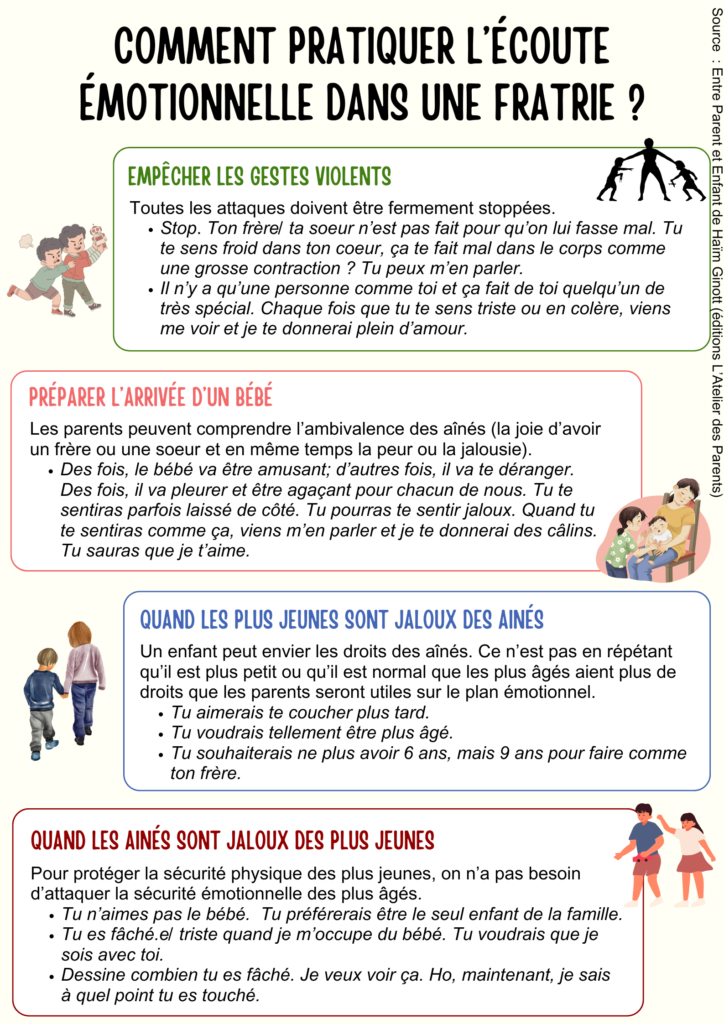
| Situation | What to say | What to avoid |
|---|---|---|
| Hitting or pushing | "I won't let you hit. You were angry." | Shaming or long lectures |
| New baby arriving | "You're happy and also worried." | Promising nothing will change |
| Younger child jealous | "It's hard to watch him do that." | Comparing the two children |
| Older child jealous | "You miss it being just us." | Arguing with the feeling |
| Constant rivalry | "Tell me what bothers you." | Equal-treatment scorekeeping |
Preventing Violent Gestures Between Siblings
Emotional listening does not mean letting children hit each other. You stop the violent gesture firmly and immediately, then turn to the feelings underneath it. A useful order is: stop the hands, name the emotion, and offer a safer way to express it.
Try phrases such as "I won't let you hit. You were very angry when she took your toy." This protects the child who was hit while showing the other that their frustration is understood. Calmer play often follows when children have open ended toys that reduce competition over a single item.
Separate the act from the feeling
Make it clear that the feeling is allowed and the action is not. Children learn that anger is acceptable while hurting someone is not, which is the foundation of self-regulation.
Preparing for a New Baby in the Family
Before a baby arrives, emotional listening means making room for mixed feelings. An older child may be excited and worried at once, and both deserve acknowledgment. You might say, "You're happy about the baby and also a little worried about sharing us."
Practical preparation helps too: talk about what will stay the same, keep familiar routines, and let the older child help in small ways. If you are choosing first items, these toys for babies can give you ideas while you also plan time alone with the older sibling.
After the birth, expect some regression and welcome it without shame. Naming the feeling out loud often does more than a lecture about being the big sibling.
When Younger Children Are Jealous of Older Ones
Younger children often envy the freedoms and skills of their older siblings. Emotional listening here means saying, "It's hard to watch him do that when you want to do it too." That sentence validates the wish without asking the older child to shrink.
Avoid comparing the two, even favourably, because comparison feeds the very jealousy you want to reduce. Instead, point to each child's own progress and let the younger one practise safely. Cause and effect play, for instance with cause and effect toys, gives little ones a sense of mastery of their own.
Give the younger child small responsibilities and real choices so their sense of competence grows from their own achievements rather than from the older sibling's limits.
When Older Children Are Jealous of Younger Ones
Older children can resent the attention a baby or toddler receives, and they may express it through regression or irritability. Emotional listening means taking that seriously: "You miss the time when it was just us." Do not argue with the feeling or promise that it is not true.
Protect small pockets of one-to-one time and let the older child be little sometimes without teasing. If tiredness or illness is adding to the tension, it helps to read about a tired child and adjust expectations rather than push harder. When an older child is away and calls asking, the same patient listening applies.
Over time, these honest conversations build trust. Children learn that jealousy is normal, speakable and survivable, which is exactly what emotional listening is meant to teach.

My hands-on take
In my own home, the phrase that changed the most was simply naming the feeling before anything else. When one child grabbed a toy from the other, I used to launch straight into a lecture about sharing. Now I stop the grabbing, then say something like "You really wanted that and you're upset." The surprising part is how often the argument deflates once the feeling is spoken out loud.
I also learned to stop keeping score. For a long time I worried about being perfectly fair, dividing time and treats down to the minute. It never worked, and the children still felt shortchanged. What helped instead was noticing what each one actually needed that day, which sometimes meant ten quiet minutes with one child and none with the other. Emotional listening is not a script I follow perfectly; it is a habit I keep practising, and the calmer evenings are worth it.
Frequently asked questions
Does emotional listening mean I never set limits?
No. You stop harmful behaviour clearly, then listen to the feeling behind it. Limits and empathy work together rather than replacing each other.
What if my child refuses to talk?
Stay nearby and offer simple, open phrases instead of questions. Silence and calm presence often make it easier for a child to open up later.
Can this approach really reduce sibling jealousy?
It gives children language for their feelings and reduces the sense that love is being measured. Progress is gradual and shows up in calmer everyday moments.
Should I treat all my children exactly the same?
Treating them identically can make children feel interchangeable. Responding to each child's specific needs shows them they are valued as individuals.
Product Reviews
 Best Toys for Dogs With High Prey Drive |
Best Outdoor Toys for 3-4 Year Olds |
Best Outdoor Toys for 6 Year Olds |
Best Harness for Poodle |
Best LEGO Sets for Adults |
Best Travel Toys for 4 Year Olds on Airplane |
Best Toy Stores in Washington DC |
Best Potty Training Toys |
Best Toys for Tripod Dogs |
Maillot equipe de france







