


Knowing how to compliment children well matters more than most parents expect, because the words we choose shape whether a child looks inward for approval or outward at an adult's face. The most valuable learning happens when children are deeply involved in what they are doing, not when they are worrying about how others judge them.
This article draws on the gentle-communication approach of Adele Faber and Elaine Mazlish, who suggest one key question before praising: do my words make my child more dependent on me and my approval, or do they help my child recognise their own strengths and build a more accurate picture of their abilities?

Below you will find descriptive compliments you can use at home, plus the reasoning behind them, so you can adapt the idea to your own family rather than memorising scripts.
Quick takeaways
- Ask whether your words build dependence on approval or awareness of strengths
- Describe what you see instead of labelling the child
- Name effort, discipline, honesty and kindness, not just results
- End with a question that hands the thinking back to the child
- Praise the process so the child builds their own evidence
- Keep it brief and specific rather than frequent and general
The key question before you praise
Faber and Mazlish, specialists in respectful adult-child communication, invite parents to pause before offering a compliment and ask a single question. Does what I am about to say make my child more dependent on me and my approval, or does it help them recognise their own strengths and give them a clearer picture of their skills and achievements?
That question changes the direction of the words. Instead of the child waiting for an adult to grant or withhold a verdict, the compliment points back to what the child actually did. If you are also working on everyday routines and health at home, the same principle of noticing specifics applies, much like the practical guidance in child illness signs where observation matters more than general reassurance.
The aim is not to stop praising. It is to describe rather than evaluate, so the child learns to assess their own effort.
What descriptive compliments sound like
A descriptive compliment names what you see. For effort and results: "It took determination and hours of work to get those grades. You must be proud of yourself." For a piece of writing: "Your description is so detailed that I can almost see the place." For schoolwork: "Every answer is correct. You have really mastered this idea."
For a presentation: "This project is full of interesting information. I learned a lot about the topic from it." For self-discipline: "It takes personal discipline to do your homework when you feel tired." Each sentence hands the credit back to the child instead of making your approval the reward.
Noticing character, not just output
Descriptive praise also works for kindness and honesty: "When you realised he had forgotten his sandwich, you gave him part of yours." And "You told me you cheated even though you knew it would make me angry. That is what I call honesty."
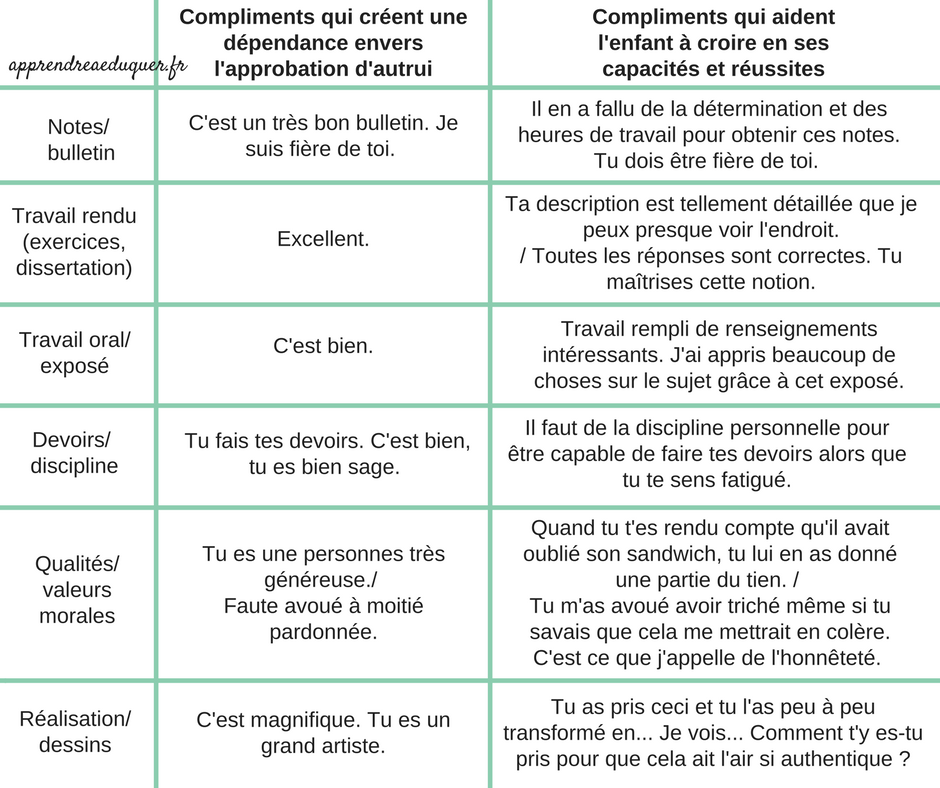
| Instead of saying | Try saying | What the child learns |
|---|---|---|
| You are so smart | You worked on this for hours | Effort leads to results |
| Good job on the project | I learned a lot from your project | Their work has real value |
| You are a good friend | You shared your sandwich when he forgot his | Kindness is something they do |
| You are such an artist | How did you make it look so authentic? | Reflection and pride in process |
| Finally, honest! | You told me the truth even though I would be angry | Honesty is recognised and safe |
Turning evaluation into description
Compare a verdict with a description. "You are such a good artist" is a label the child has to live up to or doubt. "You took this and gradually turned it into something new. I see how much care went into it. How did you make it look so authentic?" invites reflection instead.
The follow-up question matters as much as the first sentence, because it hands the thinking back to the child. This habit of asking rather than declaring is useful well beyond praise; the same patient, step-by-step approach appears in baby language steps where children build skills through daily repetition rather than one big leap.
If you are choosing materials for creative play, keep the focus on process too, as suggested in tummy time toys where the value lies in exploration rather than performance.
Why this builds lasting confidence
When children hear descriptions of what they did, they accumulate evidence about themselves. They learn that effort, patience and honesty are things they possess, not gifts handed out by an adult. That internal record is what carries them when no one is watching.
It also reduces the anxiety of constant judgement, which leaves more attention for the task itself. Families who think about long-term wellbeing often apply the same logic to health habits, as in nutritious canario food where small consistent choices matter more than one dramatic change.
Older children benefit especially, since they are already sensitive to how they are seen. The same respectful framing helps during the more self-conscious years discussed in teenage makeup choices.
Putting it into practice day to day
Start small. Pick one moment a day, perhaps homework or a chore, and describe instead of rating. Keep a short note of what you said and how your child responded; most parents notice children repeating the behaviour you described.
Watch for the moments that are easy to miss, such as patience with a sibling or tidying up without being asked. Even family logistics offer chances to notice cooperation, as with the practical planning covered in bunk bed safety or the shared routines in adoption and fostering.
Play is another natural setting: describing how a child builds or experiments works better than applauding the result, whether the toys are for babies as in newborn tummy toys or for older builders as in LEGO company history.

My hands-on take
I started trying this after reading that key question, and my first attempts felt clumsy. I would catch myself saying "good boy" out of habit, then try again with something specific, like naming how long my son had kept at a puzzle before it finally worked. What surprised me was his reply: he told me exactly which piece had been hardest, which he had never done after a plain "well done".
The other change was quieter. When I described his patience with his little sister instead of calling him a good brother, he started pointing out his own kind moments to me. I still slip into automatic praise, especially when I am tired, but the descriptive version has become easier with repetition, and it feels more honest. My advice is to pick one moment a day and not worry about getting every compliment right.
Frequently asked questions
Does this mean I should never say "well done"?
No. A quick "well done" is fine now and then. The point is to make description the habit, so the child's sense of achievement does not depend on your verdict.
What if my child asks directly whether I am proud?
Answer honestly and then add a description. You can say you are proud and name what impressed you, which gives the child something concrete to hold on to.
Is descriptive praise useful for teenagers too?
Yes, often more so, because teenagers dislike being evaluated. Describing what you noticed respects their growing independence while still showing you are paying attention.
How do I start without overthinking it?
Choose one routine, such as homework or tidying up, and practise describing it for a week. Once it feels natural, extend it to other moments.
Product Reviews
 Best Toys for Dogs With High Prey Drive |
Best Outdoor Toys for 3-4 Year Olds |
Best Outdoor Toys for 6 Year Olds |
Best Harness for Poodle |
Best LEGO Sets for Adults |
Best Travel Toys for 4 Year Olds on Airplane |
Best Toy Stores in Washington DC |
Best Potty Training Toys |
Best Toys for Tripod Dogs |
Maillot equipe de france







