


Emotions and reason are often treated as opposites, as if good decisions require switching feelings off. Recent work in neurobiology suggests the opposite: feelings are part of how we reason, not a distraction from it.
Catherine Belzung, a professor of neuroscience, points to research by Antonio Damasio showing that people decide not only through logic but through the emotional weight they attach to each possible option. That weight comes from inborn biological mechanisms and from past experience.

Understanding this link helps parents see a child's feelings as useful information rather than noise to be silenced.
Quick takeaways
- Emotions are not the opposite of reason; they feed into it.
- Somatic markers are bodily signals that flag options as safe or risky.
- They are shaped by biology and by upbringing and culture.
- Pleasant markers encourage a choice; unpleasant ones warn against it.
- Brain injury to the ventromedial prefrontal cortex disrupts this guidance.
- Naming a child's feelings helps them use the signal, not fight it.
What the Somatic Marker Hypothesis Says
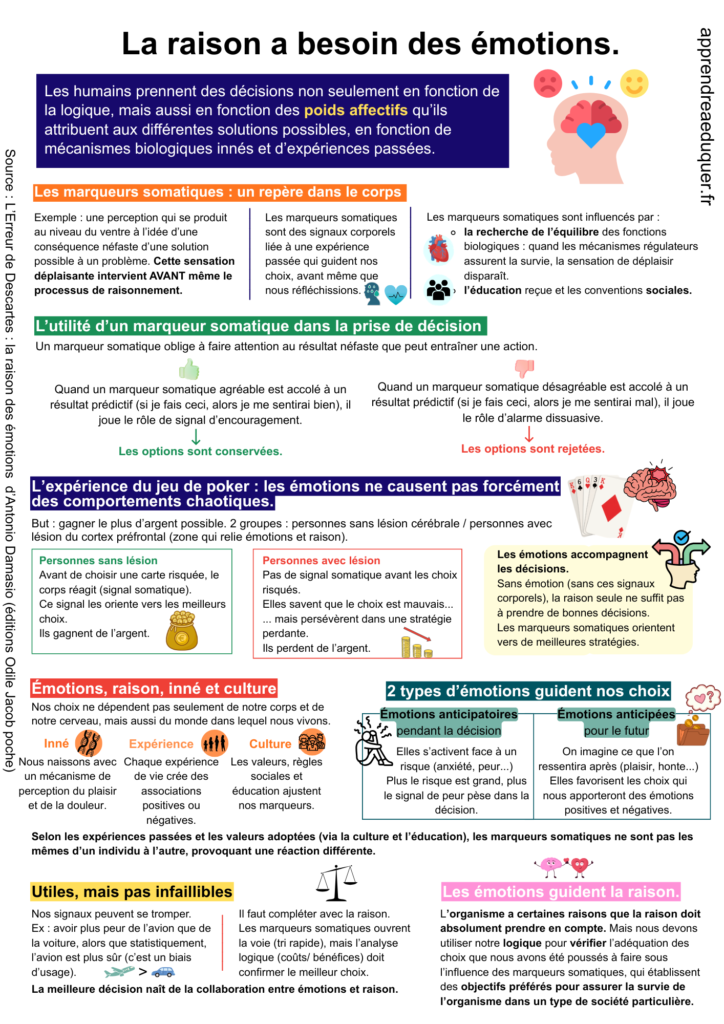
Damasio proposed the somatic marker hypothesis to explain how the body participates in choice. He describes a gut-level perception that appears at the very idea of a harmful consequence, before any reasoning process begins. He calls this bodily perception a "somatic state," and because it is tied to a particular image that acts like a marker, he calls it a somatic marker.
Fear offers a clear example: sweating, a faster heartbeat, or rising blood pressure. These markers are shaped by two forces. The first is the internal homeostasis system, which seeks balance among biological functions and, when its innate regulators do their job of keeping the organism alive, makes the unpleasant sensation fade. The second is the education a person received and the social conventions of the culture they live in.
Why the Body Signals at All
In everyday parenting, this is why a child may feel uneasy about a situation before they can explain it. That early signal is worth listening to, even when the explanation comes later.

Why a Somatic Marker Is Useful
A somatic marker forces attention onto the harmful outcome an action might produce. It works like an automatic alarm saying: be careful, this option carries danger. For Damasio, these markers increase the precision and efficiency of decision making because they allow a preselection of possible options.
When an unpleasant marker is attached to a predicted result, it acts as a dissuasive alarm and the option is rejected. When a pleasant marker is attached, it acts as an encouraging signal and the option is kept. This is the same mechanism behind learning numbers games, where a good feeling keeps a child returning to practice. Parents who want to understand these emotional patterns better can explore TED Talks on parenting.
Damasio sums it up plainly: the processes we call cognitive are genuinely bound up with those we call emotional. Neither runs the show alone. This is also why mom and dad both matter in shaping a child's emotional responses.
| Signal type | What the body does | Effect on the choice |
|---|---|---|
| Pleasant marker | Comfort, ease, calm | Option kept and encouraged |
| Unpleasant marker | Sweating, faster heartbeat | Option rejected as a warning |
| No marker (lesion) | No bodily response | Poor choices persist despite knowing |
| Homeostasis at work | Regulators restore balance | Unpleasant sensation fades |
| Learned convention | Culture and upbringing | Shapes what feels right or wrong |
The Poker Game Test
Damasio's team ran a laboratory experiment to find what helps or blocks rational decisions. They tested two groups: people with no lesion in the ventromedial prefrontal cortex and patients with such a lesion. This brain area links the capacity to reason with the capacity to feel emotions, allowing somatic marker states to be integrated into decision making.
The goal was to win as much money as possible, and a subject was considered rational if they played to optimize gains. Patients with lesions made irrational choices. Researchers noticed these players knew perfectly well that their cards were a bad choice, yet they persisted in a losing strategy. In normal subjects, a physiological response appeared before choosing a disadvantageous card, and this response was absent in the lesion group.
What the Results Suggest
Normal subjects used somatic markers to steer toward the most rational strategies. Patients without that bodily activation had no warning of danger, which kept them from adopting rational strategies. The experiment shows emotions do not necessarily cause chaotic behavior; negative markers inhibit options perceived as a threat to the individual's balance.
Belzung concludes that if we make rational decisions, it is because we manage not to carry out irrational ones, and bodily activation of emotional markers makes that possible. Emotions are better understood as an organizing principle that accompanies decisions and eases some cognitive processes. The same principle explains why toys for six year olds work best when they feel rewarding rather than forced.

What This Means for Parents
If feelings are part of reasoning, then dismissing a child's emotions removes information they need. A child who feels a knot in the stomach before a social event is receiving a signal, not misbehaving. Helping them name it and check it against reality teaches them to use the marker rather than obey or suppress it.
This also reframes everyday routines. A stressful goodbye at daycare can be eased with predictable rituals, much like the nursery adaptation tricks that help a baby settle. And when a child seems withdrawn or off, physical signals deserve attention too, as with the signs in baby dehydration signs.
Play is another place where emotion and thinking cooperate. Games that feel safe and enjoyable let children take on challenge, whether through crawling toys for a baby or toys for four year olds that stretch problem solving. Even screen content matters: some material, like the television trailer scares, can plant fear markers that shape choices long after.
My hands-on take
I first tried this idea at home after a small failure. My child kept refusing a puzzle that was clearly too hard, and I kept pushing because I thought persistence was the lesson. Then I watched their shoulders drop and their breathing change before they even touched the pieces. That was the marker, plain as day.
So I started asking a simple question before activities: how does your body feel about this? Sometimes the answer was "heavy," and we chose something easier. Other times it was "light," and they dove in. I stopped treating the resistance as defiance and started treating it as data. Nothing dramatic changed overnight, but the arguments got shorter, and my child began noticing their own signals without me pointing them out.
Frequently asked questions
Does this mean I should follow every feeling?
No. Somatic markers are information, not instructions. They help narrow options, but reasoning still checks whether the signal fits the situation.
Can children use these signals?
Yes, though they need help naming them. A parent who asks "what does your body tell you?" gives a child language for a signal they already feel.
Why do some people ignore clear warnings?
The poker experiment showed that damage to a specific brain area removes the bodily warning. In ordinary life, stress and habit can also drown out the signal.
Is this relevant to choosing toys or activities?
It is. Activities that feel rewarding keep children engaged, while constant discomfort signals a poor fit worth reconsidering.
Product Reviews
 Best Toys for Dogs With High Prey Drive |
Best Outdoor Toys for 3-4 Year Olds |
Best Outdoor Toys for 6 Year Olds |
Best Harness for Poodle |
Best LEGO Sets for Adults |
Best Travel Toys for 4 Year Olds on Airplane |
Best Toy Stores in Washington DC |
Best Potty Training Toys |
Best Toys for Tripod Dogs |
Maillot equipe de france







