


Competent children are not a hopeful slogan; they are what you actually live with every day, whether or not you notice it. Even very young kids do not merely want to learn how the adult world works — they want to be part of it.
That drive to understand and to prove skill is as strong as the need for food, rest or sleep, and sometimes stronger. Every parent has met the tired child who cannot be forced to bed because something interesting is still happening in the waking world.

When adults refuse to see that competence, the clash of needs often turns into harshness dressed up as education — the familiar “it’s for your own good” that hurts more than a later bedtime.
Quick takeaways
- Children are competent: they want to learn and to take part in the adult world now.
- Curiosity is a basic need, as strong as hunger, rest or sleep.
- Harsh discipline often hides behind the phrase “it’s for your own good.”
- Learning through free exploration is not the same as being taught.
- Observe closely, trust more, and give children real, meaningful tasks.
- Replace “because I said so” with explanations and shared decisions.
Seeing Children as Capable Beings
The thinker John Holt, who spent years on alternatives to conventional schooling and on self-directed learning, regretted how few adults see children as competent — both willing and able to do what adults do. In his work on how children learn, he insists that kids are not waiting for permission to be curious.
It is a serious mistake to claim that children must first be able to delay gratification, meaning they should be willing to learn pointless things in the faint hope that some of it may be useful later. Their curiosity, energy and patience come from wanting to do something real now, not in some distant future.
This has practical consequences. If you want a child to engage, let the task be genuine and immediate rather than abstract preparation. The same principle shapes how we choose playthings: even a simple building project rewards real effort, as you can see when you look at LEGO set design and how it keeps hands and minds busy.

What Stops Adults From Trusting Children
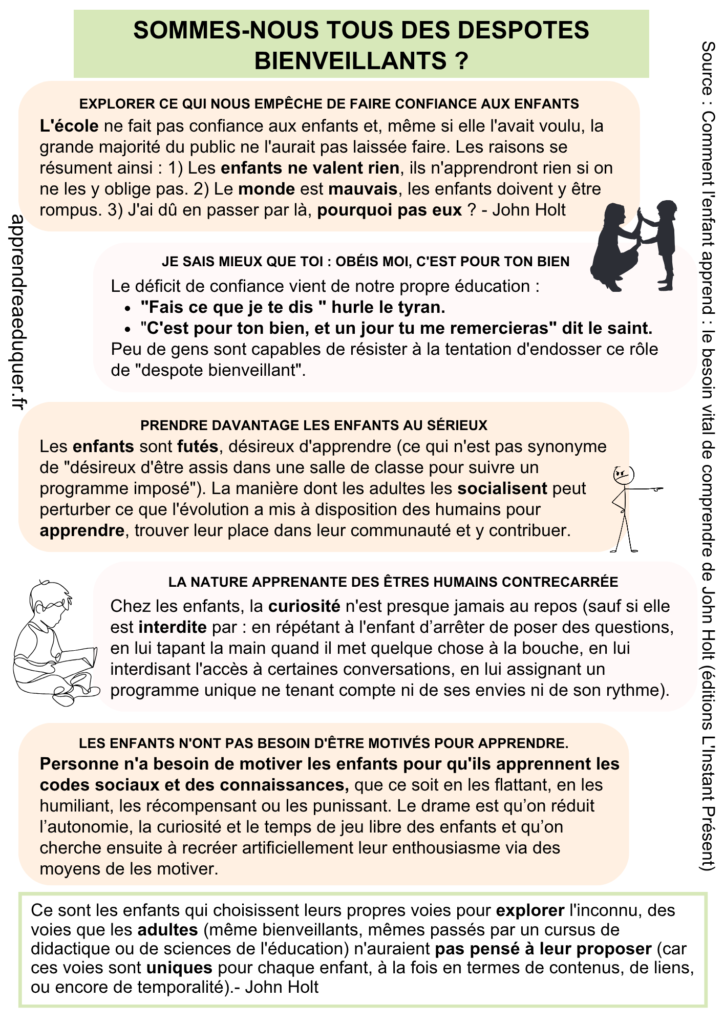
Many adults must relearn how to trust children. Holt traced the fear of autonomous learning back to their own upbringing, which grants the right to behave like tyrants while feeling like saints. “Do as I say,” shouts the tyrant; “it’s for your good, and one day you’ll thank me,” says the saint.
Few people who feel powerless in a confusing world can resist the temptation of that benevolent despot role. The pattern is reinforced by schooling, which does not trust children — and, Holt argues, the wider public would not have allowed it to try.
The three common justifications
He sums up the reasons people give: children are worthless and will learn nothing unless forced; the world is bad, so children must be broken in; and “I had to go through it, why shouldn’t they?” Recognising these phrases in yourself is the first step toward change.
Socialisation can disturb what evolution already provided for learning and contributing. Adults who repeat “stop asking questions,” slap a hand away from an exploring mouth, or impose a single programme regardless of rhythm slowly switch curiosity off — just as household chores can either build responsibility or become a battleground, depending on how much real trust you extend.
| Situation | Benevolent despot | Respectful guide |
|---|---|---|
| Child asks questions | “Stop asking, be quiet” | “Let’s find out together” |
| Bedtime resistance | Threats and shouting | Calm limit plus a real reason |
| Learning a skill | Imposed programme | Free exploration with support |
| Household tasks | Orders and correction | A genuine, useful role |
| Child’s opinion | Overruled without discussion | Heard, then decided together |
Learning and Teaching Are Not Synonyms
Children do not need to be motivated to learn. Curiosity is almost never at rest unless it has been forbidden. When we want to know something, there is a reason: a gap, an empty space in our mental picture of the world.
While the gap remains, we feel tension; when learning fills it, we feel pleasure. Here learning means free exploration, not instruction — and that exploration can be supported by an adult without being controlled by one.
This is why a child who struggles in a classroom may still spend an afternoon absorbed in a manual task, or why a hesitant reader may devour instructions for a model. You can see the same appetite at work in build a LEGO transformer or in the patience demanded by LEGO Batman length questions, where the child genuinely wants the answer.
Taking Children Seriously in Daily Life
Holt invites parents and teachers alike to take children more seriously: to observe them closely, think carefully about what their actions mean, appreciate them more, trust and respect them, and enjoy their company. Children are clever and eager to learn — which is not the same as eager to sit in a room with thirty same-age peers following an imposed programme.
They are hungry to play a real role in the adult world and are born with what they need to manage it. That is worth remembering when a child’s readiness is judged by a calendar rather than by evidence, whether the question is ready for high school or simply ready to help in the kitchen.
Observation also protects you from misreading behaviour. A child who seems defiant may be tired, hungry or overwhelmed, and the same lens applies to development: knowing the signs of maturational delay characteristics helps you respond to the actual child rather than to a label.

From Benevolent Despot to Respectful Guide
The shift is not permissive. It means replacing coercion with genuine participation: offering real tasks, explaining reasons, and letting natural consequences do some of the teaching. A child trusted with a small responsibility usually rises to it.
Play is the main vehicle here. Open-ended toys leave room for real decisions, which is why choosing well matters — the guidance in best toys babies or best toys infants is really about matching challenge to ability rather than entertaining passively.
Finally, watch the words you use. “Because I said so” closes a door; “show me what you’re trying to do” opens one. The goal is a child who keeps wanting to understand the world — and an adult who keeps wanting to understand the child.
My hands-on take
I noticed this most clearly with bedtime. For a long time I treated my child’s protests as defiance, and the evening turned into a shouting match that left everyone worse off. When I started explaining what was actually happening and offering a short, real transition — finishing one small thing together — the resistance shrank dramatically.
The same happened with chores. Handing over a genuine task, rather than a pretend one, changed everything: my child wanted to do it properly because it mattered. I still get it wrong, especially when I am tired, but watching closely and asking “what are you trying to do?” has replaced most of my “because I said so” moments.
Frequently asked questions
Does trusting children mean letting them do whatever they want?
No. Trust means taking their competence seriously and giving real responsibilities with clear limits. Adults still set boundaries, but they explain them instead of enforcing them through fear.
Why is “it’s for your own good” considered harmful?
The phrase often justifies shouting, threats or ignored crying, which hurt the child more than the temporary discomfort being avoided. The intention may be kind, but the effect on the child is what counts.
How can I tell if I am being a benevolent despot?
Listen for “because I said so,” “one day you’ll thank me,” or “I had to go through it too.” If those phrases come up often, it is a signal to slow down and involve the child in the decision.
Do children really not need motivation to learn?
Curiosity is naturally active unless it has been shut down by repeated discouragement or rigid programmes. What children need is something real and immediate to work on, not external pressure.
Product Reviews
 Best Toys for Dogs With High Prey Drive |
Best Outdoor Toys for 3-4 Year Olds |
Best Outdoor Toys for 6 Year Olds |
Best Harness for Poodle |
Best LEGO Sets for Adults |
Best Travel Toys for 4 Year Olds on Airplane |
Best Toy Stores in Washington DC |
Best Potty Training Toys |
Best Toys for Tripod Dogs |
Maillot equipe de france







