


Emotional literacy is the skill of noticing what we feel, putting it into words and understanding what those feelings are telling us. Many specialists describe emotions as signals on a dashboard: when a feeling rises in the body, it works like a warning light that asks to be noticed rather than ignored.
This matters for adults as much as for children. Naming an emotion precisely is harder than it sounds: we often settle for "I feel good" or "I feel bad", or we slip into "I like it / I don't like it" instead of describing the feeling itself. Even when we recognise the emotion, judging its intensity and finding the exact word remains a real challenge.

Emotional literacy is therefore a shared process. Few of us learned the language of emotions in childhood, and children build these skills largely through imitation of the adults around them.
Quick takeaways
- Emotions work like dashboard signals: they carry information worth noticing.
- Naming feelings precisely is hard for adults too, so start simple.
- Use stories and gentle hypotheses to give children emotional words.
- Move from primary emotions to intensity words like irritated or furious.
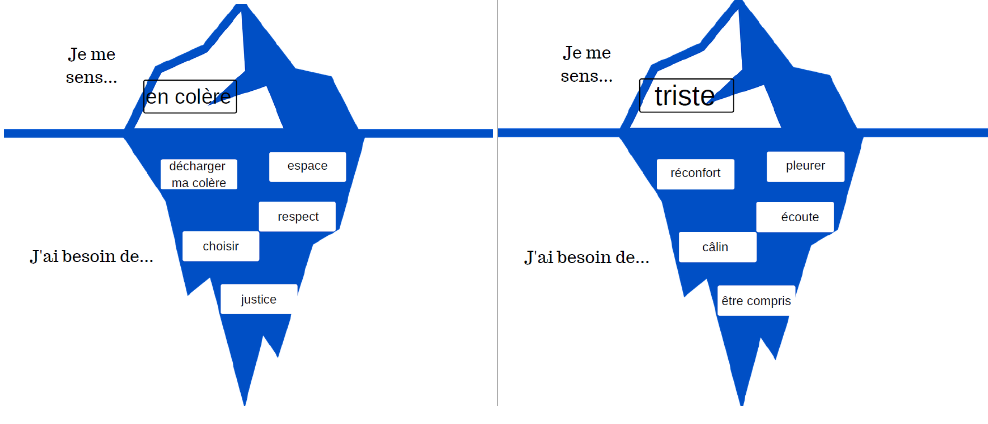
- Treat emotions as the visible tip of an iceberg above hidden needs.
- Words reduce acting out, because children no longer need to shout to be heard.
Raising Children's Awareness of Emotions
Before children can talk about feelings, they need to hear feelings being talked about. Everyday conversation is the starting point, and stories and films are ideal material. After reading a book together, you might ask: "In this story, would you say the hero feels angry, or maybe sad?" The vocabulary can grow gradually as the child does.
A second tool is offering a gentle hypothesis when a child seems to be struggling, while leaving room to be corrected. For example: "I hear you shouting at your sister. It really makes you angry when you ask her not to come into your room and she does it anyway." This gives the child words without imposing a verdict, and it respects the possibility that you have misread the situation.
These small moments of naming feelings are the foundation on which everything else rests. They also connect naturally with early language development, which you can explore in how children learn to speak step by step.
The Primary Emotions as a Shared Family Language
Once the primary emotions — joy, anger, sadness and fear — have entered everyday family language, the ground is prepared for more nuance. Until then, keep the words simple and repeat them often, so they become familiar rather than abstract.
It helps to remember that children pick up emotional vocabulary the same way they pick up any other language: by hearing it used naturally, not by being quizzed on it. If a child is shy or withdrawn, for instance, naming that experience calmly can be far more useful than commenting on it — a theme explored in a shy child and how to respond. Simple shared activities, such as snow games, can also give these words a natural place to surface.
Children also notice how the adults around them handle their own feelings. When we name our own states out loud, we model the very skill we hope to teach, and we show that emotions are normal rather than shameful. The same principle of patient, consistent guidance applies to dogs with high prey drive, who also respond best to calm, steady cues.

| Emotion | Lower intensity | Higher intensity |
|---|---|---|
| Anger | uncomfortable, irritated | furious, enraged |
| Sadness | disappointed, down | heartbroken |
| Fear | uneasy, worried | terrified |
| Joy | content, pleased | delighted, thrilled |
Enriching the Vocabulary of Emotions
An important next step is showing children that the same emotion does not always have the same intensity. Being angry is not the same as feeling uncomfortable, irritated, furious or enraged. Each word carries a slightly different weight, and learning to distinguish them helps children describe their experience with far more accuracy.
You can enrich this vocabulary in ordinary life in two ways: by using richer words to describe your own emotional state as an adult, and by reflecting your child's emotions back with empathy. A simple chart of emotional states, which is not exhaustive, can support this at home. Many parents find it useful to keep such a reference visible in the kitchen or playroom, so the words stay present in daily conversation.
It is worth noting that this process takes patience: children may understand a word long before they use it spontaneously, and that is perfectly normal.
Emotions and Needs Go Together
Emotions do not exist in a vacuum: they go hand in hand with needs. Identifying an emotion is most useful when it helps us find the need behind it. Naming a need opens up possible actions that can restore balance and help us keep going.
A helpful image is an iceberg, with emotions as the visible tip and needs as the submerged part. What we see on the surface points to something deeper that deserves attention. When a child is upset about a broken toy, the visible anger may sit above a need for comfort, fairness or a sense of control.
This is also why emotional literacy reduces the risk of violence: when words are available to name feelings, there is less need to act out in order to be heard and understood. The same principle applies to sibling conflict and to moments when children catch us losing our temper — see children catch us red-handed for a related perspective.
Putting Emotional Literacy into Practice Day by Day
Emotional literacy is not a lesson to be delivered once; it is a habit woven into daily life. Mealtimes, car journeys and bedtime are all natural openings for naming feelings, and a long drive is a surprisingly good setting for relaxed conversation — the ideas in car games travel can help keep the mood light.
Play offers another route. Role-play, drawing a feeling or acting out a story lets children explore emotions without pressure, and it connects well with creative activities such as children learn dance, where expression happens through the body. Choosing toys that invite pretend play can support this too, as you will see when browsing toys under twenty dollars for simple, open-ended options. Story time works in the same way, and our autumn stories give feelings a gentle seasonal frame.
Finally, be patient with yourself. Adults are learning this language alongside their children, and correcting yourself out loud is itself a useful model of emotional honesty. If your child loves a character-led adventure, try our Ninjago character quiz to spark talk about bravery and teamwork.

My hands-on take
In our home, the biggest change came from naming my own feelings out loud rather than asking my child to name hers. I started saying things like "I'm feeling a bit irritated right now, I need a quiet minute" instead of just going silent. At first it felt awkward, but it gave her a model to copy, and she began borrowing the words.
I also learned to soften my guesses. When I said "you seem angry" too confidently, I was often wrong, and she would shut down. Asking "is it more frustration, or something else?" worked far better. Keeping a short list of feeling words on the fridge helped us both, and I still correct myself out loud when I catch the wrong word.
Frequently asked questions
At what age can I start talking about emotions with my child?
You can start from the very beginning, simply by naming feelings in everyday language. The words become familiar long before a child uses them independently.
What if I guess my child's emotion wrong?
That is completely normal and even useful. Offer your guess gently and leave room to be corrected, so the child learns to identify the feeling for themselves.
Does naming emotions really reduce conflict?
It can help a great deal. When children have words for what they feel, they are less likely to act out in order to be heard and understood.
Do I need special materials?
No. Everyday conversation, stories and films are enough to begin. A simple chart of emotional words can be a helpful extra reference.
Product Reviews
 Best Toys for Dogs With High Prey Drive |
Best Outdoor Toys for 3-4 Year Olds |
Best Outdoor Toys for 6 Year Olds |
Best Harness for Poodle |
Best LEGO Sets for Adults |
Best Travel Toys for 4 Year Olds on Airplane |
Best Toy Stores in Washington DC |
Best Potty Training Toys |
Best Toys for Tripod Dogs |
Maillot equipe de france







