


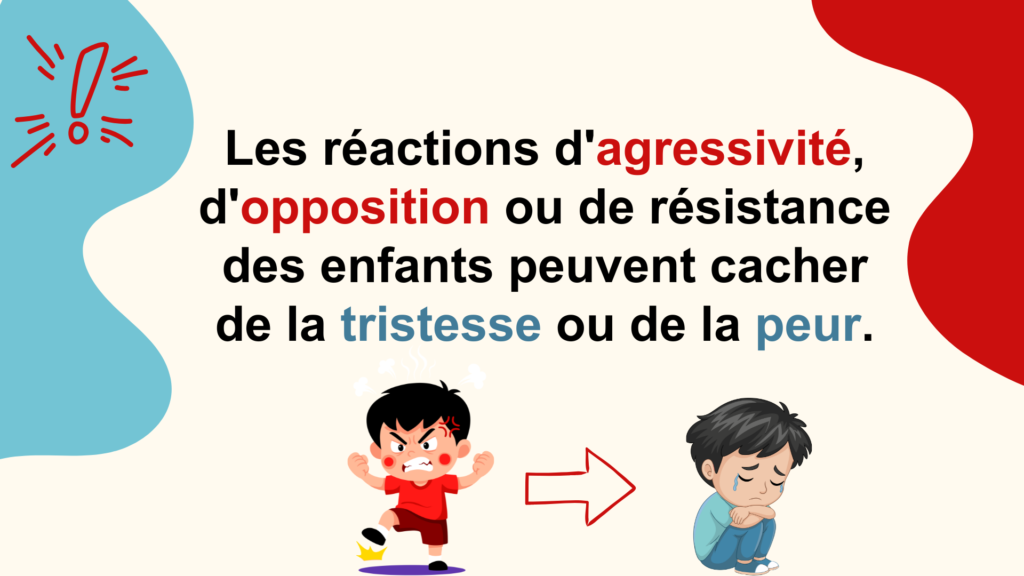
Aggression in children, along with opposition and resistance, often hides sadness or fear rather than simple defiance. When children face difficult or stressful situations, their emotions can take indirect forms that need to be decoded.
It is hard for children to find the words and the courage to say how they really feel in their heart, body and head. As adults, we can stay attentive to these roundabout signals so we can guide sad or anxious children toward greater well-being.

Quick takeaways
- Anger, refusal and fatigue often hide sadness or fear.
- Anxiety frequently appears as physical symptoms like trembling or a racing heart.
- Anxious children may avoid choices, new activities and the dark.
- Let anger run its course so tears of sadness can follow.
- Empathic words and calm presence matter more than correction.
- Persistent anxiety or aggression deserves professional support.
Sadness Hiding Behind Aggression
There is often sadness, fear, or both behind reactions of aggression, opposition or resistance. These feelings rarely announce themselves directly; instead they surface as anger, refusal, tiredness or boredom that seem out of proportion to the moment.
Your child may shout that a toy is stupid because it will not fit together, or flatly refuse to do homework or brush their teeth. They may claim to be too tired to play outside, complain of boredom, reject a snack they usually like, or bargain endlessly for ten more minutes of screen time.
Reading the Everyday Signals
None of these moments is proof of a "difficult" child. They are clues pointing to an emotion that has no outlet yet. Staying curious rather than corrective keeps the door open. If daily transitions are already a struggle, these car games can make shared routines calmer.
How Anxiety Shows Up in the Body
Anxiety also takes physical forms that need decoding. For some anxious children it is easier to describe a bodily pain than something indescribable, so a stomach ache or headache may speak for them.
Anxiety has a physical side: children may feel suddenly short of breath, break into cold sweats, tremble, or feel their heart racing. They may also burst into tears unexpectedly, without any obvious trigger.
Hesitation and Fear of the Dark
Anxious children can find it hard to make choices, state a position or commit to something new. They may ask the adults around them to act or ask questions on their behalf rather than risk exposure or failure. Some are genuinely terrified of the dark and imagine a string of catastrophes that keep them from falling asleep. Leaving a light on is a common request, yet it does not always calm the anxiety, and bedtime can become an exhausting obstacle course for everyone. Gentle baby sleep methods remind us that settling routines matter at every age, just as every baby breastfeeds in their own way.
| What you see | Possible hidden emotion | Supportive response |
|---|---|---|
| Anger over a toy or task | Sadness or frustration | Name the difficulty calmly |
| Refusing requests | Need for control or fear | Offer limited choices |
| Sudden tiredness or boredom | Overwhelm | Slow down, reconnect |
| Physical complaints | Anxiety | Acknowledge the feeling |
| Fear of the dark | Anxiety | Gentle bedtime routine |
Why Anger Needs Room to Run Its Course
Ideally, a parent can read the signs that another emotion is trying to express itself behind a child's frustration. That might sound like: "Wow, I get the feeling this is hard for you right now. Usually when you react like this, something is off. You're fed up and there is too much homework, right?"
For that to happen, a child must be allowed to live their anger fully and then to have tears of sadness for as long as they need, within a trusting relationship with a caring adult. The parent can walk that path alongside them with a hug, a tender gesture, silence, patience, or words like "I'm here" and "That's true, it is hard," depending on what the child accepts and seems to need.
Holding Your Own Emotions Steady
When a child is very angry and falls apart, tears will eventually come, and parents can hold on to that idea by letting the frustration be, without making things worse through punishment, lecturing or premature reassurance. It is genuinely difficult to handle a child's frustration and our own emotional control at the same time. Knowing which forms of aggression adults tend to normalize helps us respond with more awareness.
Everyday Moments That Deserve a Second Look
Daily life offers many small windows into a child's inner world. A child who suddenly cannot bear a sibling's choice, who clings at daycare drop-off, or who melts down at the end of a busy day is often signalling overload rather than misbehaviour. Naming what you notice, without judgment, gives the feeling somewhere to go.
Practical routines support this. Predictable mealtimes, quiet time after school and a calm bedtime help regulate emotions before they spill over. Even seasonal care matters: just as we protect children's feet from the cold with proper winter foot care, we can protect their emotional footing with steady, warm routines. Packing a summer bag with comfort items can also ease transitions on busy days.
Play as an Emotional Outlet
Play remains one of the safest ways for children to process fear and sadness. Building, drawing or role-playing lets a child act out what they cannot yet say, and it gives you a natural opening for conversation. Sorting and storing completed LEGO set storage together, for instance, becomes a quiet moment to talk, and knowing what LEGO can guide which sets to keep.

When to Seek Extra Support
Most of these reactions ease when children feel heard. But if anxiety or aggression persists, intensifies, or starts to interfere with sleep, school or friendships, it is worth speaking with a paediatrician or child psychologist. Seeking help is a sign of attentive parenting, not failure.
Meanwhile, small rituals of connection carry real weight: a few minutes of undivided attention, a shared story, a calm goodbye. These deposits of trust make it easier for a child to show you the sadness or fear underneath the noise. If you are expecting another baby, preparing the whole family calmly, much like choosing maternity swimsuits for yourself, is part of the same caring outlook.

My hands-on take
I remember a phase when my child would slam a puzzle piece down and declare the whole thing stupid. My first instinct was to correct the tone. What worked far better was sitting down and saying quietly, "It's frustrating when it doesn't fit, isn't it?" Almost every time, the anger gave way to a wobbly lip and then a cuddle.
I also learned to watch the clock. Meltdowns clustered at the end of busy days, so I started building in ten quiet minutes before homework. It did not remove the feelings, but it gave them somewhere gentler to land, and bedtime stopped feeling like a battle.
Frequently asked questions
Is aggression always a sign of sadness?
No, but sadness or fear often sits behind anger, opposition and resistance. Looking for the emotion underneath helps you respond to the cause rather than the behaviour.
How can I tell if my child is anxious rather than just tired?
Anxiety often shows physical signs such as trembling, sweating or a racing heart, and may include unexpected tears. Tiredness tends to ease with rest, while anxiety persists across situations.
Should I punish my child for angry outbursts?
Punishment, lecturing or rushing to reassure can make things worse. Allowing the frustration to exist, while staying calm and present, usually lets the underlying sadness surface.
When should I seek professional help?
If anxiety or aggression persists, gets worse, or disrupts sleep, school or friendships, speak with a paediatrician or child psychologist. Early support makes a real difference.
Product Reviews
 Best Toys for Dogs With High Prey Drive |
Best Outdoor Toys for 3-4 Year Olds |
Best Outdoor Toys for 6 Year Olds |
Best Harness for Poodle |
Best LEGO Sets for Adults |
Best Travel Toys for 4 Year Olds on Airplane |
Best Toy Stores in Washington DC |
Best Potty Training Toys |
Best Toys for Tripod Dogs |
Maillot equipe de france







