


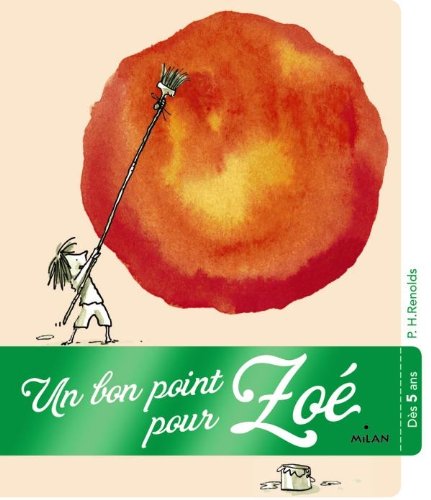
The Dot is a children's book written to encourage perseverance, give children the courage to express themselves and help them move past their fears. It works beautifully from around four or five years old.
No, no and no: Zoe has decided she simply cannot draw, and that is that. To prove the point, she jabs the tip of her marker hard against the paper and leaves a dot, a tiny dot of nothing at all. Her surprise the next day, when she finds that same little dot framed on the classroom wall, is where the story truly begins.

Quick takeaways
- Zoe believes she cannot draw until a teacher asks her to sign a single dot.
- The golden frame shows the child that her effort has real value.
- One small success releases a flood of creative experimentation.
- Zoe later encourages a younger boy with the same words and gesture.
- The book suits children from around four or five years old.
- It strengthens self-confidence and spreads kindness to others.
A Small Girl Who Has Given Up on Drawing
Zoe is a little girl who does not like drawing, or rather who has convinced herself she does not like it because she believes she cannot do it. Her teacher, Madame Chevalet, does not argue with her. Instead she invites Zoe to express herself in the simplest possible way: "Just draw a little dot, just to see."
Zoe grabs a marker and crushes the tip against the sheet. When Madame Chevalet looks at that small dot on the blank page, she does not criticise or correct it. She simply asks Zoe to sign it. That single request treats the dot as real work, and it changes everything. For parents who want to nurture this kind of quiet encouragement at home, these tips for children can help you notice small strengths instead of correcting every imperfect attempt. The same patient spirit applies to everyday tools, which is why it helps to know what makes a good comb for a child.
Why the Teacher's Reaction Matters
The adult does not praise the drawing itself. She honours the child's effort by asking for a signature, which quietly tells Zoe that what she made belongs to her and has value.

The Golden Frame That Unlocks Creativity
The following lesson, Zoe is astonished to see her picture hanging above Madame Chevalet's desk, surrounded by a golden frame. Seeing her own small dot displayed with such care, Zoe tells herself she could paint more of them. Her creativity is suddenly released: dots in every colour, big dots and small dots, mixtures of colours.
She discovers that she takes real pleasure in creating and that she can bring joy to others by showing her pictures. This is the heart of the book: a child does not need talent to start, she needs one adult who takes her seriously. If you are raising a child who thinks in unusual directions, these Montessori climbing toys and open-ended materials give that same freedom to experiment without a right answer. The same patient encouragement applies to children's knives in the kitchen and everyday independence.
From One Dot to Many
Each new dot is a small proof that she can do it, and the pleasure of making replaces the fear of failing. The frame is not a reward for a masterpiece; it is a signal that her effort was seen. As with sports and children, small steps build lasting confidence.

| Story moment | What the child learns | Simple home follow-up |
|---|---|---|
| The single dot | Effort counts, even when small | Offer a blank page with no instructions |
| The signature | What I make belongs to me | Let your child sign and date their work |
| The golden frame | My work has value to others | Display one picture where it can be seen |
| Many coloured dots | Trying again is enjoyable | Keep markers and paper within reach |
| Encouraging the boy | Kindness and confidence spread | Ask your child to teach you something |
Passing Kindness On to Another Child
Later, a little boy approaches Zoe with admiration: he would so love to be a great artist like her. Zoe answers, "I'm sure you can do it." She smiles and hands him a sketchbook, just as Madame Chevalet had done for her some time before. The boy eventually draws a wobbly line, and Zoe says mischievously, "Well, sign it now."
The circle closes: the child who was encouraged becomes the one who encourages. This is the quiet message of the story, that confidence spreads from person to person. The same spirit of patience and gentle routine shows up in these perfect books for routines, which help children feel secure enough to try new things.
Confidence That Travels
Zoe does not keep her new courage to herself. She recognises the same doubt in the boy and answers it with the exact words and gesture that once freed her.

A Classic That Invites Children to Prove Themselves
This book is a classic of English-language children's literature. It invites children to prove themselves, to move past their fears and to express themselves creatively through the encouraging gaze of caring adults. It is a book for strengthening a child's self-confidence and nudging them to discover the hidden artist inside, and also to spread kindness around them.
It suits children from four or five years old, and it reads well aloud in a calm moment. Pair it with a simple sketchbook and a few markers, and the message becomes something a child can act on the same afternoon. Families who like to keep learning playful often find ideas in these toys for tummy time for the youngest siblings while an older child draws, and even baby hiccups rarely interrupt a good drawing session.
What Makes It Last
There is no lecture and no moralising. The lesson arrives through a teacher's small gesture and a child's own discovery, which is why it stays with readers.

Reading It Together at Home
The story works best as a shared read. Stop on the page where the dot appears in its frame and ask your child what they think Zoe felt. Then offer a blank page and no instructions at all, and let whatever appears be signed and kept.
For children who resist creative activities, the pressure of "draw something nice" is often the real obstacle. Removing the goal, as Madame Chevalet does, is usually enough. A calm, unhurried setting helps too, and these toys for one year old ideas show how the right materials at the right age reduce frustration. Keep the emphasis on the doing, not the result, and the confidence tends to follow.

My hands-on take
I read this book with a child who had quietly decided she was "bad at drawing" and would push the paper away before even starting. What struck me was how little the teacher does: she does not teach technique, she just asks for a signature. So I tried the same thing, offering a page with no theme and asking only that she sign it when she was done. The first attempt was a scribble, and I framed it anyway.
The change was not instant, but over a few weeks she started asking for paper without being prompted. What I learned is that my own reactions mattered more than any activity I planned. Praising the effort rather than the result, and keeping a stack of finished pages instead of judging them, did more than any lesson. It is a short book, but it gave me a practical script for encouraging a child who is afraid to try.
Frequently asked questions
What age is The Dot suitable for?
It is generally recommended from around four or five years old, when children start comparing their work with others and can feel discouraged. Younger children can still enjoy the pictures and the simple story.
Is the book only about drawing?
No. Drawing is the vehicle, but the theme is broader: perseverance, self-expression, courage and self-confidence. The same message applies to music, sport, writing or any activity where a child fears failing.
How can I use the book at home?
Read it together, then offer a blank sheet and no instructions. Let your child sign whatever appears and display one piece somewhere visible, so the message moves from the page into daily life.
Does it push children to be talented artists?
Not at all. The point is that a child does not need talent to begin, only permission to try and one adult who takes the attempt seriously.
Product Reviews
 Best Toys for Dogs With High Prey Drive |
Best Outdoor Toys for 3-4 Year Olds |
Best Outdoor Toys for 6 Year Olds |
Best Harness for Poodle |
Best LEGO Sets for Adults |
Best Travel Toys for 4 Year Olds on Airplane |
Best Toy Stores in Washington DC |
Best Potty Training Toys |
Best Toys for Tripod Dogs |
Maillot equipe de france







