


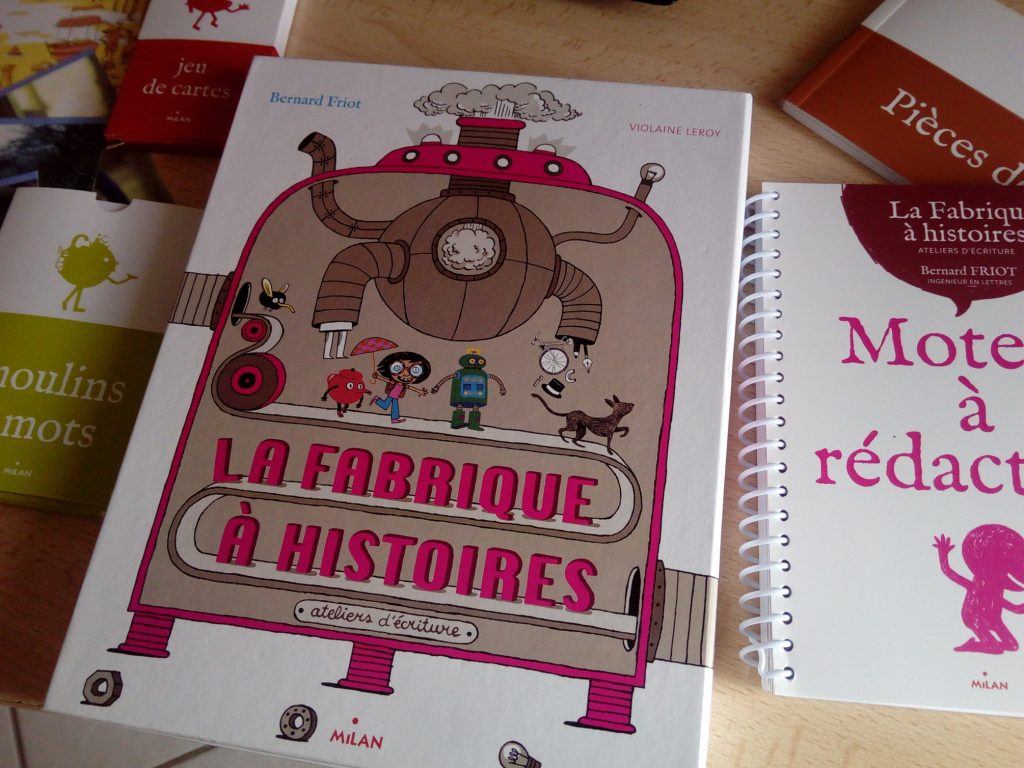
Story Factory is a creative writing toolkit built around a simple idea: children produce better stories when they are given ingredients instead of a blank page. Packed into a small case, it offers pictures, drawings, word cards, a notebook and sentence starters that work from the first year of primary school right up to the early years of secondary school.
The ideas inside are varied, funny and original, so the kit suits children who feel stuck for inspiration as much as those who already love inventing tales. Everything is designed to be used orally first, which matters: spoken language comes before written production, and demanding a full written text too early often backfires.

Quick takeaways
- A case of images, word cards, prompts and a notebook, not a single workbook
- Recommended from age six or seven through the early secondary years
- The writing engine guides a story step by step using the other tools
- Builds setting, character, problem, suspense and point of view separately
- Works orally first, which suits children who dislike writing
- Flexible enough for home education, siblings and short sessions
Inside the Story Factory case
Story Factory comes as a case holding a whole set of materials rather than a single book. You will find images, drawings, word cards, a notebook and sentence starters, all meant to be pulled out and combined freely. The variety is what makes it last: a child who is bored by one prompt will click with another.
Because the ideas are funny and offbeat, the kit works for reluctant writers and eager storytellers alike. Children who lack inspiration get a starting point; children who love inventing get new constraints to play with. If you want to keep the playful spirit going between sessions, a look at Rubik's cube shows how a simple object can hold attention for hours.
From age six upwards
The material is recommended from six or seven years old and remains useful through the end of primary and into secondary school, since the same cards can support a very simple oral story or a far more elaborate written one.
The writing engine at the heart of it
The writing engine is the main element of the kit: an activity notebook that guides a child through building a story step by step, picking up the ingredients it needs from the other tools. Activities revolve around themes and techniques children genuinely enjoy, such as two images showing a beginning and an end with the middle left to invent, or silly text openings to complete.
Other prompts ask a child to describe a character, to retell the same story from a different point of view, or to draw and pair word cards. Each activity targets one building block of narrative rather than the whole story at once, which keeps the task manageable. Parents who want to extend this kind of guided play at home will find more ideas in home experiments that follow the same learn-by-doing logic.
| Tool | What it is | Skill it builds |
|---|---|---|
| Writing engine | Activity notebook | Step-by-step story structure |
| Catalogue | Gallery of characters and places | Choosing heroes and settings |
| Card game | Situation cards | Openings and plot twists |
| Game board | Setting with moving characters | Pacing and danger |
| Word mill | Word prompts | Dialogue and language registers |
The supporting tools in the box
Around the writing engine sit several smaller tools, each with its own role. A catalogue offers a gallery of characters to choose heroes, places and situations from; a card game lets children flip situations around and try different ways of opening a story. A game board lets them move characters across a setting, put them in danger, help them and invent a route.
A reservoir of real material, including postcards, identity photos and panoramas, means you are never short of inspiration. Detached pieces include a sketch booklet for cutting a story into stages and pushing it forward, while a word mill helps characters speak and lets children play with registers of language. A reserve of sample texts shows what other children produced with the same tools.
If your child prefers building to writing, hands-on kits make a natural bridge; our guide to toddler toys and the wider world of outdoor toys both show how physical play feeds imagination.
What children actually practise
Story Factory targets the specific skills that make a story work. Children practise setting a scene with as much detail as possible, then introducing a character with physical traits and personality. From there they imagine problems and unexpected events, hold back information to build suspense, switch point of view, and relaunch the plot with "what if" questions.
These are the same bones you would find in any structured narrative: who, when, where, a problem, complications, an ending and a return to a stable situation. Working on them one at a time, orally and then in writing, is far less intimidating than facing a whole text. The same principle of small, repeatable steps appears in sports and children, where steady practice beats occasional bursts.
Oral work first
Speaking the story before writing it lets a child test structure and vocabulary without the burden of spelling and handwriting. Only once the oral version holds together is it worth asking for a written text.

Using it with a reluctant writer
A child who dislikes writing can still build rich stories if the pressure comes off the page. Start with oral storytelling supported by character, problem and magic-object cards, and only move to the notebook once the spoken version flows. The kit's images and word cards give a child something concrete to point at and describe.
Short sessions work better than long ones, and it helps to let the child choose which tool to use that day. Some days that means the board, other days the word mill. Keeping the mood light matters more than finishing an activity. For families juggling routines, the scheduling ideas in work schedule can help carve out a regular slot, and happy family habits support the relaxed atmosphere these sessions need.
Where it fits in family life
Story Factory is a flexible companion rather than a curriculum. It suits home education, after-school sessions, rainy afternoons and long journeys, since the whole kit packs into a case. Siblings of different ages can use the same cards at different levels, which makes it good value for a household.
Pair it with other creative play: a themed party game, a building project or a simple science activity all give children raw material to turn into stories afterwards. Our piece on Disney birthday ideas shows how a narrative theme can organize a whole afternoon, and toys for 18 month old reminds you that even the youngest siblings can join in with picture-led storytelling.


My hands-on take
I have used this kit with a primary-age child I support in home education, a boy who genuinely does not enjoy writing. We had already worked on story structure out loud, using hero, problem, ally and magic-object cards to help him resolve a plot, so the Story Factory felt like a natural next step.
For now we still work orally, and I would not rush that. Watching him describe a setting or invent a "what if" twist tells me far more about his grasp of narrative than a written page would. When he does start writing, the notebook will already be familiar territory.
Frequently asked questions
What age is Story Factory for?
It is recommended from six or seven years old and stays useful into secondary school, because the same prompts can support a simple oral story or a longer written one.
Does my child need to write well to use it?
No. The kit works orally first, and many activities are about describing, choosing and telling rather than writing, so reluctant writers can take part from day one.
Can several children use it at once?
Yes. The cards, board and word mill are easy to share, and siblings of different ages can work from the same material at their own level.
How long should a session last?
Short sessions of fifteen to twenty minutes tend to work best, focusing on one tool or one story element at a time rather than trying to finish a whole story.
Product Reviews
 Best Toys for Dogs With High Prey Drive |
Best Outdoor Toys for 3-4 Year Olds |
Best Outdoor Toys for 6 Year Olds |
Best Harness for Poodle |
Best LEGO Sets for Adults |
Best Travel Toys for 4 Year Olds on Airplane |
Best Toy Stores in Washington DC |
Best Potty Training Toys |
Best Toys for Tripod Dogs |
Maillot equipe de france







