


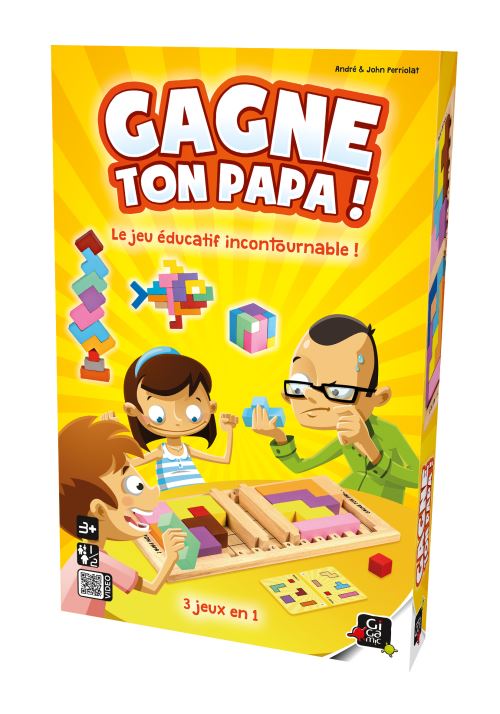
Gagne ton papa is a wooden block strategy game that had been on my radar for a while, and I finally gave in at the start of the holidays. It turned out to be every bit as good as I hoped: a logic and spatial-reasoning game built around simple wooden pieces.
Apart from the name (the game also exists as Gagne ta maman, and honestly it could simply have been called Beat Your Parents), we loved everything about it. It is perfect for small and big thinkers alike, and it starts from age three.

Quick takeaways
- One wooden block set offers three logic games: filling spaces, reproducing 3D figures, and the Houdini cube trick
- Graded cards let children compete on equal footing with adults, so no pretending to lose
- Many puzzles have several valid solutions, which builds flexible, divergent thinking
- The open-ended pieces invite free building, balancing and symmetry play
- Adult duel cards let parents enjoy the puzzles on their own
- Suitable from age three, with difficulty that grows alongside the child
Three logic games in one box
The real strength of Gagne ton papa is that one set of wooden blocks supports three distinct kinds of challenge, and arguably an endless number of variations once you start improvising. You can fill a defined space with a given number of pieces, either in a duel against another player or solo. You can reproduce figures in three dimensions, like a Tangram, building upward from a model or laying pieces flat to match a picture.
And then there is the Houdini cube, a small magic trick where you remove a piece without changing the cube's outward appearance. That little illusion is a lovely hook for curious kids, and it keeps the box feeling fresh long after the first few puzzles are solved. It also pairs well with other budget friendly toys that reward patience and problem-solving.
Duel or solo, the choice is yours
Because every challenge works both as a head-to-head race and as a quiet solo puzzle, the game adapts to the mood of the moment. Some days call for competition, others for calm concentration at the kitchen table. Either way, it sidesteps the pressure tactics of hooligan parents and lets kids enjoy the challenge on their own terms.

Children can genuinely win against adults
One of my favourite things about this game is that children have just as much chance of winning as their parents. There is no need to hold back or pretend to lose: a system of cards at different levels means kids can truly beat the grown-ups, which is why the name is well chosen after all. For more on raising children who feel capable and confident, see this piece on parental allies. If you want to keep the learning playful, these online games are worth a look.
Many puzzles also accept several valid solutions. When my daughter finds the right arrangement quickly (faster than me, in other words), I invite her to look for another way to place her cubes. I do the same when I finish first. It softens the winner-loser dynamic and gently develops divergent thinking.
Progression that grows with the child
Each game offers graded difficulty, with models and cards colour-coded according to the rulebook. You can start at three and keep adding challenge, so boredom never really sets in. For little ones drawn to capes and heroes, these superhero toys pair well with this kind of play.

| Feature | What it offers | Good for |
|---|---|---|
| Space-filling puzzles | Place a set number of pieces in a shape | Logic and planning |
| 3D figure building | Reproduce models upright or flat | Spatial reasoning |
| Houdini cube | Remove a piece invisibly | Curiosity and fun |
| Graded cards | Colour-coded difficulty levels | Ages three and up |
| Adult duel cards | Head-to-head puzzles for grown-ups | Parent play |
| Free building | Houses, towers, animals, shapes | Creativity and balance |
Open-ended material for endless building
The pieces invite a multitude of model-free constructions: houses, towers to balance, animals, flat reproductions of geometric shapes. You move from vertical to horizontal, mix the two, play with balance and symmetry, test, compare, and if it all falls down, the fun is in starting again differently.
This open-ended quality is what makes a simple wooden toy so durable. If you are building a collection of toys that reward experimentation, these Montessori toys follow the same philosophy of hands-on discovery.
There is also an irresistible urge, once the children are in bed, for parents to play against each other. Special adult duel cards make that possible, and I have tested it with other grown-ups over a good long puzzle session.

A gentle introduction to geometry and scientific thinking
Children work both flat and in volume, so they are quietly introduced to three-dimensional thinking. To solve the game's problems they must anticipate, trial and error, check, build, undo and rebuild, and copying from the opponent is simply impossible. Those are the very principles of the scientific approach.
That habit of testing an idea and revising it is valuable far beyond the game table. It is the same patience children need when they learn to write, where trying, crossing out and starting again is part of the process. Parents looking for more support can turn to motherhood blogs for everyday encouragement.
Where to find it
Gagne ton papa and Gagne ta maman are available in toy libraries, toy shops and online retailers. If you enjoy logic and strategy, Blokus is another family favourite worth a look, and a simple cardboard box can extend the play even further, as this piece on a box of play shows. Families who want to set clear screen-time rules may also like this mobile phone contract idea.



My hands-on take
I bought Gagne ton papa at the start of the holidays after eyeing it for a while, and we have played it almost every day since. What surprised me most is how naturally it levels the field: my daughter solves some arrangements faster than I do, and I genuinely have to concentrate to keep up.
My favourite habit now is asking for a second solution once a puzzle is solved, whoever got there first. It turns a quick race into a longer conversation about shapes, and it takes the sting out of losing. When the children are asleep, the adult duel cards come out, and I have happily lost a few evenings to the Houdini cube.
Frequently asked questions
What age is Gagne ton papa suitable for?
The game is designed for children from age three, and the colour-coded cards and models add difficulty as players grow. Adults enjoy it just as much, so it works as a whole-family game.
Can young children really beat their parents?
Yes. The graded card system means children are not automatically disadvantaged, so parents do not need to let them win. That makes victories feel genuine for everyone.
Is it only a competitive game?
No. Every challenge can be played solo as a puzzle, and the blocks support plenty of free building without any model at all. Many problems also accept more than one correct solution.
Do parents need to supervise constantly?
Not really. Once the rules are understood, children can puzzle independently, though the Houdini cube trick usually needs a first demonstration. It is an easy game to leave out on the table.
Product Reviews
 Best Toys for Dogs With High Prey Drive |
Best Outdoor Toys for 3-4 Year Olds |
Best Outdoor Toys for 6 Year Olds |
Best Harness for Poodle |
Best LEGO Sets for Adults |
Best Travel Toys for 4 Year Olds on Airplane |
Best Toy Stores in Washington DC |
Best Potty Training Toys |
Best Toys for Tripod Dogs |
Maillot equipe de france







