


A child in crisis needs two things above all: movement and connection. When emotions run high, our first instinct is often to hold the child still, to stop them from running or hitting. Yet what actually helps is letting the body discharge the emotion while a calm, trusted adult stays close.
This article walks through what a dysregulated child truly needs, how to help them name what is happening in their body, and how play can channel aggression safely. It also looks at the needs of the parents standing beside them.

Quick takeaways
- A child in crisis needs movement and connection more than restraint.
- Redirect hitting without hurting; avoid squeezing a child to block all movement.
- Welcome trembling and crying: they help the body discharge stress.
- Name body sensations with curious, specific questions.
- Use listen-play and roughhousing to release tension through laughter.
- Parents need support and calm too; trade off when you can.
Why connection calms a child in crisis
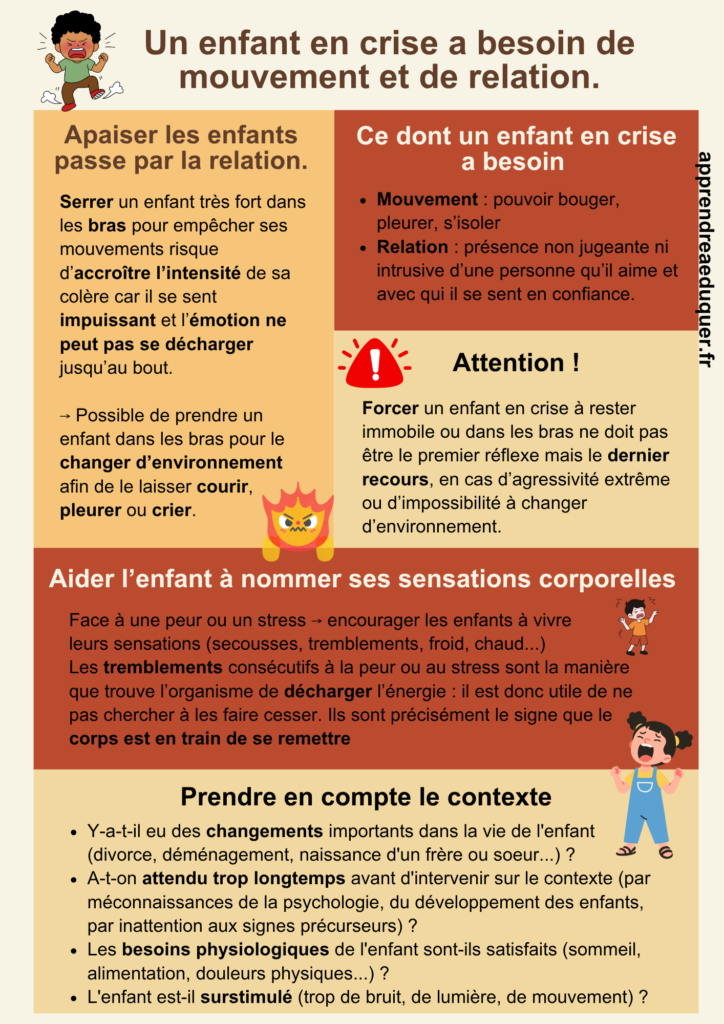
When a child is in emotional crisis, adults often try to contain them to prevent flight or hitting. But a child in crisis needs both movement and relationship: the freedom to move, cry or withdraw, and the non-judging, non-intrusive presence of someone they love and trust.
If a child tries to hit, stop or redirect the gesture without hurting them rather than hitting back or shouting. Squeezing a child tightly to block all movement can intensify anger, because they feel powerless and the emotion cannot discharge. Holding a child is acceptable to change environment, so they can run, cry or shout elsewhere. Forcing stillness should be a last resort, reserved for extreme aggression or when no space is available. This sits at the heart of positive discipline practice.

Let trembling and crying do their work
Shaking after fear or stress is the body's way of discharging energy. Welcome those tremors instead of trying to stop them; they signal that the body is recovering. Trembling and crying are normal and help a child release the shock, so let children cry, including after a tantrum. Accompanying anger allows sadness to emerge, and that sadness marks mourning and acceptance.
Facing fear or stress, encourage children to stay with physical sensations such as shaking, feeling cold or hot. A rich vocabulary for sensations helps them read the body's messages, recognise their influence and use them to decide well. Humans of any age benefit from expressing precisely what happens inside. If your child struggles to describe it, ask gentle questions: how does your belly feel, your throat, your chest? Is it tight, is there a hollow feeling, are your muscles hard? You might notice they are restless, trembling, hands cold, and ask whether the cold is elsewhere too.
| Situation | Helpful response | Avoid |
|---|---|---|
| Child tries to hit | Stop or redirect the gesture gently | Hitting back or shouting |
| Child is angry and restless | Change environment so they can move, cry or shout | Forcing them to stay still |
| Child trembles or cries | Stay close and let it happen | Trying to stop the tears |
| Child cannot describe feelings | Ask about belly, throat, chest, muscles | Ignoring the body |
| Child refuses touch | Stay nearby, watch for a change of mind | Forcing a hug |
Stay close, then notice the shift
Remain near the child calmly, offering a warm, supportive, containing presence, with a hug if the child accepts one. Respect their wish not to be approached or touched, staying open to signs that they have changed their mind and are ready for contact. After a few minutes, point out changes in the body: has the temperature of their hands changed, has the choking feeling eased, what does the hollow feel like now?
Welcoming and naming sensations is a key relational skill. Sensations indicate the nature and intensity of emotions, and knowing they are not dangerous and do pass helps a child avoid collapsing, panicking or turning to violence. Naming our own sensations matters too, so ignored feelings do not harden into trauma. Parents carrying their own stress may find support in happy couple habits and family happiness keys.

Listen-play and roughhousing to channel aggression
Patty Wipfler, founder of the Hand in Hand approach, coined "listen-play": a form of listening where parents show they want to know what the child thinks and feels by giving them the most powerful role in the game. It lets children show worries in a non-painful, non-violent way.
As Wipfler explains, a key to deep listening is an active response quite different from ordinary play. When you take the role of the smaller, less competent one, your child feels confident enough to show thoughts and feelings about important matters. As the listener, you look for chances to help them resolve tensions through laughter. Roughhousing games channel aggression the same way, and if hitting persists, see controlling aggression for more ideas.
What parents need while a child is in crisis
Parents need support too. Staying regulated while a child screams is demanding, so trade off with a partner when possible and give yourself permission to step back briefly. A calm adult is the containing presence the child borrows until their own calm returns.
Small daily routines protect everyone's reserves. Organising the home reduces friction, as these home organisation tricks suggest, and understanding sleep helps too, since tiredness fuels big reactions, as this guide to naps explains. When a child is frightened about separations, this nursery reassurance piece is useful, and for school-age worries, teen test anxiety offers perspective. Parents of babies juggling everything may enjoy motherhood then, while a simple shared craft, like these Father's Day crafts, rebuilds connection after hard days.

My hands-on take
I remember the first time I stopped trying to pin my daughter's arms during a meltdown. Instead I carried her to the garden and simply stood nearby while she stomped and cried. It felt wrong at first, like I was doing nothing, but the storm passed faster than it ever had when I held her still.
Later I started asking about her body: where does the anger sit, is your chest tight, are your hands cold? She began answering, and those answers became our way back to calm. I also learned to say when I needed a break, handing over to my partner. That small honesty changed everything.
Frequently asked questions
Should I hold my child tight during a tantrum?
Not as a first reflex. Tight holding can increase anger because the child feels powerless. Use holding mainly to move them somewhere they can move freely, and reserve restraint for extreme aggression or when no other space is possible.
Is it bad to let my child cry?
No. Crying, including after a tantrum, helps release tension, and allowing sadness to surface supports acceptance. Stay close and calm rather than trying to stop the tears.
How do I help a child who cannot describe their feelings?
Ask simple, concrete questions about the body: how the belly, throat or chest feels, whether muscles are tight, whether hands are cold. Naming sensations gives clues about the emotion and shows that sensations pass.
What is listen-play?
It is a playful form of listening, developed by Patty Wipfler, where the parent takes the less powerful role so the child feels safe to show worries. Laughter during the game helps release tension.
Product Reviews
 Best Toys for Dogs With High Prey Drive |
Best Outdoor Toys for 3-4 Year Olds |
Best Outdoor Toys for 6 Year Olds |
Best Harness for Poodle |
Best LEGO Sets for Adults |
Best Travel Toys for 4 Year Olds on Airplane |
Best Toy Stores in Washington DC |
Best Potty Training Toys |
Best Toys for Tripod Dogs |
Maillot equipe de france







