


Positive discipline offers a simple but demanding answer to the question every parent asks: how do I get my children to listen? The usual reflex is to order, explain or deliver a moral lesson, yet these habits often produce resistance rather than cooperation.
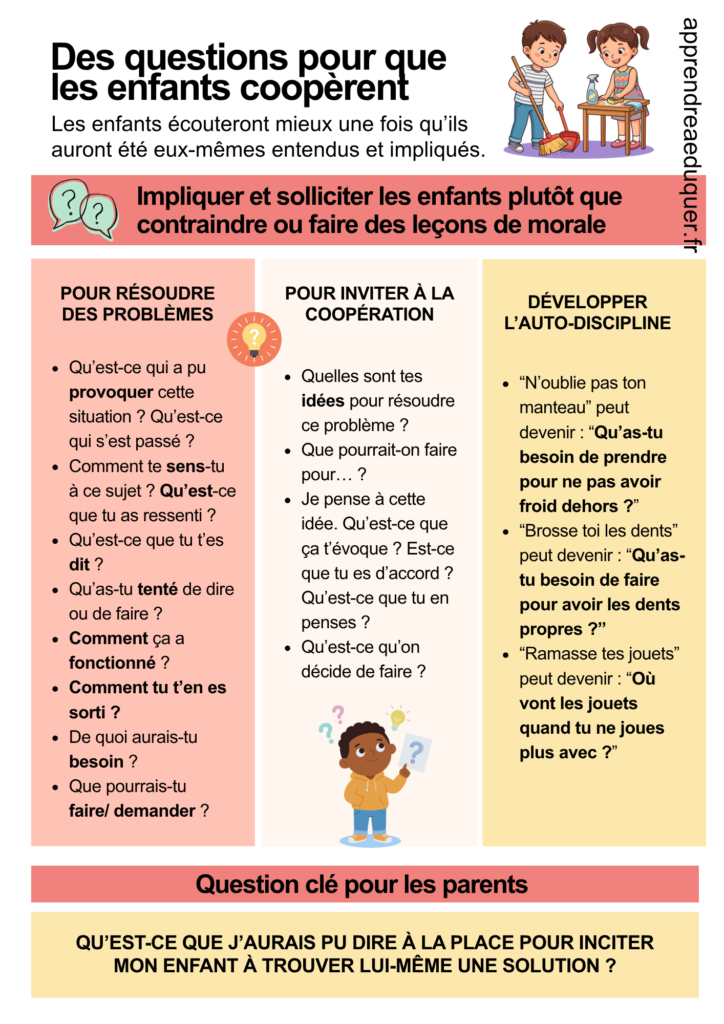
Jane Nelsen, author of the book Positive Discipline, suggests replacing orders, explanations and moral lessons with questions put to the child. Her core idea is that the key to discipline is listening to children: they listen to us more readily once they have been heard and involved themselves.

Nelsen even suggests dropping a coin in a jar every time we order, explain or lecture, simply to see how much we "tell" instead of involving. The key question for a parent becomes: what could I have said instead to encourage my child to think for themselves and find their own solution?
Quick takeaways
- Replace orders, explanations and moral lessons with genuine questions.
- Children listen better once they feel heard and involved.
- Use a sequence of questions to help a child solve a problem.
- Offer your own idea, then ask what the child thinks of it.
- Rewrite everyday orders as questions that prompt thinking.
- Expect a gradual shift, not perfection, in your own habits.
Questions to help children listen and cooperate
The shift is small on paper and large in practice. Instead of announcing a solution, you invite the child to describe what happened and to reason through it. This works well with shy child moments too, where a gentle question feels safer than a public instruction.
Nelsen's problem-solving questions follow a natural sequence. You ask what may have triggered the situation and what actually happened, then how the child feels and what they felt. Next comes what they told themselves, what they tried to say or do, and how that worked out.
Closing the loop
The sequence ends with reflection rather than judgement: how did you get through it, what do you need, and what could you do? These questions build the habit of self-review, and they pair well with calm routines such as positive sleep phrases at bedtime.
Inviting cooperation instead of demanding it
Once a child has described a problem, cooperation becomes easier to request. You can ask directly for their ideas: what are your ideas for solving this problem, or what could we do about it? The word "we" matters, because it places parent and child on the same side.
Nelsen also suggests offering your own idea and then handing the floor back: I am thinking of this idea, what does it bring up for you, do you agree, what do you think? The child is invited to weigh in rather than comply.
Finish with a decision question: what are we deciding to do? A shared decision carries more weight than an instruction, and it works alongside everyday cooperation habits such as clothing name labels for nursery or school items. The same collaborative spirit applies when you make tie dye t shirts together, and it is worth avoiding Machiavellian toys that undermine trust.

| Order | Question version | Skill it builds |
|---|---|---|
| Don't forget your coat | What do you need to take so you are not cold? | Anticipation |
| Brush your teeth | What do you need to do for clean teeth? | Self-care |
| Pick up your toys | Where do the toys go when you finish? | Organisation |
| Stop that right now | What happened, and how do you feel? | Emotional awareness |
| Do it this way | What are your ideas for solving this? | Problem-solving |
Turning orders into questions for self-discipline
The most practical part of the approach is rewriting familiar orders as questions. "Don't forget your coat" can become "what do you need to take so you are not cold outside?" "Brush your teeth" can become "what do you need to do to have clean teeth?"
"Pick up your toys" can become "where do the toys go when you are not playing with them?" Each version keeps the same goal but hands the thinking back to the child, which is how self-discipline develops over time.
Why it works
A question forces the child to picture the outcome and choose an action, while an order only requires obedience or resistance. The same principle supports early language work, so speech therapy toys that prompt a child to respond fit naturally here.
Keeping the tone calm and the questions honest
Questions only work when they are genuine. A question loaded with a known answer, or delivered in a sharp tone, is an order in disguise, and children spot it quickly. Slow down, keep your voice level, and accept the answer you get.
It also helps to pick your moments. Asking a tired or hungry child to reason through a conflict rarely goes well, whereas a quiet moment after the storm is ideal. Some families find that home science experiments build the same questioning habit in a low-stakes, playful setting. The same patient listening matters when he calls asking.
Finally, expect repetition. You will still order and lecture sometimes, and that is normal; the goal is a gradual shift in balance rather than perfection.
Using questions in daily routines and play
Routines are the easiest place to start because the goal is already clear. Mealtimes, getting dressed and tidying up all offer natural openings for a question instead of a reminder, and the child can then own the next step.
Play is another good training ground. Open-ended toys invite a child to decide and explain, and cause and effect toys reward a child for predicting what will happen next. Craft sessions work the same way when you ask what they plan to make before handing over materials.
Outdoors, a simple "what do we need to take?" replaces a checklist, and spring season changes give you fresh, concrete things to talk through together. The more often a child is asked, the more fluent their answers become.
What to do when questions are refused
Not every child answers on the first try, and silence is not defiance. You can offer a choice between two options, name what you notice, or simply wait and return to the conversation later. Sometimes the child needs to be heard first before they can think out loud.
If a question clearly irritates your child, drop it and switch to a short, neutral statement of the limit. Questions are a tool for cooperation, not a test, and they should never become a way of trapping a child into the answer you wanted.
Keep the long view in mind: the aim is a child who can reason, decide and recover from mistakes, and that capacity grows slowly through many small conversations rather than one perfect exchange.

My hands-on take
I started with one routine only: the morning coat-and-shoes scramble. Instead of announcing what to grab, I began asking what my child needed to take so as not to be cold outside. The first few mornings produced blank stares, and I nearly gave up and went back to issuing orders.
What changed things was waiting. I stopped filling the silence and let the question sit while I finished my own preparations. Within a couple of weeks, the answer started arriving on its own, sometimes with an extra item I had not thought of. I still forget and bark instructions when we are late, but the question has become my default, and the mornings are calmer for it.
Frequently asked questions
Does this mean I should never give my child an instruction?
No. Clear limits and short instructions still matter, especially for safety. The point is to shift the balance so that questions become a regular habit rather than a rare exception.
What if my child does not answer my question?
Silence is common at first, particularly with a tired or upset child. Offer a choice of two options, give them time, and come back to the conversation later instead of pressing for an answer.
Is this approach only for older children?
The wording needs to be simpler with younger children, but the principle holds. Even a toddler can be asked what they need to take outside or where a toy belongs.
How long does it take to see a change?
It varies from family to family, and progress is gradual. The realistic goal is a slow shift in how often you ask rather than a sudden transformation.
Product Reviews
 Best Toys for Dogs With High Prey Drive |
Best Outdoor Toys for 3-4 Year Olds |
Best Outdoor Toys for 6 Year Olds |
Best Harness for Poodle |
Best LEGO Sets for Adults |
Best Travel Toys for 4 Year Olds on Airplane |
Best Toy Stores in Washington DC |
Best Potty Training Toys |
Best Toys for Tripod Dogs |
Maillot equipe de france







