


When a child won't talk and freezes into silence after an emotional hurt, an argument or a clumsy moment, it can feel alarming. Many parents wonder how to help a child who doesn't want to confide without forcing words or damaging the bond.
The good news is that talking is only one channel of communication. Behaviour, gestures and even silence carry meaning, and once we learn to read them as emotions and needs, we can respond far more helpfully than by pressing for explanations.

Quick takeaways
- Behaviour, gestures and silence are communication; decode them as emotions and needs.
- Respect a child's need to withdraw, and state your availability without pressure.
- Offer drawing, storytelling cards and therapeutic tales as indirect routes to feelings.
- Use play with dolls, figures or bricks to let a child replay and master a difficult scene.
- Model how you handle vulnerability and solve problems; children copy what they see.
- Keep the door open with low-pressure, side-by-side moments rather than interrogations.
Treating Behaviour as Communication
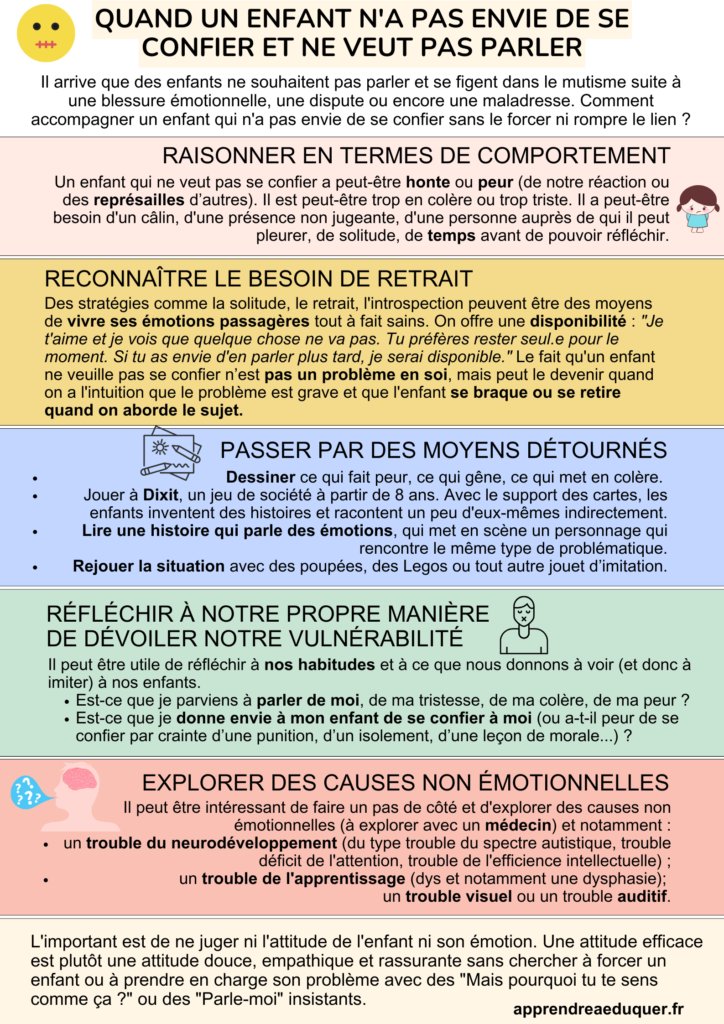
Communication does not always happen through words. Behaviour, gestures and silences are also forms of communication, and our job is to decode them in terms of emotions and needs. A child who refuses to confide may be ashamed or afraid, perhaps of our reaction or a punishment. They may simply be too angry or too sad to speak.
What they need might be a hug, a non-judgemental presence, someone beside whom they can cry, solitude, or time to release angry energy before they can think. Thinking this way gives us access to the emotions and needs underneath the behaviour instead of sliding into a power struggle.
Avoid the Interrogation Trap
Phrases like "Tell me", "Why won't you talk to me?" or "If you don't tell me what happened, I can't help you" push a child into defending themselves. Reading a sulk as a kind of language, rather than an attack on us, changes everything about how we respond.

Respecting a Child's Need to Withdraw
Solitude, withdrawal and introspection can be perfectly healthy ways of living through passing emotions. Here the task is not to force the child but to guarantee space and quiet time while making our availability clear. Something like: "I love you and I can see something is wrong. You'd rather be alone for now. If you want to talk later, I'll be here for you."
Kind listening is not about dragging information out of a child at any cost, and children are entitled to their private garden. A child not wanting to confide is not a problem in itself. It becomes one when we sense the issue is serious but the child clams up or retreats whenever we raise it. After all, children need our gaze to build themselves.
Watch for the Serious Signs
If you are worried, keep the door open gently rather than pushing harder. Regular, low-pressure moments together often do more than a single serious conversation, and some families find that a calm talk about teenager grief support helps when a loss is involved. It also helps to know how often new sets arrive, so shared rituals stay fresh.
| Approach | Best for | What the adult does |
|---|---|---|
| Non-judgemental presence | Shame, fear, sadness | Stays close, says "I'm here if you want to talk later" |
| Drawing | Young children, unclear feelings | Offers paper, asks open questions about the picture |
| Storytelling cards | Children 8 and up, indirect talk | Invites stories, listens without interpreting |
| Replay play | After an argument or upset | Introduces the scene, lets the child decide the ending |
| Modelling | Children who hide sadness | Names own feelings calmly, shows how problems get solved |
Using Indirect Routes to Reach Feelings
Children, especially younger ones and those who lack the vocabulary for emotions, often cannot put feelings into precise words. This is harder still because young brains are immature, and even older children, teenagers and adults lose access to the thinking brain under strong emotion.
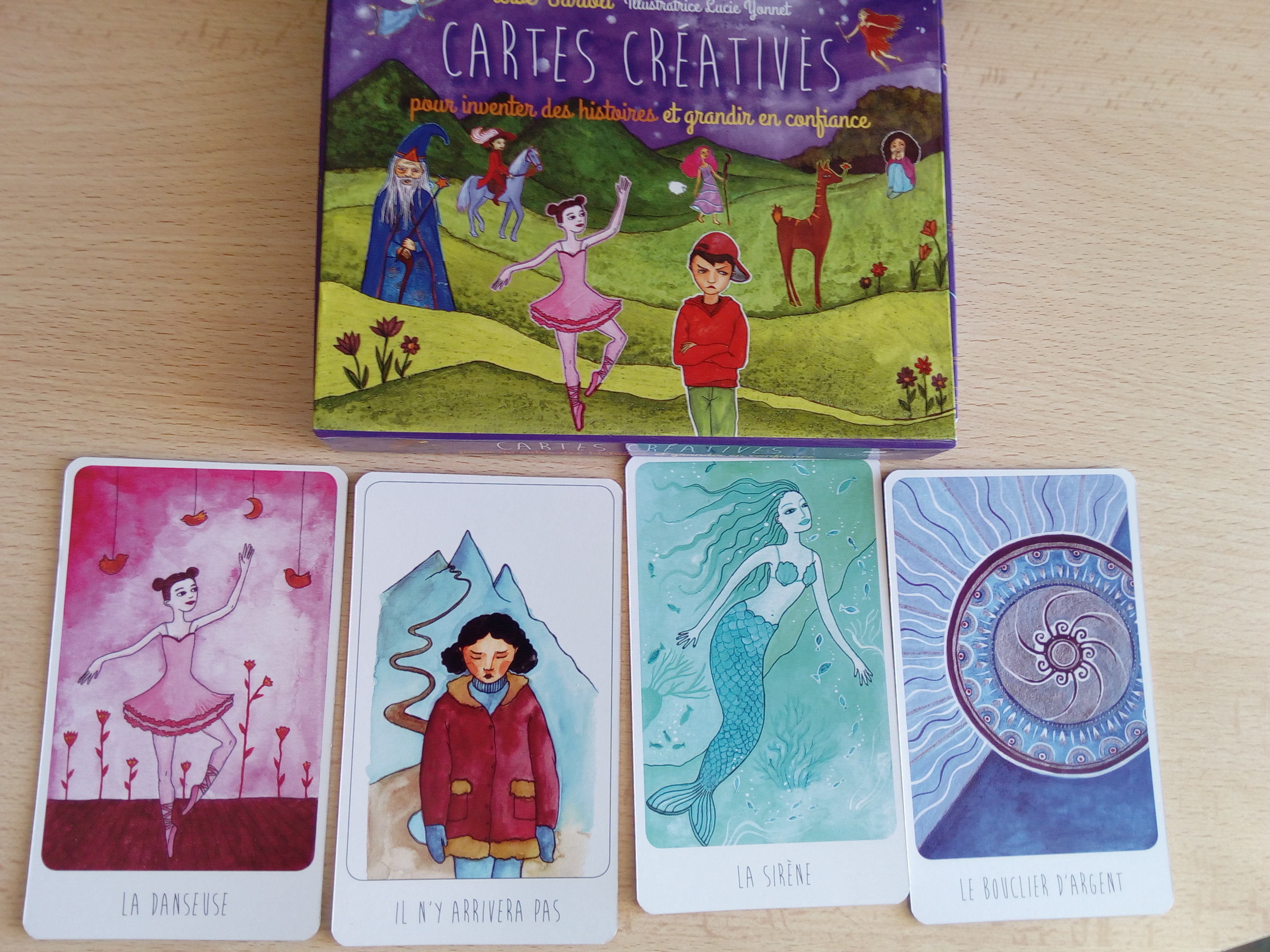
A child can draw what frightens them, bothers them or makes them angry. Drawing is already a way of releasing emotion, and it gives adults a support for starting a conversation. Board games help too: a storytelling game with beautifully illustrated cards invites players to become storytellers, and with the cards as support children invent stories and reveal a little of themselves indirectly.
Creative Cards and Therapeutic Tales
Creative card sets work on the same principle of self-narrative, inviting the child to build tales around their own issues. By identifying with the heroes, the child intuitively replays scenes from their life, externalises inner conflicts and explores new strategies. Positive endings help them project into future experiences while bringing calm, confidence and autonomy.
Stories are another route: read a book about emotions featuring a character facing the same kind of problem, or invent a therapeutic tale tailored to the child's experience. You can also tell a story together, with the adult setting a scene deliberately designed so the child can continue it.
Play as a Way to Untangle Difficult Situations
Parent-child play is remarkably effective for loosening stuck situations. Play lets a child recover from a upset by replaying it, express painful zones where they felt stupid, humiliated or incapable, and refill their attachment tank. Replaying the situation with dolls, small figures, building bricks or any imitation toy can help.
Without forcing a particular scene, you can introduce the events during play and let the child decide what follows: ignore them, amplify them, or transform them. One specialist in playful parenting describes a mother and daughter playing with dolls after a tense, shout-filled day. As they put the dolls to bed, the mother said to one, "The day was rough, there was a lot of shouting in this house." The little girl scolded a doll: "Naughty, you disobeyed today, you'll sleep on the floor!" The mother answered: "You know, I think she didn't do it on purpose, she probably just needs a cuddle to be comforted after her hard day."
Building toys lend themselves especially well to this kind of replay, and sorting a shared box of LEGO storage containers together can become a calm moment for talking sideways rather than face to face. The same playful approach can ease other transitions too, such as changes for men or preparing for an exchange abroad.
Reflecting on How We Show Vulnerability
Children imitate us, and it is possible they learned to close up when sad simply by watching how we handle our own pain. If we never show vulnerability or never let them see us solve a problem, they receive no model for doing it themselves. Naming our own feelings calmly, without dumping them on the child, teaches that emotions are manageable.
It also helps to notice what we do when we are hurt: do we go quiet, snap, or disappear into a screen? Children read these signals closely. Showing that we can ask for help, take a breath and come back to a conversation later gives them a script they can borrow. It is worth asking ourselves, as we reflect on wanting to be small, what our own reactions are teaching.
Small Everyday Openings
Low-key shared activities, from a walk to a game of pool games children in summer, create natural side-by-side moments where confidences often surface. The same is true of choosing clothes together, a surprisingly good moment for chatting, as anyone who has compared notes on children's undershirts will know.

My hands-on take
I remember a week when my own child went completely quiet after a falling-out with a friend. Every question I asked made the shoulders hunch a little more, so I stopped asking. Instead I sat on the floor with the building bricks and started making a small house, saying nothing much. After a while a figure appeared next to mine and a whole story came out about a character who had been left out of a game.
What stuck with me was how much easier it was sideways than face to face. Since then, I try to remember that silence is not rejection, and that my job is often just to stay nearby and keep the door unlocked. Drawing on the same paper together has worked well too, especially when words felt too big.
Frequently asked questions
Should I keep asking my child what happened?
No. Repeated questioning tends to push a child into defending themselves. State once that you are available, then offer quiet company or a shared activity instead.
Is it normal for a child to prefer solitude?
Yes. Withdrawal and introspection can be healthy ways of living through passing emotions. It only becomes a concern when you sense something serious and the child consistently shuts down.
What if my child is too young to name emotions?
Use indirect routes such as drawing, stories and play. These let a child express and release feelings without needing precise vocabulary.
Can play really help after a difficult day?
Yes. Replaying a scene with dolls or figures lets a child process what happened and try out new endings, which supports a sense of control and calm.
Product Reviews
 Best Toys for Dogs With High Prey Drive |
Best Outdoor Toys for 3-4 Year Olds |
Best Outdoor Toys for 6 Year Olds |
Best Harness for Poodle |
Best LEGO Sets for Adults |
Best Travel Toys for 4 Year Olds on Airplane |
Best Toy Stores in Washington DC |
Best Potty Training Toys |
Best Toys for Tripod Dogs |
Maillot equipe de france







