


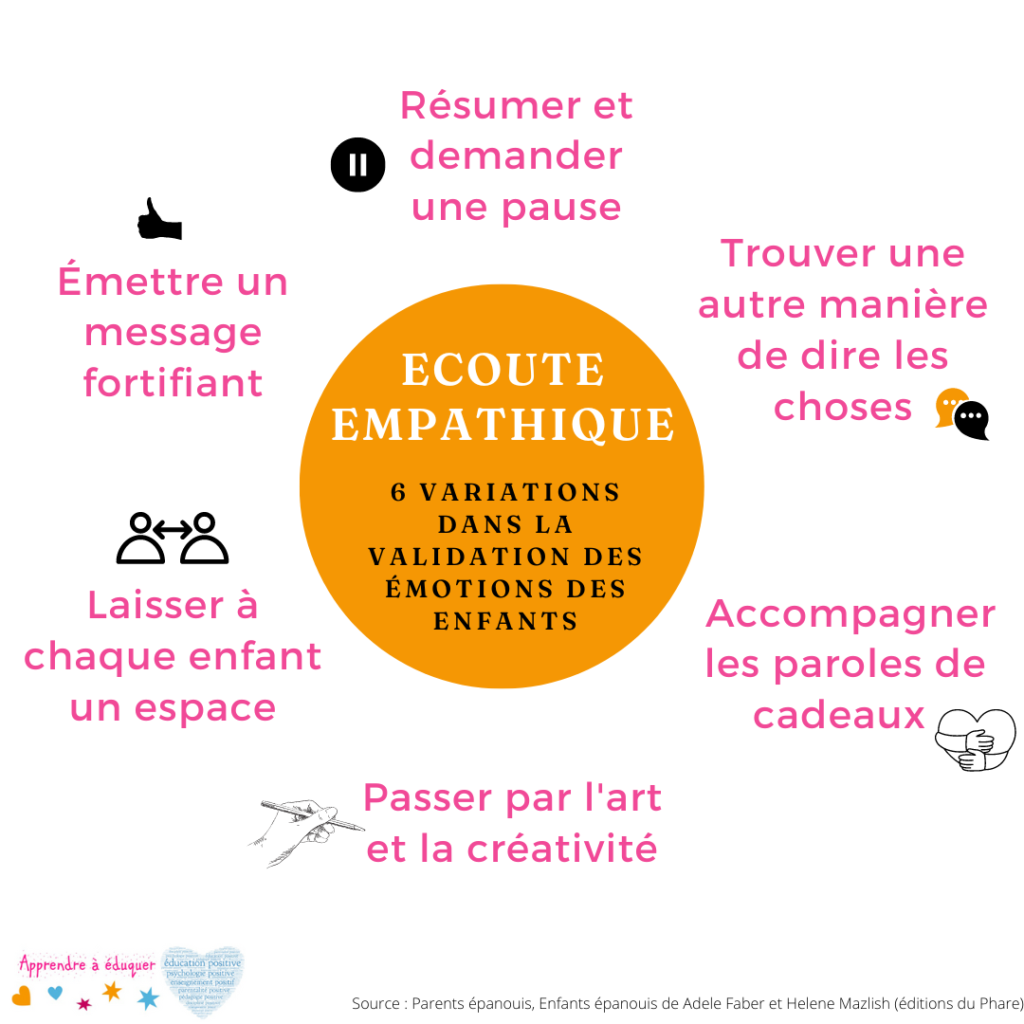
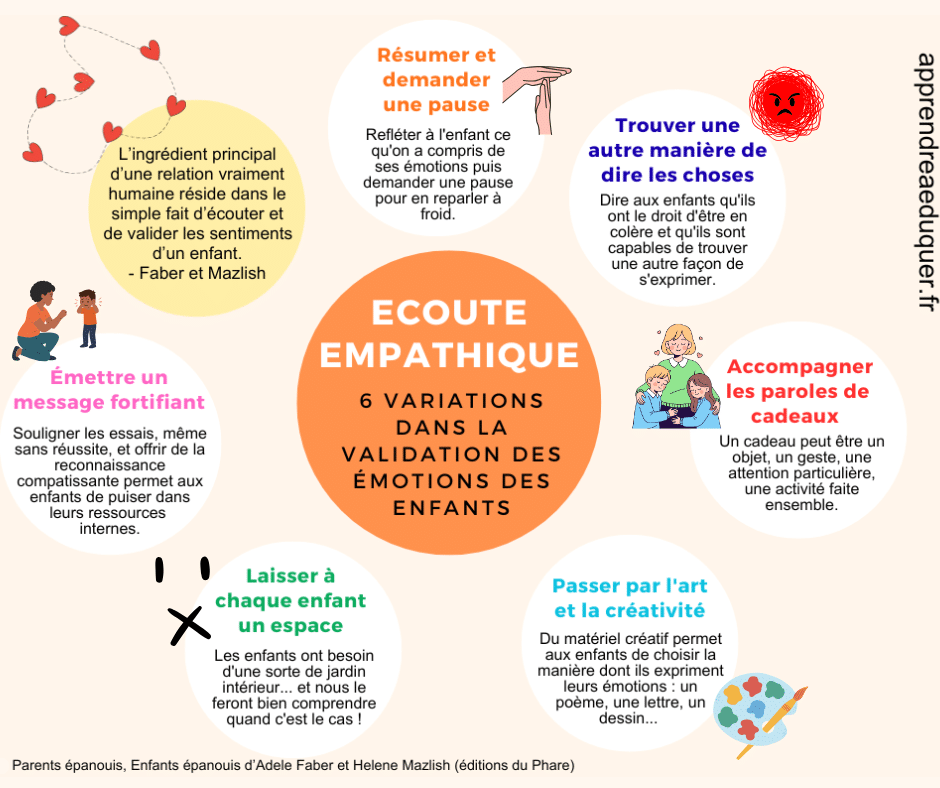
Validating children's emotions is the foundation of a genuinely human relationship, and it starts with the simple act of listening to and accepting what a child feels. Psychologists Adele Faber and Elaine Mazlish, specialists in parent-child communication, describe several variations that complement listening rather than replace it.
These variations exist because listening alone is not always enough. Some children need more than words, some need less talk and more space, and some need a physical gesture or a creative outlet. The six approaches below follow that same order and give you concrete options for the moments when plain listening runs out.

Quick takeaways
- Summarize the feeling, then honestly ask for a pause when your listening runs out.
- Accept the emotion but redirect insults, threats and discriminatory words.
- Small gifts, gestures and consensual touch can complete verbal listening.
- Keep art supplies accessible so children can channel intense feelings creatively.
- Respect a child's inner garden when they signal they need space.
- Offer a fortifying message that names the difficulty and trusts the child to cope.
1. Summarize and Ask for a Pause
Some children need to be heard far beyond their parents' capacity to listen. When you have validated feelings for several minutes and your child still does not feel relieved or understood, summarizing what you heard and proposing a break can close the exchange respectfully. Name the emotion you caught, whether fear, anger, disappointment, frustration, sadness or shame, then state your own limit honestly.
You might say: "I hear you. You are telling me you really care about this, and you feel very sad because of it. I understand, but I am no longer able to listen and I need a pause. Let's talk about it again in ten minutes, after dinner, or when the other parent is home." This keeps the door open instead of shutting the conversation down. If you want to understand how children's fears and reactions are shaped before you respond, it helps to read about fears inherited and how they play out at home.
Why the pause works
A pause signals that the feeling was received, not dismissed. It also models self-regulation: you show your child that adults have limits and can name them without blame.
2. Ask Your Child to Find Another Way to Say It
Sometimes children express emotions in language so violent that counter-attacking feels easier than listening. Every adult has a different tolerance for words, but insults, death threats and racist or homophobic attacks need to be redirected rather than accepted.
You can tell your child that the emotion is legitimate, that being angry is allowed, but that these particular words are unacceptable in their mouth, and that they are capable of finding another way to express themselves. This separates the feeling from the wording, which is the whole point of children misbehaving without turning the moment into a power struggle. For a child who needs to burn off that anger physically, active games can offer a safe outlet.
Keep the correction short and calm, then return to the feeling underneath. A child who hears "you may be furious, and you may not call me that" learns that emotions are welcome while hurtful language is not.
| Situation | Variation to use | What to say or do |
|---|---|---|
| You are exhausted after long listening | Summarize and pause | Name the feeling, state your limit, set a time to resume |
| Child uses violent or hurtful words | Redirect the language | Accept anger, reject the words, invite another way |
| Child seems unreachable by words | Gift or gesture | Offer a hug, a small object or a shared activity |
| Emotion is very intense | Creative outlet | Provide paper, paint or clay; act as secretary |
| Child withdraws or goes quiet | Inner space | Stay available without questioning |
| Child faces a hard challenge | Fortifying message | "It is hard, I respect your struggle, I trust you" |
3. Pair Words with Small Gifts or Gestures
Faber and Mazlish note that a small gift can sometimes help a child in distress. Here "gift" is meant very broadly: an object, a gesture, a special attention, or an activity done together. Think of a flower, a pretty pebble, a hand on the shoulder, a massage, or a hug, provided the child consents to physical contact.
These gestures do not replace listening; they complete it in a more physical than verbal way. For example, to a child who complains that you love a sibling more, you might answer: "You don't feel loved? That is not a pleasant feeling at all. I think this is a good moment for a hug and a nice hot chocolate."
Consent matters here, so offer rather than impose. When touch is welcome, it often reaches a child that words alone cannot, much like the calm routines described in sleep on Twelfth Night help children settle after an emotional day.
4. Use Art and Creativity as an Outlet
When a child is caught in a very intense emotion, you can sometimes help direct those feelings toward a creative outlet. Keep art supplies accessible at home: pens, pencils, paint, paper pads, cardboard, blackboards, boxes, modeling clay and so on.
Availability lets children choose how to live and express what they feel: a poem about the loss of a pet, a letter to a TV channel protesting a cancelled show, a drawing full of anger. For very young children, a parent can act as secretary. The goal is to let imagination run, and the same playful spirit appears in board games that build visual skills while children relax.
A father's notebook
One father whose son was furious with his swimming instructor wrote down everything the boy said. When the son paused for breath, the father read it back: "You must have been really angry with your coach today. Listen: 'That big man thinks he is the boss of everyone. He is really mean, I hate him.'" The son listened, captivated, then asked his father to keep writing. Hearing his own speech read aloud, he nodded vigorously and asked to hear it again.
5. Leave Each Child an Inner Space
In some circumstances it is better not to understand, not to be in contact, and not to know what a child feels. Some children need a kind of inner garden, and they will make that clear when it is the case.
Respecting that space is not neglect; it is trust. You stay available without interrogating, and you let your child return to you when ready. The same patience applies to daily independence, from choosing a book to trying new activities alone.
Watch for the signal rather than forcing the door. A child who turns away, goes quiet or retreats to a room is often asking for exactly that garden, and offering it teaches self-reliance.
6. Send a Fortifying Message
Sometimes a child needs the sound of a trumpet to rally courage and fighting spirit. This is the fortifying message, a form of compassionate acknowledgment: "Yes, it is hard. Yes, it is difficult. I respect your struggle and I trust that you will find a way through."
It differs from empty praise because it names the difficulty instead of denying it. You are not promising success; you are expressing confidence in the child's ability to cope. That confidence carries into challenges like sports and children or the everyday courage of team sports and individual sports alike. The same steady confidence also supports everyday independence, such as introducing children's knives in the kitchen.
Use it sparingly and sincerely. A fortifying message lands best when the child has already been heard, so keep listening first and let the encouragement close the moment.


My hands-on take
I started using the summarize-and-pause variation after one long evening when my child kept circling the same grievance and I could feel my patience thinning. Instead of snapping, I said what I had understood and admitted I needed a break. To my surprise, my child nodded and came back later calmer, ready to talk properly.
The notebook trick also stuck with me. When words were flying, I wrote them down and read them back, and the anger visibly deflated. I keep paper and pencils within reach now, and I try to remember that a hug offered and accepted often does more than another round of explanations.
Frequently asked questions
Does validating emotions mean accepting every behavior?
No. Validation concerns the feeling, not the action or the words. You can accept anger fully while still refusing insults, threats or hurtful language.
What if my child rejects a hug or a gift?
That is fine and important to respect. Offer the gesture, then let your child decline; the offer itself still communicates care without pressure.
How long should a pause last?
Long enough for both of you to settle, whether ten minutes or after dinner. What matters is that you actually return to the conversation as promised.
Can these variations replace listening?
No. Faber and Mazlish present them as complements to listening and welcoming emotions, never as substitutes for it.
Product Reviews
 Best Toys for Dogs With High Prey Drive |
Best Outdoor Toys for 3-4 Year Olds |
Best Outdoor Toys for 6 Year Olds |
Best Harness for Poodle |
Best LEGO Sets for Adults |
Best Travel Toys for 4 Year Olds on Airplane |
Best Toy Stores in Washington DC |
Best Potty Training Toys |
Best Toys for Tripod Dogs |
Maillot equipe de france







