


Playful parenting offers a different route through the behaviours that exasperate us most, replacing irritation and power struggles with connection and contact. Rather than criticising or punishing, the idea is to turn a problem into a game that builds closeness and teaches skills without force.
This approach draws on the work of Lawrence Cohen, who suggests that inviting a child to act out the very behaviour that annoys us can take the heat out of the moment. The child is caught off guard, and we get a chance to think about how to handle things rather than simply reacting.

Quick takeaways
- Replace irritation and power struggles with humour and contact.
- Invite the annoying behaviour on purpose to catch the child off guard.
- Turn chores, bedtime, noise and bickering into shared games.
- Signal positive intent with a wink and a smile, never mockery.
- A full emotional reservoir makes everyone less irritable.
- A few minutes of play saves time compared with arguing.
Why humour beats a power struggle
When a child refuses to help, argues about bedtime or ignores the rules, the instinctive response is often irritation followed by a power struggle. That struggle rarely ends well and can edge toward harshness. Playful parenting interrupts the pattern by replacing tension with a shared joke.
According to Cohen, asking a child to produce the horripilating reaction on purpose gives the situation a humorous twist. It lets us reflect on how to manage the behaviour while taking the child by surprise. The goal is to let parents and children laugh together about themes that usually cause friction, instead of starting battles nobody wins.
This is not mockery or sarcasm. It is a search for connection with a positive intention, and a wink or a smile helps signal that intention so the child does not feel manipulated or unsafe. If you want more ideas for building warmth at home, these self-improvement in children strategies pair well with a playful tone.

Everyday games for chores, bedtime and noise
For a child who will not do their share of household tasks, Cohen flips the request: instead of taking out the bins, would they mind lounging in front of the television? For a child who resists going to bed, he suggests offering a mock argument about bedtime, complete with a whiny "you have school tomorrow" and inviting the child to answer back.
When children are very noisy, you can suggest they go somewhere it will not bother anyone, or hand out earplugs and say: if you want to scream, it is now or never, go for it, with a timer running. For siblings who bicker, a fascinated "I can watch, right?" and a wry comment about older children acting like kings while little ones scheme quietly can dissolve the tension.
Rules, lies and interruptions
With a child who flouts the rules, invent one that simply cannot be kept, such as no blinking or no shoes of the same colour. With a child who lies, imagine the most outrageous tall tales together, or tell your own with an obvious grin. For a child who interrupts or asks awkward questions, answer normal questions in a mock-scandalised tone. A little imaginative play makes all of this feel natural, and if the toys pile up, a quick tidy keeps the games easy to find. On a rainy afternoon, you could even try tie dye t shirts together.
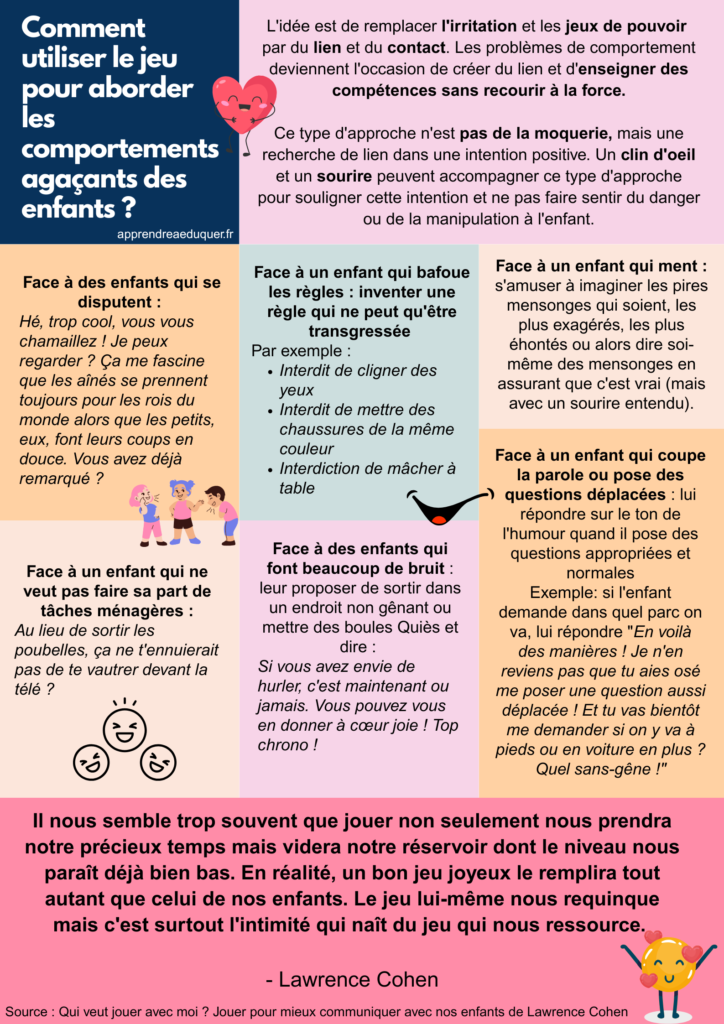
| Situation | Playful move | Intention |
|---|---|---|
| Refuses chores | Ask them to lounge in front of the TV instead | Break the power struggle |
| Resists bedtime | Offer a mock argument about bedtime | Release tension through laughter |
| Very noisy | Earplugs plus a timed screaming session | Give noise a safe outlet |
| Siblings bicker | Watch with mock fascination | Defuse the fight |
| Breaks rules | Invent an impossible rule | Reframe rule-breaking |
| Lies | Invent outrageous tall tales together | Openness without shame |
Why it works, and when it does not
Inviting a child to behave in the way that annoys us can resolve many difficulties almost miraculously, though it does not work every time. Sometimes the result is subtler: our perception of the behaviour shifts, or we tolerate it better. Either way, the point is reached once the behaviour stops exasperating us.
This approach can look artificial, ineffective or time-consuming. Yet humour and play fill the emotional reservoirs of every family member, and a person whose reservoir is full is far less irritable. A few minutes of play also saves time: it takes less time than getting angry and negotiating endlessly, and over the medium and long term a relationship of trust and respect reduces opposition and resistance.
We often fear that playing will drain our already low reserves. In reality a good, joyful game fills ours as much as our children's, and it is the intimacy born from play that truly restores us. Parents who feel stretched may find encouragement in these things not to a mother. When a child does not want, play can ease the tension too.
Building the habit gently
You do not need a script. Start with one recurring flashpoint, notice the moment tension rises, and choose a single playful response to try. Keep your tone light and your smile visible so the child reads the invitation as friendly. If it falls flat, drop it without commentary and try again another day.
Play also supports development in quieter ways, from early reading routines to the confidence children gain through pretend games. If you are curious about early literacy, this guide on reading to baby explains when to begin. And when play needs materials, simple options like these outdoor toys keep things easy.
For families juggling a lot, it helps to remember that connection is not a reward for good behaviour but the ground it grows from. Respect for other adults matters too, and these tips on respect the caregiver complement a playful home.

My hands-on take
I first tried this on a morning when my child would not put on shoes and we were both already late. Instead of repeating myself, I dramatically announced that nobody was allowed to wear matching shoes today, and suddenly we were laughing and the shoes went on. It felt silly, but it worked, and the morning did not spiral.
What I have learned is to pick my battles and keep the smile genuine. When I force the joke, children sense it and it lands badly. When I am genuinely amused, the whole room relaxes, and I usually feel lighter too. I keep a couple of these moves in mind for the moments I know will be hard.
Frequently asked questions
Is this the same as mocking my child?
No. The intention is connection, not ridicule. A wink and a smile make clear the game is friendly, so the child does not feel manipulated or unsafe.
What if my child does not respond to the game?
It will not work every time. Sometimes the change is subtler: your perception of the behaviour shifts, or you tolerate it better, which still counts as progress.
Does playing take too much time?
A few minutes of play is usually quicker than getting angry and negotiating endlessly. Over time, trust and respect reduce opposition, saving more time.
Can I use this for serious misbehaviour?
Playful parenting suits everyday friction like chores, bedtime and bickering. It is a way to build connection, not a substitute for calm, clear limits when safety is at stake.
Product Reviews
 Best Toys for Dogs With High Prey Drive |
Best Outdoor Toys for 3-4 Year Olds |
Best Outdoor Toys for 6 Year Olds |
Best Harness for Poodle |
Best LEGO Sets for Adults |
Best Travel Toys for 4 Year Olds on Airplane |
Best Toy Stores in Washington DC |
Best Potty Training Toys |
Best Toys for Tripod Dogs |
Maillot equipe de france







