


Encouraging child cooperation starts with how we communicate, not with how loudly we repeat ourselves. The same request can land very differently depending on whether it is shouted from the bottom of the stairs or delivered face to face, in short words, with a clear picture of what comes next.
There is no single trick that works every time, and that is exactly the point. A varied set of communication approaches tends to be more effective and more respectful, both for getting things done and for protecting the relationship. The suggestions below are simple, free, and easy to adapt to your own child and your own daily rhythm.

Quick takeaways
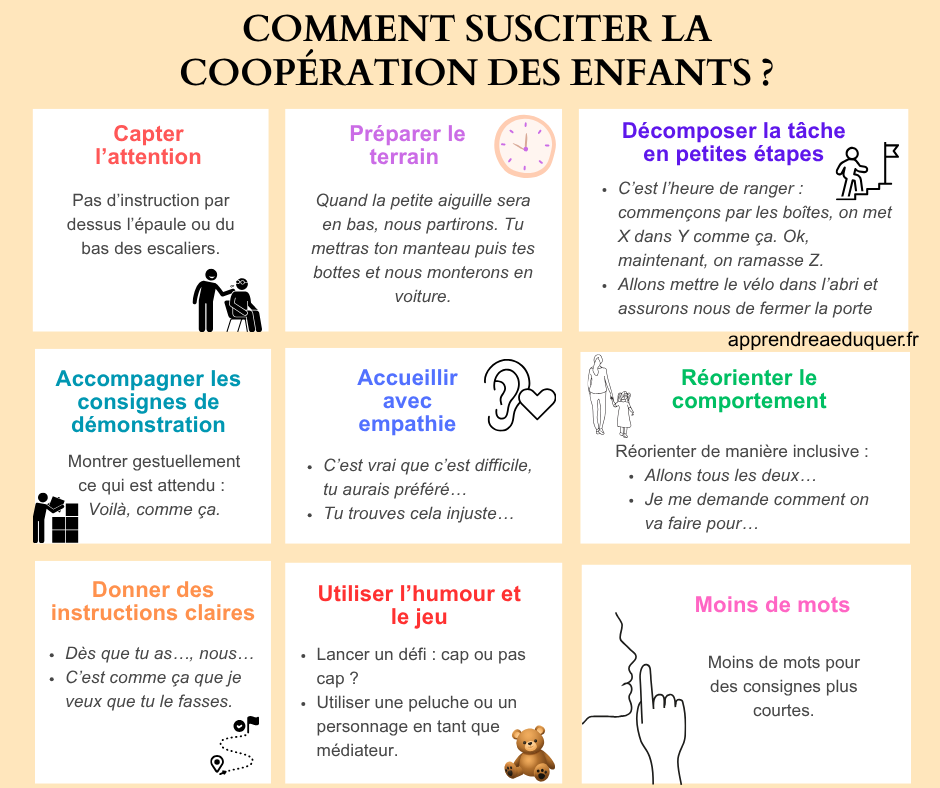
- Get your child's full attention before giving an instruction.
- Announce what comes next so transitions feel predictable.
- Break big tasks into small, concrete, finishable steps.
- Show the expected action instead of only describing it.
- Name feelings with empathy, then redirect as a team.
- Keep instructions short, clear, and playful when possible.
Get their attention before you give an instruction
An instruction called over your shoulder or from the bottom of the stairs is easy to miss, and missing it is not the same as refusing. Children are often absorbed in what they are doing, so the first step is to make sure you actually have their attention before you ask for anything.
Move closer, get down to their level, and wait until they look at you. Only then does the request have a chance of being heard. This small habit removes a surprising amount of daily friction, and it pairs well with the good father mindset of being present rather than shouting from another room.
Prepare the ground
Announcing what will happen next gives a child time to adjust. Instead of a sudden order, describe the sequence: when the little hand points down, we will leave, you will put on your coat and boots, and then we get in the car. The same logic helps with baby nursery drop-offs, where a predictable goodbye routine makes transitions calmer for everyone.
Break the task into small, doable steps
A big instruction like "tidy up" is vague and overwhelming. Splitting it into small, concrete steps makes it achievable: it is tidy-up time, let us start with the boxes, we put the bricks in the red box like this, and now we gather the soft toys.
The same applies outdoors: let us put the bike in the shelter and make sure the door is closed. Each step is a small win, and children get the satisfaction of finishing something rather than the frustration of a task that never seems to end. Keeping fewer toys in rotation makes this even easier, as these toy organization tips explain.
Show, don't just tell
Pair your words with movement and a demonstration of what you expect. A simple "there, like this" while you model the action often communicates more than a long explanation, especially for younger children who are still building language.
| Approach | What it sounds like | Best moment to use |
|---|---|---|
| Get attention | Waiting until they look at you | Before any request |
| Prepare the ground | "When the hand points down, we leave" | Before transitions |
| Break into steps | "First the boxes, then the toys" | Big or vague tasks |
| Show and demonstrate | "There, like this" | New or tricky actions |
| Welcome feelings | "You find this unfair" | Resistance or upset |
| Humour and play | A silly voice or a race | Tense or rushed moments |
Welcome feelings and redirect behaviour inclusively
Naming what is happening for the child costs nothing and changes the tone: it is true that this is hard, you would have preferred to stay, you find this unfair. Empathy does not mean giving in; it means the child feels seen before you move on.
Then redirect with inclusive language. "Let us both do it" or "I wonder how we are going to manage this" turns a confrontation into a shared problem. That collaborative spirit is the same one behind improving family life, where children are treated as partners rather than opponents.
Keep instructions clear
Clear, specific phrasing works better than hints: as soon as you have finished, we will go out, or this is how I want you to do it. Fewer words, shorter sentences, and one instruction at a time all help. If you are dealing with a strong-willed phase, these thoughts on spoiled children can help you tell firmness apart from harshness.
Use humour and play to invite cooperation
Play is one of the most reliable tools a parent has. Turning a request into a game, a silly voice, or a challenge lowers the stakes and often gets the job done without a battle. Playful parenting is not about bribing; it is about meeting children where they already are.
It also builds shared memories. The same spirit animates snow games in winter or a simple fatherhood humour moment that defuses tension. When the mood is light, cooperation usually follows.
Match the approach to the moment
Some days call for preparation and clear steps, others for a joke and a race to the door. Having several approaches in your pocket means you are not stuck repeating the one that is not working. Older children respond well to a bit of negotiation, while younger ones thrive on demonstration and routine, much like the play ideas in these learning toys suggestions.

Build a calmer daily routine around cooperation
These approaches work best when they become habits rather than emergency measures. Getting attention, preparing transitions, breaking tasks down, showing what you expect, welcoming feelings, redirecting inclusively, giving clear instructions, and using humour and fewer words all fit into an ordinary day.
They also connect to bigger choices: the environment you set up at home, the routines you keep, and even the nursery school you choose all shape how many transitions a child faces. A calm, predictable setting reduces the number of conflicts before they start.
None of this requires special equipment or a perfect day. It requires a little intention, a willingness to try a different approach when one fails, and the patience to repeat yourself kindly. Over time, these small communication habits do more for cooperation than any single technique.

My hands-on take
In our house, the single change that made the biggest difference was simply walking over to my child before asking for anything. I used to call instructions from the kitchen and then feel irritated when nothing happened. Once I started crouching down, waiting for a look, and saying one short sentence, the number of repeated requests dropped noticeably.
The other habit I lean on is announcing what comes next. A quick "in five minutes we put shoes on, then we go" heads off most of the morning battles. I still forget sometimes, and on those days I try a game instead of a louder voice. It does not always work, but it keeps the relationship intact, which matters more than a perfectly tidy room.
Frequently asked questions
What if my child ignores me when I give an instruction?
Check first whether you actually had their attention. Move closer, get to their level, and wait for eye contact before speaking. An instruction delivered from another room is easy to miss rather than deliberately refused.
Does empathy mean giving in to my child?
No. Welcoming a feeling simply means acknowledging it before you hold the limit. You can say you understand the disappointment and still follow through with the plan.
Why should I break tasks into steps?
A broad request like "tidy up" is hard to picture and easy to avoid. Small, concrete steps give a clear starting point and a sense of completion, which makes cooperation more likely.
Is playful parenting effective for older children?
It can be, though the style shifts. Older children often respond to light negotiation or a challenge rather than a silly voice. The principle stays the same: lower the tension and invite cooperation.
Product Reviews
 Best Toys for Dogs With High Prey Drive |
Best Outdoor Toys for 3-4 Year Olds |
Best Outdoor Toys for 6 Year Olds |
Best Harness for Poodle |
Best LEGO Sets for Adults |
Best Travel Toys for 4 Year Olds on Airplane |
Best Toy Stores in Washington DC |
Best Potty Training Toys |
Best Toys for Tripod Dogs |
Maillot equipe de france







