


A one-minute calm-down for kids is a short, structured pause children can take when a conflict is brewing, whether in a classroom, a playgroup or between siblings. The idea is simple: instead of reacting straight away, the child stops, settles and lets the first wave of emotion pass before deciding what to do next.
The ritual uses a visual wheel of four prompts, a soft bell and a one-minute hourglass. It is easy to set up and needs no special equipment beyond a bell and a timer, but it works best when an adult introduces it regularly before children start using it on their own.

Quick takeaways
- Offer the pause, never impose it as a punishment
- Use a bell and a one-minute hourglass for clear cues
- Let each child choose one of four prompts
- Protect sharing with no mockery and no repeating outside
- Practise when calm so the skill is ready in conflict
- Remind children that big emotions block good decisions
Why a one-minute pause helps children avoid violence
Under the grip of anger, fear, shame or sadness, children cannot make good decisions. Their bodies are flooded with strong sensations and their thinking brain is temporarily offline, so the first reaction is often shouting, pushing or shutting down. A one-minute pause gives the emotion time to lose its sharpest edge.
This is not about suppressing feelings or telling children to calm down. It is about creating a small, predictable space between the trigger and the response. Once the intensity drops, the child can think again and look for a solution that does not involve violence.
A ritual, not a punishment
The pause should always be offered, never imposed as a consequence. Framing it as a helpful tool rather than a sanction keeps children willing to use it when they genuinely need it.
Introducing the activity to a group
Although the exercise is simple, children need to meet it formally and repeatedly before they can take it on independently. An adult, whether a teacher, activity leader or parent, presents the wheel to the whole group and invites each child to pick one of the four prompts. Group leaders can also draw on educational toys under $50 to keep younger children engaged.
Everyone then settles comfortably, sitting or lying down. The adult rings a soft bell, such as a Tibetan bell, and turns over a one-minute hourglass. The children hold their chosen prompt in mind and try to soak in whatever comes to them.
That might mean seeing colours in their mind, hearing sounds or words, noticing pleasant sensations such as warmth in the body, or simply breathing with the emotion they feel. When the hourglass runs out, the adult rings the bell again. For active groups, outdoor toys can help balance calm moments with movement.
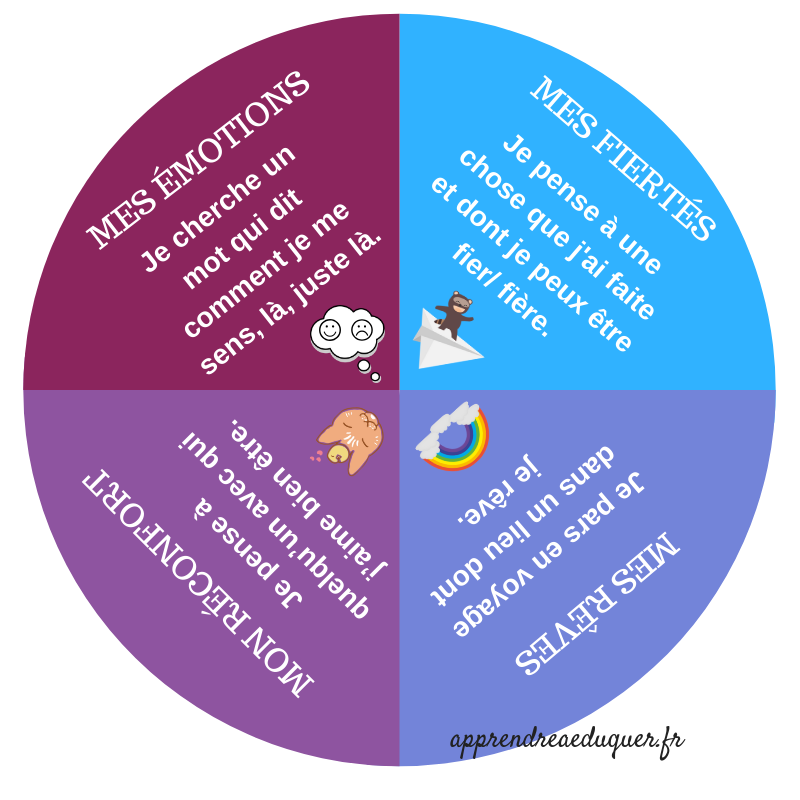
| Prompt focus | Child's need | Good moment to use it |
|---|---|---|
| Emotions check-in | Naming what they feel | After a disagreement |
| Self-esteem | Feeling capable again | Before a difficult task |
| Comfort | Soothing and safety | After a hard day |
| Letting go | Releasing tension | When anger is rising |
| Estimated minute | Independence | Once the ritual is familiar |
Sharing feelings in a safe, kind setting
After the second bell, children who want to can share what they noticed. This sharing only works inside a caring, secure framework: no mockery, no interrupting and no repeating what was said outside the group. Those rules protect trust and make children more willing to speak honestly.
The adult can then explain that this activity is available whenever a child feels the need for a break. Depending on what they need, whether it is checking in with their emotions, boosting self-esteem, seeking comfort or letting go, they can choose one of the four prompts and do the exercise alone.
Without an hourglass, they simply estimate a minute, the point being to pause long enough for the live emotion to subside. Remind them that they cannot make good decisions while anger, fear, shame or sadness is still running the show.
Adapting the ritual at home or in class
The same structure works across settings with small adjustments. At home, a parent can offer the pause during sibling friction or after a hard moment at school. In class, it can become a regular transition ritual before a discussion or after playtime, and a good teacher family relationship helps keep the cues consistent between both.
Keep the physical cues consistent so the ritual becomes familiar: the same bell sound, the same hourglass and the same comfortable spot. Children who respond well to sensory input may enjoy exploring stimulate the senses through colour or sound prompts, while quieter children may prefer breathing and body warmth, and cozy fun Christmas pajamas can make the home pause feel extra safe.
If you are choosing materials for a calm corner, keep them simple and non-distracting, much like the focused selection you would make when picking learning toys for 3 year that invite attention rather than scatter it. Older children can be trusted to estimate their own minute once the routine is well established.

Building the habit over time
Consistency matters more than perfection. Practise the ritual when everyone is calm, not only in the heat of a conflict, so the skill is available when it is needed. A short daily slot, such as after lunch or before home time, helps it become second nature.
Adults can model the pause too, naming their own need for a break out loud. Children learn far more from watching a grown-up take a breath than from being told to do so. Over weeks, many children begin to ask for the minute themselves, much as they pick up new language skills through steady, gentle repetition.
Some families pair the ritual with calm, screen-free play, in the spirit of outdoor toys for 4 year that let energy out before it builds into tension. Others keep a small comfort object nearby, chosen with the same care as teething toys for babies are chosen for very young children, safe and soothing rather than stimulating, especially for little ones with fragile lungs.
What to keep in mind
This activity is a pause, not a cure. It supports emotional regulation but does not replace conversation, repair or adult support after a conflict. Children still need help naming what happened and finding solutions.
Watch for signs that a child is using the pause to avoid problems rather than to face them. The goal is to return to the situation calmer, not to escape it. Gentle follow-up questions after the minute help bridge back to the group.
Finally, keep the tone light and non-judgemental. A pause offered with warmth is far more likely to be adopted than one that feels like a demand. The minute belongs to the child, and that sense of ownership is what makes it stick.

My hands-on take
I first tried this with two children who were constantly bickering over the same toy. Instead of stepping in with a lecture, I rang a small bell and turned over a kitchen timer set to one minute. The first attempt was met with giggles, but by the third day they were choosing a prompt without being asked.
What surprised me most was how much the ritual changed my own behaviour. Having a clear, repeatable script meant I stopped raising my voice as quickly. I keep the wheel on the kitchen wall now, and the children sometimes reach for it before I do.
Frequently asked questions
How long should the pause last?
One minute is the starting point, measured with an hourglass. Later, children can estimate the minute themselves, as long as the pause lasts long enough for the strong emotion to settle.
Can this be used with siblings at home?
Yes. The same ritual works with a small group, including a sibling pair. An adult presents the wheel, the children each choose a prompt and the bell marks the start and end.
What if a child does not want to share afterwards?
Sharing is always optional. The secure framework means no pressure, no mockery and no repeating outside the group, so a child can simply keep their experience private.
Is this a replacement for talking about the conflict?
No. The pause only creates calm so a conversation becomes possible. Adults should still help children name what happened and find a solution afterwards.
Product Reviews
 Best Toys for Dogs With High Prey Drive |
Best Outdoor Toys for 3-4 Year Olds |
Best Outdoor Toys for 6 Year Olds |
Best Harness for Poodle |
Best LEGO Sets for Adults |
Best Travel Toys for 4 Year Olds on Airplane |
Best Toy Stores in Washington DC |
Best Potty Training Toys |
Best Toys for Tripod Dogs |
Maillot equipe de france







