


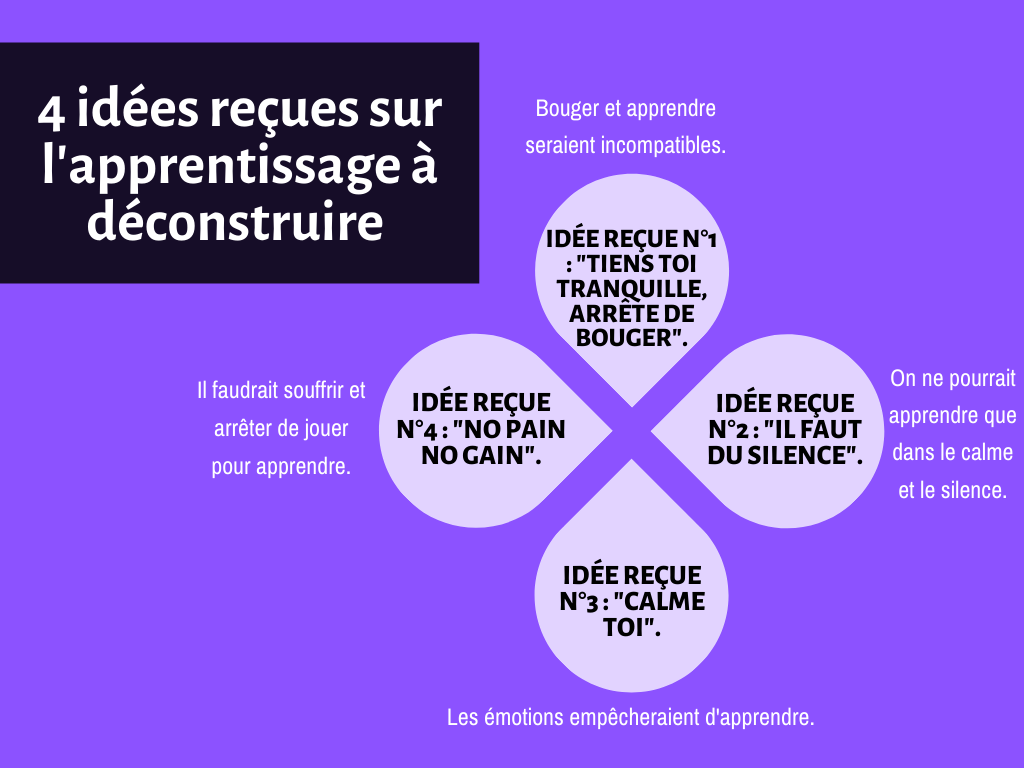
Learning myths are everywhere, and four of them shape daily life with children more than any others: the belief that movement and learning are incompatible, that silence is required, that emotions get in the way, and that play stands opposed to work. Each one deserves a closer look.
None of these ideas survives contact with how children actually learn. Movement feeds the brain, the right kind of sound can help or hinder depending on the task, joy is the engine of curiosity, and play is the raw material of understanding. Here is what the evidence and classroom experience suggest, along with practical ways to apply it at home.

Quick takeaways
- Movement supports attention and memory; regular breaks are not a reward but a condition for learning.
- Music helps simple tasks and can hinder complex memorization, where performance drops by 40%.
- Joy drives curiosity, and curiosity drives learning; dopamine rewards discovery.
- Play is not the opposite of work: it is how children rehearse and consolidate understanding.
- Practical fixes include moving between rooms, standing to revise, doodling and never removing recess.
Myth 1: children must sit still to learn
You do not need to be motionless at a desk to learn. It is closer to the opposite: movement supports intelligence, and children who stay frozen for hours stifle their own brain potential. American pediatrician Bob Murray, a researcher at Ohio State University, compiled studies showing that children learn better after a break in which they could move and play.
If you want a child to stay attentive and focused on a task, or to retain a piece of information, regular breaks are what make it possible. A study published in Pediatrics found that children who get at least an hour of physical activity after school improve their attention and learning capacities. Using the body to learn, as Pailleau and Akoun put it, supports the development of cognitive functions.
What a Texas school changed
At Eagle Mountain Elementary in Fort Worth, Texas, kindergarten and first-grade children get four 15-minute recesses a day, taking total recess time from 20 minutes to an hour. The model is inspired by Finland, where children enjoy far more free play during breaks than their American and French peers. Teachers report children who are less distracted, more attentive and chattier less in class. The strangest effect concerned pencils: children used to grind, break and chew them, and that habit disappeared once the four recesses were introduced.
Myth 2: silence is the only condition for learning
We feel positive emotions when listening to music we enjoy, and it is now well established that we learn better in a positive emotional state. The reality is more subtle, because the effects of music depend on the type of activity involved.
Listening to music does not interfere with simple, easy cognitive tasks: copying something neatly, sorting, colouring. When the task requires thinking, understanding or long-term memorization, the rational brain has to manage two competing language-based tasks at once. Research here is clear: memorization performance drops by 40%. If you are unsure which style of music suits a given moment, the task itself is the best guide. As one pediatrician reminds parents, our own habits set the tone children mirror each morning.
How to use music well
Context and the child's preferences matter. One option is to put music on until you reach a state of relaxation and well-being, then switch it off to work. Another is to choose music according to the task: fine for simple copying, best avoided for complex comprehension, reflection or memorization. In some particular cases music can act as an insulator against disturbing noise such as a loud environment or building work, and instrumental tracks without lyrics are the ones to favour. A small back to school reward can also help mark the end of a focused block.
| Task type | Music on or off | Movement allowed |
|---|---|---|
| Copying, sorting, colouring | Music is fine | Free movement is fine |
| Reading comprehension | Instrumental only, or off | Short breaks between blocks |
| Memorizing for the long term | Off, or instrumental as noise insulation | Standing, walking, pacing |
| Homework at home | Child's choice | Floor, chair or standing |
| Recess and sport | Not applicable | Never withheld |
Myth 3: emotions get in the way of learning
Joy is the engine of curiosity, and curiosity is the engine of learning. Intelligence grows in joy, contrary to what the common myths suggest. Nature has equipped humans with the emotion of joy linked to discovery, and the intensity of that joy is even higher in the youngest children. This is why toddlers want to touch everything, ask so many questions and act on their environment: climbing, rolling, repeating, throwing.
Exploration makes them want to discover more, in order to feel an even greater joy. This self-reward mechanism continues throughout life, provided it is not repressed, particularly during schooling. Dopamine is considered the main hormone of joy, though not the only one responsible. It is a neurotransmitter of the reward circuit: it brings an intense sensation of pleasure and, through it, allows the memorization of the neural networks involved in the action that led to that pleasure. Dopamine motivates us to act when it anticipates interesting prospects linked to those experiences.
Myth 4: play and work are opposites
The idea that play is the opposite of work does not hold up. Play is how children rehearse, test, fail safely and consolidate what they understand. A simple cardboard box can carry as much learning as a worksheet, because the child decides what it becomes and stays engaged in the process.
Open-ended materials serve the same purpose: they leave room for the child's own questions rather than prescribing an outcome. If you want a starting point for choosing them, these open ended toys reward exactly the kind of exploration that feeds curiosity. The same logic applies to toys that invite movement, building and experimentation rather than a single correct answer, which is why a considered toddler toys selection matters more than volume.
Play also gives emotions room to surface, which is where the joy of discovery does its work. Games that engage the senses, like these stimulate the senses activities, turn observation into a habit. Even a hip sprain that limits running and jumping doesn't end play, and knowing how to explain difficult events helps play process big feelings. None of this requires a formal lesson: the learning is a by-product of the child being absorbed.

Practical ways to bring movement into learning
Several options work at school and at home. Children can move from one room to another, even one floor to another: for example, to memorize the spelling of dictation words, read the word in one room and write it in another. Never deprive a child or teenager of recess or sport. Let pupils walk barefoot or in socks in class, and even in the grass.
Rethink classroom layout and teaching so that free movement is possible, as in flexible seating arrangements. Allow children to move as much as they need while doing homework: sitting on the floor, lying with the head upside down or spinning on the desk chair are all acceptable. Revising and learning while standing works too, and so does allowing doodling.
These adjustments cost little and change a great deal. A child who is allowed to move is often a child who can settle when the task truly demands it. For families juggling homework routines, small changes in the room matter as much as the schedule itself, and even a trunk for every occasion can double as a mobile homework station that moves with the child.

My hands-on take
In our house, homework used to happen at the kitchen table, and it was a battle almost every evening. What changed things was letting my son stand up, pace between two rooms and read his spelling words aloud in one place before writing them in another. It looked chaotic, and I nearly stopped it several times, but the work got finished faster and with far fewer tears.
I also learned to time the music. Instrumental tracks help during tidying and copying, but the moment we move to reading comprehension, the music goes off. It is not a rule I read somewhere and applied perfectly; it came from watching what actually worked on a Tuesday night when everyone was tired.
Frequently asked questions
Does listening to music really hurt memorization?
For complex tasks involving understanding and long-term memory, research reports a 40% drop in memorization performance, because the brain handles two competing language tasks. For simple copying or sorting, music does not interfere.
Should I stop my child from fidgeting during homework?
No. Sitting on the floor, lying down or turning on the chair are acceptable ways to move while working. What matters is whether the work gets done, not the posture.
Is play really learning?
Yes. Play lets children test ideas, fail safely and consolidate understanding, and it keeps the joy of discovery alive, which is what sustains curiosity over time.
What if my child's school removes recess as punishment?
It is worth raising the issue, since movement breaks support attention and learning. Depriving a child of recess or sport works against the very focus the school is trying to obtain.
Product Reviews
 Best Toys for Dogs With High Prey Drive |
Best Outdoor Toys for 3-4 Year Olds |
Best Outdoor Toys for 6 Year Olds |
Best Harness for Poodle |
Best LEGO Sets for Adults |
Best Travel Toys for 4 Year Olds on Airplane |
Best Toy Stores in Washington DC |
Best Potty Training Toys |
Best Toys for Tripod Dogs |
Maillot equipe de france







