


Playful parenting offers a gentle, laughter-based way to respond to inappropriate behavior in children, and it starts with a simple idea: many difficult behaviors are really requests for contact, attention and connection.
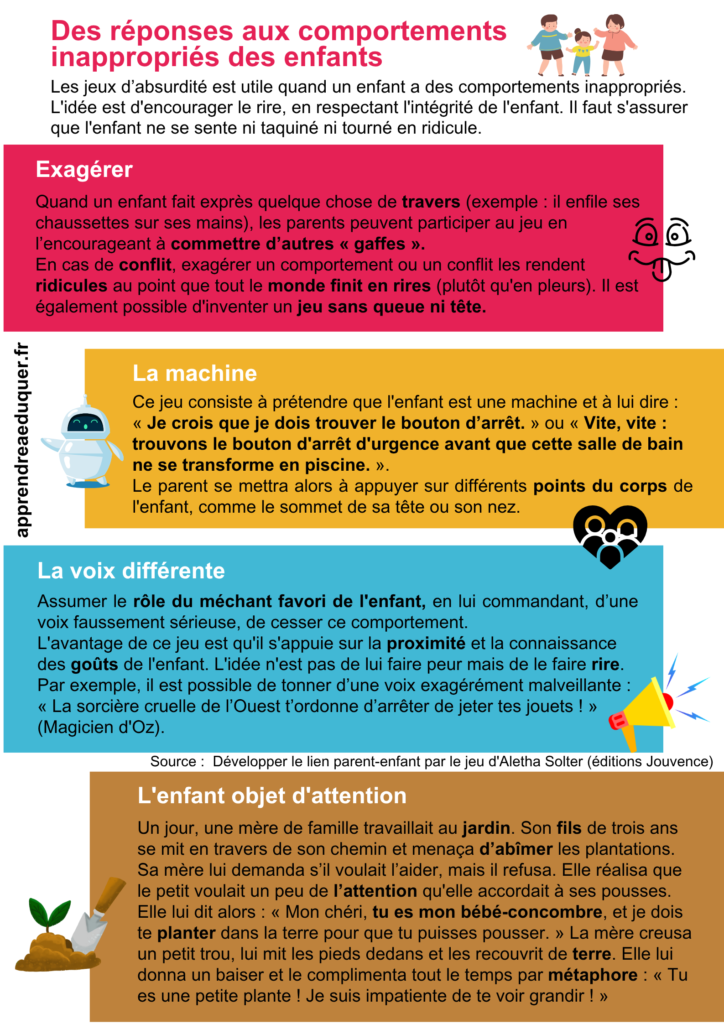
Rather than meeting every misstep with a lecture or a punishment, you can answer it with a silly game that makes everyone laugh instead of cry. The key is to keep the child's integrity intact, making sure they never feel teased or ridiculed.

Below you'll find concrete playful strategies, from exaggerating a mistake to pretending your child is a machine with an off button, that you can try the next time a small conflict starts to build.
Quick takeaways
- Many inappropriate behaviors are really requests for contact, attention and connection.
- Exaggerating a mistake or conflict turns tears into shared laughter.
- The machine game uses a pretend off button to redirect a child playfully.
- A mock-villain voice from a favorite storybook orders a stop without frightening.
- Making your child the star of a silly story can meet their need for attention.
- Always keep the child's integrity intact: laugh with them, never at them.
Why playful parenting works
Playful parenting is an approach built on using games to handle discipline. Its power comes partly from the fact that a game creates a loving connection between you and your child, and that same need for connection may be the underlying reason behind behavior that sometimes feels unbearable.
Before you reach for a game, it helps to pause and ask what need is hiding behind the behavior. Is your child tired, hungry, or simply asking for a few minutes of your full attention? If you're wondering whether your child is genuinely children misbehaving or just signaling a need, that question is often the whole answer.
When you respond with play, you meet the need directly instead of fighting the symptom. This is also why it pays to accompany from love rather than from fear: a child who feels connected is far more willing to cooperate than one who feels scolded.
Exaggerate the mistake
When a child deliberately does something the wrong way, such as pulling socks onto their hands instead of their feet, you can join the game rather than correct it. Encourage them to play the fool and make a few more harmless "blunders" alongside them.
In a conflict, exaggerating the behavior or the argument turns it into something so ridiculous that everyone ends up laughing instead of crying. You can also invent a nonsense game with no point at all, simply to break the tension.
This kind of shared silliness works well during daily routines that often turn into battles, like creative games at bath time or getting dressed in the morning. The laughter releases pressure, and the power struggle quietly dissolves.

| Strategy | What you do | Best for |
|---|---|---|
| Exaggeration | Join the mistake and make more harmless blunders | Power struggles, getting dressed |
| The machine | Pretend to search for the off button on their body | Bath time, transitions |
| Different voice | Use a mock-serious villain voice to give an order | Toy throwing, refusals |
| Attention story | Cast your child as the star of a silly tale | Attention-seeking moments |
| Check-in | Confirm your child is laughing, not shrinking | Every playful response |
Play the machine game
The machine game means pretending your child is a machine and announcing that you need to find the off button. You might say, "Quick, quick, let's find the emergency stop button before this bathroom turns into a swimming pool!"
You then press different points on your child's body, such as the top of their head or their nose, hunting for the "magic button that stops the naughty machine." The search is the fun part, so take your time and be deliberately bad at finding it.
This game suits toddlers and preschoolers especially, the same age group that enjoys simple cause and effect toys where one action produces a reaction. It also pairs naturally with the routines around out of the crib moments, when a tired child needs redirection more than a lecture.
Use a different voice
Another method is to take on the role of the villain from your child's favorite storybook and order them, in a mock-serious voice, to stop the behavior. The advantage is that it draws on closeness and on your knowledge of what your child loves.
The goal is never to frighten but to make them laugh. For example, you can thunder in an exaggeratedly wicked voice: "The Wicked Witch of the West commands you to stop throwing your toys!" A familiar character feels safe, so the child can enjoy the joke.
You can adapt the voice to whatever your child is into that week, from a growling dragon to a pompous king. Reading together regularly gives you a ready supply of characters, and even a simple toys for 4 month old baby can enjoy the playful tone long before understanding the words.
Make your child the center of attention
One story illustrates how attention-seeking can be answered with play. A mother was working in the garden when her three-year-old son deliberately stepped into her path and threatened to damage the plants. She offered to let him help, but he refused.
Feeling annoyed, she then realized he simply wanted some of the attention she was giving her seedlings. So she told him, "My darling, you are my baby cucumber, and I must plant you in the soil so you can grow." He agreed, delighted.
She dug a small hole, placed his feet inside, covered them with earth, kissed him, and kept complimenting him through the metaphor: "You are such a lovely little plant! I can't wait to see you grow and produce delicious cucumbers!" She watered him and patted the soil around his ankles, and afterward he let her finish her planting in peace.
Keep play safe and respectful
Playful discipline only works when the child feels safe. Always check that your child is laughing with you, not shrinking back, and stop immediately if the game tips into teasing. Respecting their integrity is what separates playful parenting from mockery.
It also helps to think about timing. A child who is overtired or hungry may not be ready for a game, and a calming routine such as the nap or a snack may serve everyone better. Knowing when to play and when to simply comfort is part of the skill.
If you're juggling several children at once, playful strategies can ease rivalry too; these build sibling bonds ideas pair well with a silly game. And if you're feeling stretched thin yourself, remember that manage stress first is not selfish, because play needs a calm adult. For more on keeping your authority intact while staying warm, see adult authority in front of the child.


My hands-on take
I first tried the machine game during a bath-time standoff, when my toddler was happily splashing water across the floor and ignoring every request to stop. Instead of raising my voice, I announced that I had to find the emergency off button before the bathroom became a swimming pool. I pressed his nose, his ears, the top of his head, and he giggled so hard he forgot to splash.
What surprised me was how quickly the tension left the room, for both of us. I've since learned to read the moment: if he's genuinely tired, a game just winds him up, and a quiet cuddle works better. But when he's testing limits and still has energy to spare, a silly voice or an exaggerated mistake saves us both a meltdown. The trick, I've found, is committing fully to the absurdity rather than half-heartedly going along with it.
Frequently asked questions
Is playful parenting the same as giving in?
No. You still set the limit, but you deliver it through a game rather than a battle. The behavior stops, and the connection stays intact.
What if my child doesn't laugh at the game?
Stop and check in. If they look upset rather than amused, the game has tipped into teasing, so switch to a calmer, gentler response.
Can I use these games with a very young child?
Yes, the tone and silliness work even before words are understood. Keep the play gentle and watch your child's reactions closely.
Do I need special toys for this?
No, these strategies rely on your voice, face and imagination. Everyday routines and a little willingness to be silly are enough.
Product Reviews
 Best Toys for Dogs With High Prey Drive |
Best Outdoor Toys for 3-4 Year Olds |
Best Outdoor Toys for 6 Year Olds |
Best Harness for Poodle |
Best LEGO Sets for Adults |
Best Travel Toys for 4 Year Olds on Airplane |
Best Toy Stores in Washington DC |
Best Potty Training Toys |
Best Toys for Tripod Dogs |
Maillot equipe de france







