


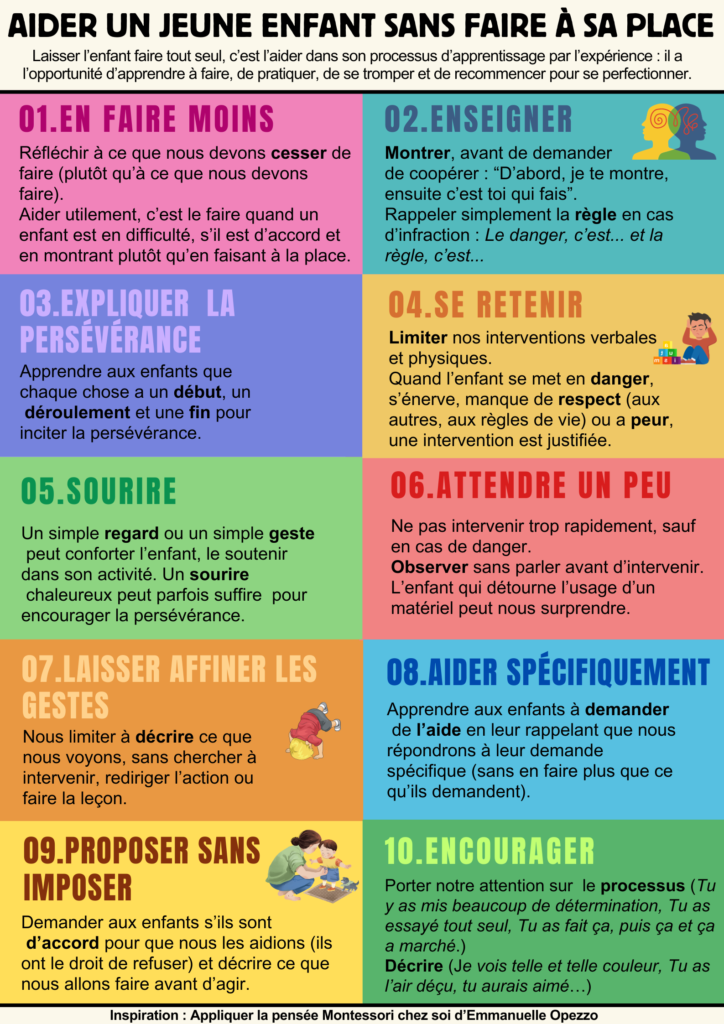
Helping a young child without doing it for them is one of the trickiest balancing acts in parenting. We are often tempted to take over because the child is still too small, too clumsy, too slow or too fragile. Yet a young child loves to do things alone, because doing is how they learn and build themselves.
Letting a child try alone supports learning through experience: they get the chance to practise, to make mistakes and to start again until the gesture improves. Maria Montessori's approach rests on the idea that when an adult does something a child already knows how to do, or prevents them from learning to do it alone, the adult gets in the way of development and skill-building.

Giving a young child frequent chances to refine their movements and senses helps them become independent faster. It also feeds self-confidence, self-esteem, perseverance and the ability to take initiative. Still, limiting our interventions never means letting a child do anything at all, at the risk of danger. So how do we help usefully?
Quick takeaways
- Helping is not the same as doing the task for the child.
- Observe before intervening: slow is not the same as stuck.
- Prepare a child-sized space so success comes more easily.
- Demonstrate slowly with your hands, then step back.
- Give real everyday tasks and accept a slower pace.
- Praise effort and keep firm, simple safety limits.
Understand the difference between helping and replacing
Helping and doing something in a child's place are not synonyms. When we take over, we often act out of kindness and haste, but the child loses the very experience that would have taught them. When we step back, the child gains the chance to learn by doing, to practise, to fail and to try again.
This is why the dose of our support matters so much: neither too much nor too little. A well-measured hand builds skills, while a hand that always intervenes builds dependence. If you want to see how much young children can absorb through daily practice, the idea of learning alongside your child is a useful starting point, much like the spirit behind learning with children.
Observation is the first tool here. Before jumping in, watch for a few seconds and ask yourself whether the child is truly stuck or simply slow.
Prepare the space so the child can succeed
A child succeeds more easily in a setting built for their size. Low hooks, a small stool by the sink, accessible shelves and baskets that hold one activity each all reduce the need for an adult to intervene. The environment does part of the work, quietly.
Choice also matters. Offering two or three options instead of a whole wardrobe or toy box keeps decisions manageable and lets the child commit to one. This is the same principle behind simple routines that children can anticipate, as with books about routines that make the day predictable. The same thinking applies when heading back and planning what a child needs each day.
Finally, keep materials within reach and in good condition. A child who can grab their own cup, cloth or shoes without asking will practise far more often, and each repetition sharpens the gesture. Even small party favors can be chosen with the same care, as these party favor toys show.
| Situation | Better response | Why it helps |
|---|---|---|
| Child is slow but progressing | Wait and watch | Preserves practice and perseverance |
| Child is truly stuck | Show the gesture slowly | Teaches the method without taking over |
| Something spills | Invite the child to wipe up | Turns mistakes into a useful skill |
| Real danger (stairs, hot pan) | Intervene immediately | Safety always comes first |
| Child is tired or overwhelmed | Scale back the task | Keeps confidence intact |
Show the gesture slowly, then step back
Instead of correcting with words, demonstrate. Slow, deliberate movements show the child exactly how to pour, fold, button or carry, and the child copies what they see rather than what they hear. Speak little during the demonstration; let the hands do the teaching.
Then withdraw. Stay nearby, available but not hovering, and resist the urge to reposition the child's fingers. If something spills, treat it as part of the process and invite the child to wipe it up, which is itself a useful skill.
Handling small objects during these demonstrations is also excellent practice for the hands. Activities that build grip and coordination, such as fine motor toys, pair naturally with everyday gestures like spooning, threading or pouring.
Let the child do the real, everyday tasks
Real tasks teach more than pretend ones. Carrying a plate, watering a plant, sorting laundry or setting the table gives the child a genuine role and a sense of belonging. The goal is not a perfect result but participation and repetition.
Accept a slower pace. A child who dresses alone takes longer, and that is the point: the time spent is the learning. Build a little margin into the morning so the child can try before you help, and let them choose simple pieces themselves.
Play supports this too. Toys that invite repeated, careful handling, like bath toys or sturdy building sets, let children rehearse the same motion until it becomes easy. If your child is drawn to vehicles, toys for cars can also offer plenty of small-scale loading, pushing and parking to refine control. Outdoor play works the same way, and these outdoor toys give children plenty of chances to practise real, hands-on skills.

Encourage effort rather than praising the result
Notice the attempt, not just the outcome. Saying that you saw them try, concentrate or start again teaches the child that effort counts, which is what sustains perseverance when a task is hard.
Let natural consequences do some of the teaching, within safe limits. A cup carried too fast spills, and the child learns to carry it more carefully next time. Our role is to keep the situation safe, not to prevent every small mishap.
This patient, encouraging stance echoes the wider idea that adults shape children by example and attention, a theme captured in teaching with care. Over time, the child internalises the message: I can try, and I can manage.
Keep the child safe while giving freedom
Limiting our interventions never means abandoning supervision. Safety comes first: secure heavy furniture, keep dangerous objects out of reach and stay close during water, stairs or kitchen tasks. Freedom grows inside clear, safe boundaries.
Set a few firm limits and explain them briefly, then allow everything else. This gives the child room to explore without constant correction, and it protects the adults from hovering. Outings are a good place to practise, for instance when you eating out with baby and let the child handle a spoon or a cup.
When the child is tired, hungry or overstimulated, scale back the challenge. Autonomy is not a test; it is a practice that grows best when the child feels secure.
My hands-on take
In my own home, the biggest shift came from simply pausing. I used to swoop in the moment a sleeve got stuck or a cup wobbled, mostly because it was faster. Once I started counting a few silent seconds before reacting, I noticed my child was often mid-solution, not mid-failure.
The second change was rearranging the space: a low stool by the sink, a small basket of cloths, cups on a reachable shelf. The nagging dropped, and the practising went up. I still get it wrong on rushed mornings, but the rule I keep coming back to is simple: help with the part that is genuinely too hard, and leave the rest to small, determined hands.
Frequently asked questions
Does stepping back mean letting my child do anything?
No. Limiting your interventions means giving room to practise inside clear, safe boundaries. You stay close and intervene at once whenever there is real danger.
What if my child asks for help?
Help, but help usefully: demonstrate the gesture, break the task into smaller steps or do only the part the child cannot manage yet. Then hand the rest back.
Is it normal for my child to be slower than I am?
Yes, and that slowness is where the learning happens. Building a little extra time into the day removes the pressure to take over.
How do I encourage without overpraising?
Describe what you saw: the concentration, the retry, the careful hand. This points the child toward effort rather than toward a perfect result.
Product Reviews
 Best Toys for Dogs With High Prey Drive |
Best Outdoor Toys for 3-4 Year Olds |
Best Outdoor Toys for 6 Year Olds |
Best Harness for Poodle |
Best LEGO Sets for Adults |
Best Travel Toys for 4 Year Olds on Airplane |
Best Toy Stores in Washington DC |
Best Potty Training Toys |
Best Toys for Tripod Dogs |
Maillot equipe de france







