


Gentle parenting is often reduced to a handful of phrases, as if swapping “no” for “stop” were enough to change a family. In reality, it is a way of thinking before it is a box of tools, a philosophy of relationship rather than a method for making children obey.
When we describe this approach as conscious, creative, playful and respectful, we give it back its full depth. It asks parents to look inward, to adapt to each child, and to protect the relationship as much as the rules.

This article walks through what gentle parenting really means and the four principles that guide it day after day.
Quick takeaways
- Gentle parenting is a philosophy of relationship, not a toolkit for obedience
- Conscious, creative, playful and respectful are the four defining words
- Clarify your long-term goals before adopting any technique
- Warmth and structure work together: firm on behaviour, soft on emotions
- Active listening addresses the feeling before correcting the behaviour
- Adapt expectations to each child’s age, temperament and needs
Redefining what gentle parenting actually means
The words that best describe this approach are conscious, creative, playful and respectful. Conscious parenting means refusing to be led automatically by inherited beliefs about what education should be. Creative parenting accepts that there is no single right way, only a philosophy embodied with flexibility, depending on the parent’s personality and each child’s age, temperament and needs.
Playful parenting recognises that laughter and play build a warm family atmosphere and feed everyone’s emotional needs. It is not about avoiding every conflict or being permanently calm. Respectful parenting applies to adults too: being kind does not mean being a doormat, and the right to make mistakes belongs to parents as much as to children.
The priority is the relationship and a sense of security. This way of thinking also shapes daily life beyond discipline, from work choices to food, community involvement and schooling. It is a genuine path of personal and relational growth, not a collection of tricks.
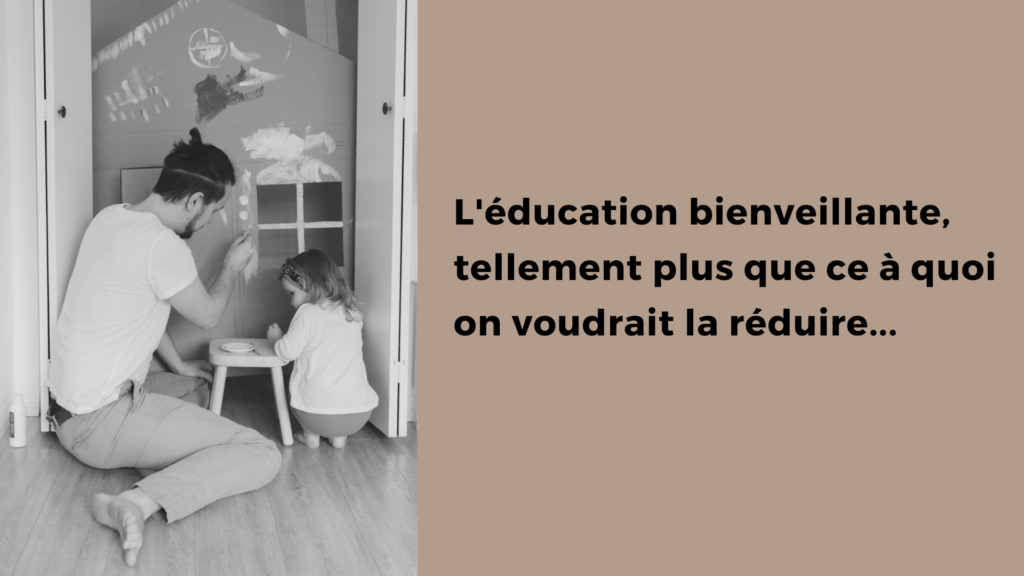
Start with your long-term goals
Before reaching for any technique, ask what kind of person you hope your child becomes. Questions about your own values, your ethics and the example you set give real substance to everyday decisions. It also helps to notice your repetitive patterns, such as what happens when you shout or lose your temper.
Then check coherence: do your daily practices actually help your children become the people you describe? What you say at the supermarket, at meals or at bedtime either supports those aims or works against them. If it does not, what could you do instead? This self-reflection is the essential pillar before redefining authority.
Looking inward is not about drowning in guilt or feeling incompetent. Excessive self-criticism is just as counter-productive as denial. The more you understand yourself, the clearer it becomes how your needs and history affect the way you act with your children. As Alfie Kohn puts it, do not stop being bothered if you find some of the things you do bothersome.

| Principle | What it means | Daily practice |
|---|---|---|
| Conscious | Acting from awareness rather than inherited beliefs | Ask what you want to embody and notice your patterns |
| Creative | No single right way; adapt to parent and child | Adjust your response to age, temperament and needs |
| Playful | Laughter and play build warmth and ease tension | Use games, stories and shared humour |
| Respectful | Rights apply to adults and children alike | Hold boundaries without shaming anyone |
| Long-term goals | Values guide everyday choices | Check whether daily words match your aims |
Warmth and structure are compatible
You can be firm about behaviour and soft about emotions. Psychologist Haïm Ginott points out that wanting to hit and actually hitting are two very different things, and that if we want to improve behaviour we must first address the emotions behind it.
Welcoming feelings and practising active listening are the practical ways to do this. In active listening, the parent tries to understand what the child feels and what their message really means, then reflects it back rather than rushing to correct or lecture. This is where sensory games and shared play become valuable, because they give children another outlet for what they cannot yet put into words.
Structure holds the boundary; warmth holds the child. Holding both at once is what makes the approach credible, and it is far more demanding than simply choosing between permissiveness and strictness.

Adapt to your child’s stage and temperament
No philosophy works the same way at every age. A toddler testing limits, a preschooler exploring the world and a school-age child seeking independence all need different responses. Observing developmental stages helps you adjust expectations instead of treating normal behaviour as defiance, whether you are reading about infant development or supporting a child who has suddenly learned to climb.
Practical routines carry a lot of this load. Predictable mealtimes, calm transitions and reliable bedtime rituals reduce friction before it starts, which is why baby sleep methods and simple daily structure matter so much. Play and stories do similar work, turning rules into something children can absorb naturally, as with fun math stories or games that build connection.
Adaptation also means respecting your own limits. A parent who is exhausted cannot be endlessly creative, and acknowledging that is part of the philosophy rather than a failure of it.

Build the environment that supports the philosophy
Gentle parenting extends into the home itself. A calm, organised space with accessible toys and clear storage reduces daily conflict, and thinking about LEGO storage or how you rotate play materials is part of that. Choosing open-ended toys that invite experimentation supports the creative and playful dimensions described above.
Family culture matters too. Shared rituals, stories and time outdoors nourish the emotional security this approach depends on, and ideas such as happy family keys or elder storytelling can anchor those habits. Even small choices, like outdoor preschool toys for daily fresh air, feed the relationship.
None of this requires perfection. It requires intention: noticing what your environment encourages and adjusting it so the philosophy has room to breathe.

My hands-on take
In my own home, the shift came when I stopped collecting techniques and started asking a simpler question each evening: did today’s words match what I actually want my children to carry into adulthood? Some days the answer was uncomfortable, and that discomfort turned out to be useful rather than something to bury.
What helped most was small and unglamorous. I named my own triggers out loud, kept bedtime predictable, and let play do some of the work when a conversation was going nowhere. I still raise my voice sometimes. But the relationship stays the priority, and repairing afterwards has become as normal as the mistake itself.
Frequently asked questions
Is gentle parenting the same as permissive parenting?
No. Gentle parenting keeps firm boundaries around behaviour while staying warm about emotions. Being respectful does not mean being a doormat, and adults keep the right to set limits.
Do I have to be calm all the time?
No. The approach does not require permanent zen or the avoidance of all conflict. What matters is repairing after difficult moments and understanding what triggered them.
Where should a parent begin?
Start with self-reflection about your long-term goals and values. That inner work gives meaning to the practical tools and helps you notice whether your daily actions match your intentions.
Does it work the same way at every age?
No. Expectations need to shift with each child’s developmental stage and temperament. Observing what is normal for the age prevents ordinary behaviour from being read as defiance.
Product Reviews
 Best Toys for Dogs With High Prey Drive |
Best Outdoor Toys for 3-4 Year Olds |
Best Outdoor Toys for 6 Year Olds |
Best Harness for Poodle |
Best LEGO Sets for Adults |
Best Travel Toys for 4 Year Olds on Airplane |
Best Toy Stores in Washington DC |
Best Potty Training Toys |
Best Toys for Tripod Dogs |
Maillot equipe de france







