


Couple communication is one of the quiet foundations of family life, and it rarely gets the attention it deserves once children arrive. A therapist who spent years sitting with struggling couples noticed that the same four habits keep showing up when relationships fray: criticism, contempt, counter-attack and avoidance.
Naming those traps is the first step. The second is replacing them with habits that keep a disagreement from turning into a contest of wills. This article walks through each pattern, explains how a couple can talk about the way they talk, and offers a simple checklist you can keep nearby.

Quick takeaways
- Criticism attacks character; a concrete complaint plus a request does not.
- Contempt is the most corrosive habit because it attacks worth, not behaviour.
- Counter-attack and avoidance both dodge the issue; name the pattern early.
- Metacommunication clarifies meaning but becomes a trap when it turns into a power struggle.
- Pair a weekly check-in with an existing routine so the habit survives.
- Children learn conflict repair by watching how adults handle friction.
Criticism: from blame to a clear request
Criticism moves past a specific complaint and turns it into a verdict on the other person. "You forgot to call" becomes "you never think about anyone but yourself." The first sentence describes a moment; the second describes a character, and nobody can defend against a character.
The practical shift is to keep the complaint concrete and add what you actually need. Say what happened, how it landed, and what would help next time. That structure feels mechanical at first, but it stops the conversation from becoming a trial.
Why contempt is the most corrosive of the four
Contempt adds a layer of superiority: eye-rolling, mockery, sarcasm, a tone that says the other person is beneath consideration. Of the four habits, this one does the most damage because it attacks worth rather than behaviour. Catching yourself mid-eye-roll is genuinely useful information.
Counter-attack and avoidance: two ways out of the room
Counter-attack meets a complaint with a bigger complaint. One person raises a small irritation, the other answers with a list, and the original issue disappears. Avoidance is the mirror image: one partner goes silent, changes the subject, or leaves, and the issue stays exactly where it was.
Both patterns protect against discomfort in the short term and cost the relationship in the long term. A useful habit is to name the pattern out loud before it takes over, then agree to return to the topic at a set time rather than dropping it. Knowing how to imaginative play works both ways here: giving a conversation room to breathe usually produces better ideas than forcing it. The same patience pays off at home, as these first three years guidelines suggest.
Parents often notice this most sharply in the evening, when patience is thin. A short pause, a glass of water, a decision to continue after bedtime — these small moves keep a disagreement from becoming a nightly ritual.
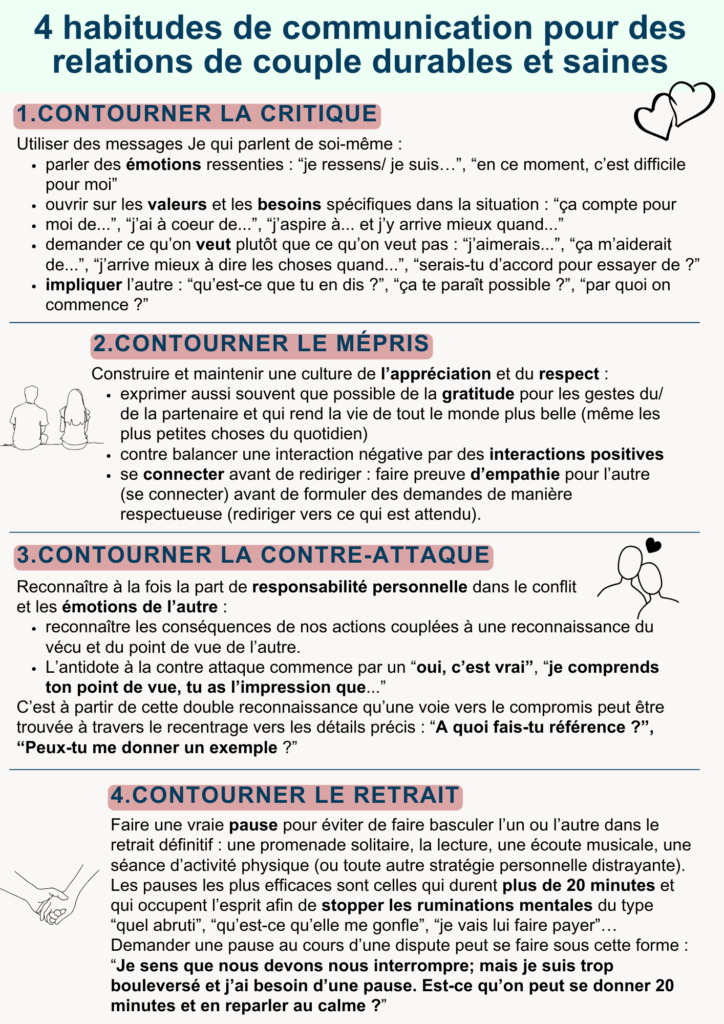
| Trap | What it sounds like | Replacement habit |
|---|---|---|
| Criticism | "You never think of anyone but yourself" | Describe the moment, then make a clear request |
| Contempt | Eye-rolling, mockery, sarcasm | Name one thing you appreciate, even briefly |
| Counter-attack | Answering a complaint with a bigger one | Acknowledge the fair part first, then add your view |
| Avoidance | Going silent, changing the subject, leaving | Ask for a set time and return to the topic |
| Metacommunication trap | Arguing about how the other is speaking | Return to the content, or ask which signal to trust |
Metacommunication: talking about how you talk
Metacommunication means communicating about communication. We do it whenever we add a comment that qualifies a message: "I'm joking, honestly," a wink, a softened tone. It clarifies meaning and acts as a regulator in the relationship.
It also has a trap. When both partners start commenting on each other's comments, the conversation drifts away from the actual content and becomes a struggle over who is right about how the other is speaking. Dialogue is replaced by a power struggle.
One way out of a double bind is to ask directly: should I trust your words or your tone? That question only works when there is enough trust to answer honestly. Building that trust is slow work, a little like the patience needed for learning to speak in the early years — steady, unglamorous, cumulative.
Habits that replace the four traps
Instead of criticism, describe the situation and make a request. Instead of contempt, name what you appreciate, even briefly. Instead of counter-attack, acknowledge the part of the complaint that is fair before adding your own view. Instead of avoidance, ask for a specific amount of time and come back.
None of these habits require a perfect day. They require noticing, which is easier when the household is not running on empty. A predictable routine — a shared snack, a calm half hour — does more for couple communication than any script. Something as ordinary as avocado toast at the kitchen table can become the moment you actually talk. A little wooden house can keep the children happily occupied nearby, and choosing the best undershirt for the school day is one less thing to sort out.
It also helps to lower the stakes. Not every conversation needs to resolve anything. Sometimes the goal is simply to be heard, and saying so out loud prevents a discussion from turning into a negotiation.

Making the habits stick in family life
New habits fade unless they are attached to something that already happens. Try pairing a weekly check-in with an existing routine: after the children are down, on a walk, on the way to work. Two questions are enough — what went well this week, and what felt hard?
Children watch how adults handle friction, and they learn from it. A household where disagreements stay concrete and repair happens quickly gives them a template. That is one reason motherhood changes priorities so dramatically: the audience is always there, and the example is always being set. The same holds for everyday care, from a newborn's bath to bigger routines.
Keep the checklist visible for a month. After that, most couples find they no longer need it, because the pause before the old habit has become automatic.

My hands-on take
I started paying attention to this after a stretch when every evening conversation seemed to end in the same place. What helped most was not a grand plan but a small rule: describe the situation, then ask for what I needed. It felt awkward for about two weeks, and then it stopped feeling like a script.
The other change was asking for time instead of going quiet. Saying "I need twenty minutes, then let's finish this" turned out to be far more useful than silence, which my partner read as dismissal. We still slip into the old patterns, especially on tired days, but we notice faster now — and noticing, it turns out, is most of the work.
Frequently asked questions
What exactly is metacommunication?
It is communication about communication — any comment, tone or gesture that qualifies a message, such as "I'm joking" or a wink. It clarifies meaning and helps regulate a relationship, but it backfires when it becomes an argument about how the other person is speaking.
Why is contempt singled out as the worst of the four?
Criticism, counter-attack and avoidance all target a situation or a behaviour. Contempt targets the person's worth, which leaves nothing to negotiate and makes repair much harder.
Can these habits work if only one partner tries?
Yes, to a point. One person changing the pattern often shifts the exchange, because the usual script no longer runs. Naming the pattern out loud and asking for a set time to continue is usually more effective than trying to change everything at once.
How do we start without a big conversation?
Pick one habit and one moment. A weekly check-in attached to an existing routine, with two simple questions, is enough to begin.
Product Reviews
 Best Toys for Dogs With High Prey Drive |
Best Outdoor Toys for 3-4 Year Olds |
Best Outdoor Toys for 6 Year Olds |
Best Harness for Poodle |
Best LEGO Sets for Adults |
Best Travel Toys for 4 Year Olds on Airplane |
Best Toy Stores in Washington DC |
Best Potty Training Toys |
Best Toys for Tripod Dogs |
Maillot equipe de france







