


Using mental images and drawing to memorize the spelling of words is a simple, low-cost trick that works especially well for children who struggle with dictation preparation. Instead of repeating a word until it sticks, you build a small, funny, personal story around the letters that keep going missing.
The method starts from the child's own associations, adds a touch of humour, and pairs the story with a quick sketch and sometimes a gesture. The goal is not beautiful art but a memorable picture that makes the correct spelling impossible to forget.

Quick takeaways
- Build a short, funny story around the letters that keep going missing.
- Draw the story simply, then have the child redraw and retell it.
- Start from the child's own associations, not the adult's.
- Add gestures to involve the body and reinforce the image.
- Link the word to its family or etymology when it helps meaning.
- Keep a notebook of images to review before each dictation.
A Real Dictation List and the First Mental Image
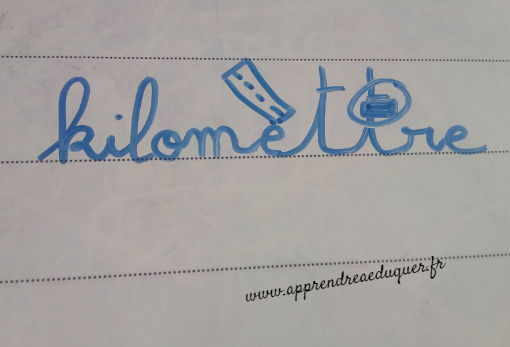
The starting point was an ordinary dictation list built around the different spellings of the sound [k]: chorale, d'accord, anorak, carte and kilomètre. A child in CE1 (second grade in France) missed several of them, so instead of plain repetition we invented little stories and drew them.
For "kilomètre", which she had written "kilomettre", the story was that covering kilometres means taking the road, which is why there is an accent on the E, drawn as a little road. The second T gets a no-entry sign, because you have to stop at the first one.
Why the Story Works
A story gives the eye something concrete to hold on to, and the drawing anchors it. This is the same pleasure children get from love of reading when a tale makes an abstract idea feel real and personal.
Four Mental Images for Tricky French Words
For the silent E in "carte", which she had dropped, we imagined a new card in an ordinary card game, with the E card glued onto the end of the word. For "anorak", we pictured a zip going up and then down to form the vertical bar of the K, then a belt being tightened to form the loop in cursive writing.
For "chorale", a conductor stands where the C should be and a singer stands where the H should be, singing on both feet and being directed. The two are inseparable, so the C and the H always appear together.
For "d'accord", the idea is that it always takes two people to agree, which explains the two C's for the [k] sound and the two D's at the start and the end. We drew arms on the letters so they could do a high five, a "check, tape en 5" that symbolises the agreement. Just as with child safety elements, these memory aids work best when paired with something concrete.
| Word | Trap | Mental image |
|---|---|---|
| kilomètre | double T, accent | road for the accent, no-entry sign on second T |
| carte | silent final E | extra E card added to a card game |
| anorak | final K shape | zip up and down, then tighten the belt |
| chorale | C and H together | conductor and singer, inseparable |
| d'accord | two C, two D | two people high-fiving to agree |
Start From the Child's Own Associations
These examples only work because they speak to that particular child and parent. At first the plan for the final E of "carte" was a globe, thinking of a map of the world, but when asked what a card made her think of, she said a card game, so the idea changed.
Older children who are used to this way of working can create their own stories completely independently. That autonomy matters, much like the confidence children build through learn to ride a bike on their own terms rather than by copying an adult.
Humour and the Grotesque
Adding humour or deliberately silly, exaggerated elements makes memorization even stronger. A ridiculous image is simply harder to forget than a sensible one, and children enjoy inventing it.
Combine Drawing With Gestures and Word Families
The core principle is to start from the child's own representations so that memorization is more effective. You can also add gestures for a kinaesthetic entry point: we mimed zipping and unzipping the anorak, then tightening the belt, and acted out the conductor and singer scene for "chorale".
Etymology and word families can reinforce meaning at the same time. For "kilomètre", we also noted that it belongs to the same family as "mètre" but represents a much greater length, a thousand metres. One approach does not exclude the other, and combining them is often the most durable solution, much like using helpful parenting apps to stay organized.
Small children respond well to movement, just as they do to hands-on play with Montessori toys that invite them to touch and manipulate rather than simply listen. For families facing bigger transitions, such as when a child goes on exchange, the same playful, hands-on approach helps learning stay anchored.

A Step-by-Step Routine You Can Repeat at Home
The routine itself is short. Tell the story once while drawing it, then tell it a second time while drawing it again from the start. Next, ask the child to retell the story using your drawing, then to draw the picture word themselves, and finally to retell the story while writing the word out in full letters.
This progression moves from listening to speaking, then to drawing, then to writing, which gradually transfers the image into the hand as well as the mind. It takes only a few minutes per word and fits easily into homework time.
No Drawing Talent Required
You do not need to be good at drawing; simple stick figures and rough shapes are enough. What counts is the story and the shared laugh, not the quality of the sketch.
Keeping the Habit Going Over Time
Keep a small notebook of the images you invent so the same story can be recalled before the next dictation. Reviewing two or three pictures the day before a test is usually enough to reactivate the memory.
Invite the child to explain the image to someone else, since teaching it back is one of the strongest ways to consolidate it. A calm, unforced moment works best, much like the relaxed routine described in neck pain advice about not tensing up. Small everyday rituals, from childhood ice creams to home haircuts, can anchor that calm.
Over the weeks, children start spotting their own tricks, and the habit becomes a toolbox they carry into middle school.


My hands-on take
I first tried this with a dictation list full of [k] spellings, and the word that stuck fastest was "kilomètre" once we turned the accent into a little road and planted a no-entry sign on the second T. My drawing was frankly terrible, but my daughter laughed, corrected the word herself, and remembered it weeks later.
What surprised me most was how quickly she took over. After two or three words she was proposing her own images, and some of them were far better than mine. I now keep a small notebook of these pictures, and a quick look at it the evening before a dictation does more than half an hour of flat repetition ever did.
Frequently asked questions
Does this method replace regular spelling practice?
No, it complements it. The image helps the child recall a specific difficulty, while reading and writing practice build overall fluency.
At what age can children invent their own images?
Children used to the technique can usually create their own stories by the end of primary school. Younger ones need an adult to propose the first images.
What if the child rejects the suggested image?
Ask what the word makes them think of and build a new story from their answer. An image chosen by the child is always more effective.
Do we need to be good at drawing?
Not at all. Rough sketches, arrows and stick figures work perfectly; the story carries the memory.
Product Reviews
 Best Toys for Dogs With High Prey Drive |
Best Outdoor Toys for 3-4 Year Olds |
Best Outdoor Toys for 6 Year Olds |
Best Harness for Poodle |
Best LEGO Sets for Adults |
Best Travel Toys for 4 Year Olds on Airplane |
Best Toy Stores in Washington DC |
Best Potty Training Toys |
Best Toys for Tripod Dogs |
Maillot equipe de france







