


Child brain development is one of the most useful lenses a parent can hold when a child melts down over something that seems trivial. Knowing that the brain is still under construction changes how we read the behaviour in front of us.
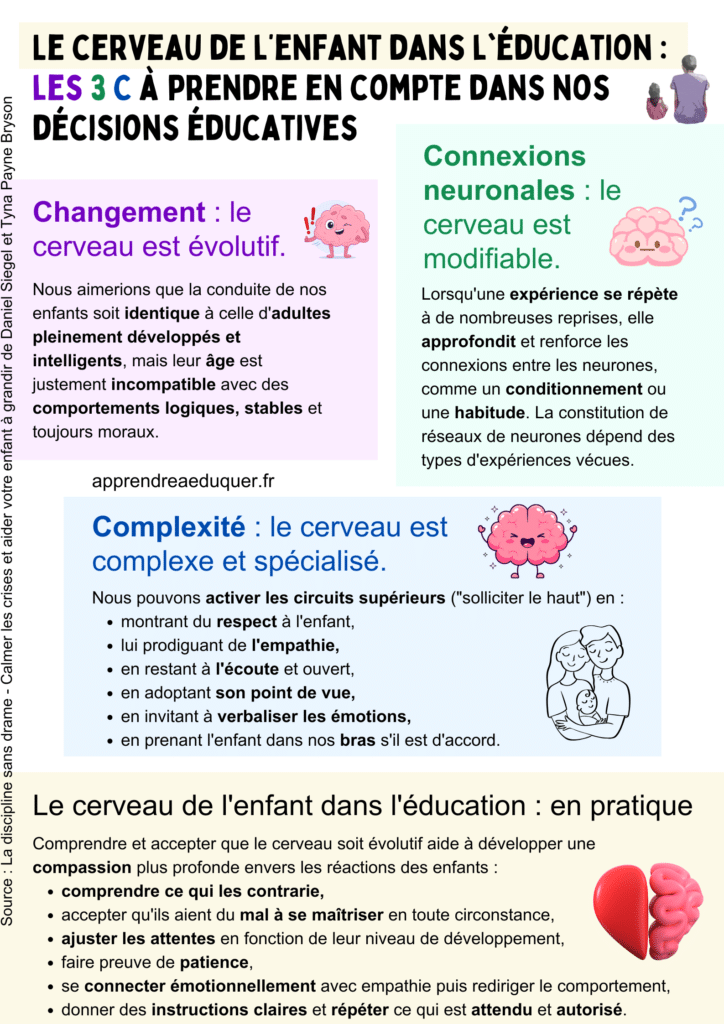
Three simple ideas, often summarised as the three C's, capture what matters most: the brain is changing, it is shaped by neural connections, and it is complex and specialised. None of this means children never need limits; it means the way we set them matters.

Quick takeaways
- The child brain is still under construction, so adult-level logic is not a fair expectation.
- The lower brain dominates in children; the upper brain matures slowly, into adulthood.
- Repeated experiences shape neural connections, for better or for worse.
- Threats trigger the lower brain and shut down reasoning; empathy engages the upper brain.
- Naming an emotion helps fear and anger subside.
- We can lend our calm adult brain as an external upper brain.
The changing brain: a house still under construction
The first C is change. A child's brain never stops transforming, and it develops from the bottom up. The lower brain handles strong emotions, primitive instincts and unconscious vital functions, and it dominates in young children. The upper brain manages emotional regulation, flexibility and rational decision-making, and it matures slowly, with full development only around age 25.
This is why expecting a child to behave like a fully developed adult is unreasonable. They cannot always stay logical, stable and moral in every situation. Adjusting our expectations is not indulgence; it is accuracy, and it lets us offer patience, take their point of view and connect emotionally before correcting. The same patience helps at every stage, from infant development to the teenage years, and it works just as well when you're soothing baby hiccups or explaining a LEGO set's cost.
Being the external upper brain
Because the child's upper brain is still being built, our mature adult brain has to lend a hand. We can act as an external upper brain, offering calm, empathy, reasoning, self-control, suitable demands, words for feelings and collaboration. This is the practical heart of the first C.

The modifiable brain: neural connections take shape
The second C is connections. The brain is neuroplastic, meaning its architecture is moulded by experience. Repeated experiences deepen and strengthen the connections between neurons, much like a habit or a form of conditioning. Those neural networks can be a good thing or a bad thing, depending on what gets repeated.
That raises honest questions for parents. What kinds of experience do we want our children to have? Which connections do we want to reinforce? And how should we react to inappropriate behaviour, knowing that repeated reminders of the rule leave a real imprint on the brain's structure? Keeping a illustrated book routine or a calm bedtime ritual is one small way to repeat the experiences we value. Everyday care counts too, so use hydroalcoholic gel thoughtfully and grow strong hair with gentle, consistent habits.
Repetition builds the pattern
Every interaction is a small rehearsal. A shouted correction rehearses shouting; a calm, firm explanation rehearses calm. That does not mean walking on eggshells, but it does mean noticing what our daily habits are quietly teaching.
| Feature | Lower brain | Upper brain |
|---|---|---|
| Main role | Strong emotions, instincts, vital functions | Regulation, flexibility, rational decisions |
| When it dominates | In young children and under threat | When calm and connected |
| What activates it | Threats, shaming, shouting | Respect, empathy, naming feelings |
| Parenting response | Soothe and reconnect first | Explain limits and expectations |
| Maturity | Present early in life | Develops slowly, fully around 25 |
The complex brain: engaging the upper brain
The third C is complexity. The brain is specialised, and when a child is upset or exasperating us, it pays to engage the upper brain rather than the lower one. Threats and shaming simply tickle the reptile: when the lower brain detects danger, it prepares to attack, freeze or flee, and that readiness shuts down the upper brain. No human, child or adult, can run primitive reactivity and self-control at the same time.
The good news is that the upper brain can soothe the lower one. We activate those higher circuits by showing respect, offering empathy, staying open and listening, taking the child's perspective, inviting them to put feelings into words, and holding them if they agree. Naming an emotion is often enough to make fear and anger subside.
Why connection comes before correction
Once the upper brain is engaged, the child can actually receive the limits and expectations we want to communicate. A calm baby care approach in the early years sets the tone for this pattern later on, much like choosing nipple creams calls for calm, informed attention.

Putting the three C's into practice
Holding these three facts in mind does not guarantee that children will always cooperate or behave as we hope. What it does do is make daily exchanges more pleasant, build a relationship of trust and mutual respect, and reduce the drama in conflictual situations.
It also does not guarantee that we will be patient and empathetic every single time. We are human, and our own lower brain reacts too. The aim is not perfection but repair: noticing when we lost our temper and reconnecting afterwards. Parents who model that repair give children a powerful lesson in making mistakes and coming back.
Practical habits help. Pause before reacting, name what you see, keep limits short and clear, and save bigger conversations for calmer moments. Even small routines, like a toy rotation that keeps play calm and predictable, support the settled state in which the upper brain can work.

What this means for limits and expectations
Understanding the brain does not remove the need for boundaries. Children still need the frame, and they still need us to hold it. The difference is that we set limits with connection rather than through threat, so the child's upper brain stays available to hear us.
Expectations should match developmental level. A toddler cannot sustain sharing for long, and a school-age child cannot regulate a tired meltdown on demand. Adjusting the demand is not lowering the bar; it is setting a bar the child can actually reach today, and raising it as the brain matures.
Over time, this steady, warm consistency builds the very capacities we hope for: self-control, empathy and the ability to recover from strong feelings. That is the long game the three C's invite us to play.
My hands-on take
In our house, the biggest shift came from naming feelings out loud instead of jumping straight to the rule. When my youngest was mid-meltdown over a broken tower, I stopped explaining and simply said, "You're really frustrated, that took ages to build." Almost every time, the volume dropped within a minute, and only then could we talk about what to do next.
I also learned to watch my own lower brain. On tired evenings I was the one reacting first, so I started taking one slow breath before speaking. It is not magic, and some days still go badly, but repairing afterwards has become part of our routine, and it has made the hard moments far shorter.
Frequently asked questions
Does understanding the child brain mean I should stop setting limits?
No. Limits remain essential. The point is to set them after connecting, so the child's upper brain is available to receive the message rather than reacting defensively.
Why does my child seem unable to reason when upset?
When the lower brain detects a threat, it prepares to attack, freeze or flee, and that shuts down the upper brain. Reasoning only works once the child is calm again.
Can repeated reminders of a rule really affect the brain?
Yes. Repeated experiences strengthen neural connections, so consistent, calm reminders build habits, while repeated harsh corrections rehearse a different pattern.
What is meant by being an external upper brain?
It means lending your mature calm, empathy and reasoning while the child's own upper brain is still developing. Over time, the child internalises that steady response.
Product Reviews
 Best Toys for Dogs With High Prey Drive |
Best Outdoor Toys for 3-4 Year Olds |
Best Outdoor Toys for 6 Year Olds |
Best Harness for Poodle |
Best LEGO Sets for Adults |
Best Travel Toys for 4 Year Olds on Airplane |
Best Toy Stores in Washington DC |
Best Potty Training Toys |
Best Toys for Tripod Dogs |
Maillot equipe de france







