


Bedtime protest is one of the most familiar struggles in family life, and it rarely looks calm. Young children, and plenty of older ones too, cry, bargain and produce a stream of excuses the moment the lights are meant to go out.
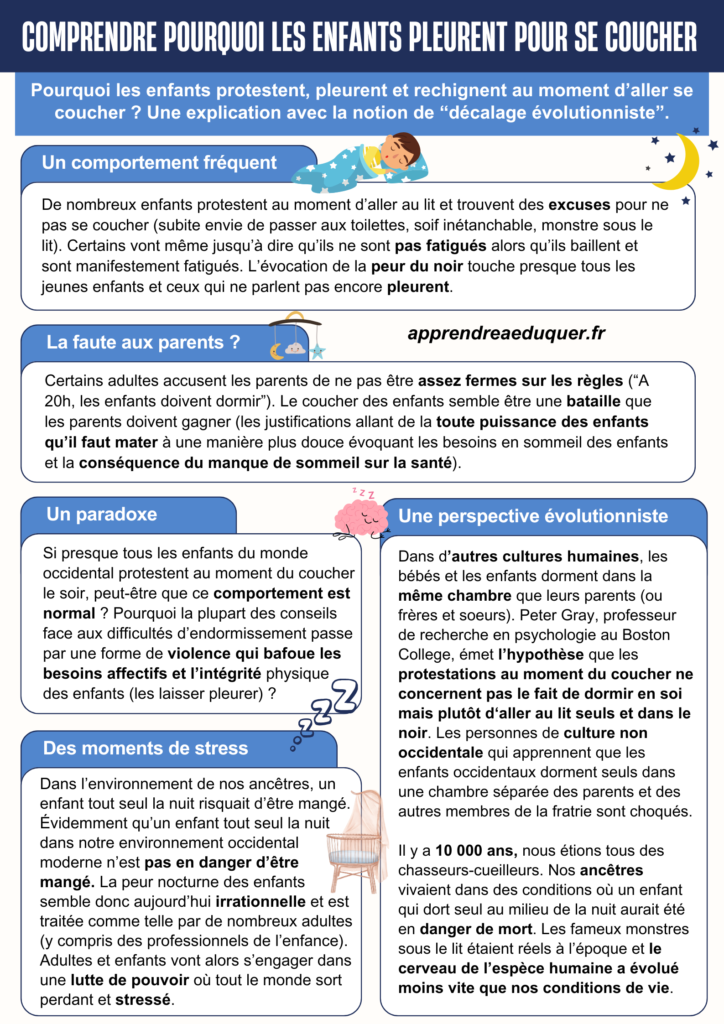
The requests range from a sudden urgent trip to the toilet to an unquenchable thirst, or a monster under the bed. Some children insist they are not tired at all while yawning widely, and the smallest ones who cannot yet speak simply cry with real intensity.

An evolutionary perspective offers a kinder explanation than the usual talk of discipline, and it points toward practical changes that respect both children and parents.
Quick takeaways
- Bedtime protest is extremely common across the Western world, which suggests it is normal rather than a discipline failure.
- Peter Gray argues the protest is about going to bed alone and in the dark, not about sleep itself.
- An evolutionary mismatch explains why an old survival alarm fires in a modern, safe bedroom.
- Children are not testing or manipulating parents; the fear is not a question of willpower.
- Power struggles leave parents exhausted and teach children to distrust their own feelings.
- Co-sleeping and creative family arrangements can respect everyone's needs and limits.
A Behaviour That Is Normal and Very Common
Almost every child in the Western world protests at bedtime in some form, and that consistency is itself a clue. Traditional advice often frames these protests as the result of parents who are too soft and not firm enough about the rule that children must be asleep by a set hour.
Bedtime then becomes a battle parents feel they must win, justified either by the idea that children need to be put in their place or, more gently, by genuine concern about sleep needs and the effect of too little sleep on health and school performance. Yet two details deserve attention: if nearly all children do this, perhaps the behaviour is simply normal, and it is strange that so much sleep advice relies on a form of pressure that ignores children's emotional needs.
That pressure sits awkwardly beside the fact that sleep is clearly something good, as good as breastfeeding cuddles for a small baby. Firm methods also clash with the broader question of children's evolutionary process and whether adults should direct it or let it unfold.

An Evolutionary Lens on Bedtime Tears
Peter Gray, an American researcher and psychology professor at Boston College, invites us to step outside the Western frame. In many other human cultures, babies and children sleep in the same room as their parents or siblings, and Gray suggests the protest is not about sleep itself but about going to bed alone and in the dark.
He reports that people from non-Western cultures are shocked to learn that Western children sleep alone in a room separate from parents and siblings. This connects to how much the first three years shape a child's sense of safety, and to the way an imaginary friend or a monster under the bed can feel utterly real to a young child.
Why the Fear Made Sense
Gray takes an evolutionary view: around ten thousand years ago our ancestors were hunter-gatherers, and a child lying alone in the dark really could be in mortal danger. The monsters under the bed were real then, and the human brain has evolved far more slowly than our living conditions. Infants and children who cried loudly when left alone had better chances of survival, because their cries drew adult attention and care; they grew up and passed on their genes to all of us.
| Approach | What the child learns | Effect on the family |
|---|---|---|
| Power struggle until the child gives in | My feelings are not trustworthy | Exhaustion and intense stress |
| Firm sleep-training schedules | Comfort is conditional | Distress for child and parent |
| Co-sleeping or shared room | Nighttime is safe | Rest for everyone, less conflict |
| Sitting nearby while the child settles | Adults are reliable | Slower evenings, calmer nights |
| Night light and predictable routine | Bedtime is predictable | Fewer excuses and tears |
Not Manipulation but an Ancestral Alarm
In this light, a child having a meltdown at bedtime is not testing or manipulating parents. The child is driven by an ancestral fear of a threat to survival, and it is not a matter of willpower: the genetic code carries the information that lying alone in the dark means risking death.
Gray calls this an evolutionary mismatch. In our ancestors' environment a child alone at night risked being eaten, while in a modern Western home that danger is gone, so the fear looks irrational and is often treated that way by adults, including child-care professionals.
Adults and children then enter a power struggle where everyone loses. Parents exhaust themselves, children lose contact with the instinct and emotions that serve as their internal compass, and everyone lives through intense stress. This is close to the dynamic behind parental blackmail and other coercive habits, and it can leave a child feeling that adults cannot be trusted, much as children catching adults red handed shakes their confidence.

Bridging the Gap in Practice
Two alternatives exist when children cry at bedtime, since we cannot simply submit to our mammal nature. One is to continue the family power struggles until children give in and resign themselves, at the cost of intense stress and the lesson that they can trust neither their own feelings nor the adults around them.
The other is to consider changes in how children go to sleep, respecting the needs and personal limits of both parents and children. Co-sleeping in one form or another can be a solution, but every family can be creative and find what suits each member.
Practical steps help: a slow, predictable wind-down, a dim night light, a parent sitting nearby for a while, or a mattress on the floor in the parents' room. A calm body matters too, so check the sleeping setup and consider tips to care for little backs. A familiar toy or a small torch can offer comfort, and a consistent routine gives a child the predictability that educational toys provide in play. Some families find that simply naming the fear out loud, without arguing about it, lowers the temperature of the whole evening.
My hands-on take
In our house, bedtime used to be the worst half hour of the day. My youngest would produce a fresh excuse every few minutes, and I would grow tenser with each one until nobody was calm. Reading about the evolutionary mismatch changed how I saw those evenings: my child was not negotiating, they were frightened.
We stopped arguing about the darkness and started sitting on the floor by the bed for a few minutes, with a small night light and the same short routine every night. Nothing was fixed overnight, and some evenings still go sideways. But the fighting has largely gone, and I no longer feel like I have to win something. If you are in the middle of it, try dropping the battle first and see what happens.
Frequently asked questions
Is bedtime protest a sign that my child is manipulating me?
No. From an evolutionary perspective the child is responding to an ancestral fear of being alone in the dark, and the reaction is not a matter of willpower or strategy.
Does this mean every family should co-sleep?
Not necessarily. Co-sleeping in some form is one option, but each family can find creative arrangements that respect the needs and limits of both parents and children.
Why does my child say they are not tired while yawning?
Children often protest with excuses, including claiming they are not tired, even when they are visibly exhausted. The protest is about the separation and the darkness, not about sleep itself.
Can a night light make a difference?
It can help by softening the darkness that triggers the fear. Pair it with a predictable wind-down routine and a calm adult presence for the best effect.
Product Reviews
 Best Toys for Dogs With High Prey Drive |
Best Outdoor Toys for 3-4 Year Olds |
Best Outdoor Toys for 6 Year Olds |
Best Harness for Poodle |
Best LEGO Sets for Adults |
Best Travel Toys for 4 Year Olds on Airplane |
Best Toy Stores in Washington DC |
Best Potty Training Toys |
Best Toys for Tripod Dogs |
Maillot equipe de france







