


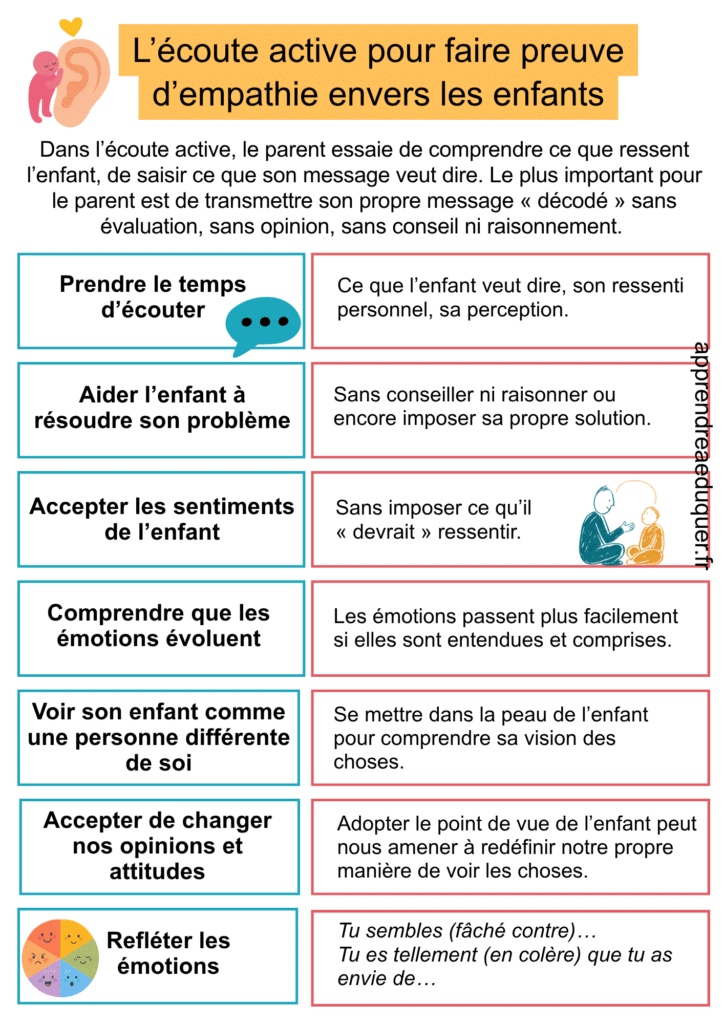
Active listening is the practice of showing empathy toward a child by trying to understand what they feel, what their message really means, and which emotions sit behind the words. For the parent, the essential task is to send back that decoded message without evaluation, opinion, advice, reasoning, or analysis.
It sounds simple and is surprisingly hard. Most of us were raised to explain, correct, and solve. Active listening asks for something else: presence, patience, and the willingness to see a situation through your child's eyes before you say anything at all.

Quick takeaways
- Reflect the feeling, not the behaviour: name what the child seems to experience.
- Drop advice, reasoning, and judgement while the child is still talking.
- Keep reflections tentative with phrases like "you seem" or "it sounds like".
- Trust that emotions pass more easily once they are heard and welcomed.
- Remember your child is a separate person with their own view of reality.
- Stay open to changing your own opinion after seeing things their way.
Attitudes that make active listening possible
Active listening is not a trick you deploy in a single sentence; it rests on a set of attitudes that make it effective. First, you have to want to take the time to hear what the child is actually saying, rather than the version you expect to hear. That means accepting their feelings without imposing what they "should" feel, and resisting the urge to reason, advise, or hand them your own solution.
It also helps to remember that emotions move. There is no need to panic about a feeling that is being expressed, because it is not permanent — and it tends to pass more easily once it has been heard, welcomed, and understood. If you are still working out how to stay calm in those heated moments, some parental cooperation strategies can make the daily routine smoother.
Finally, see your child as a person separate from you. You put yourself in their shoes to grasp their experience and their perception of reality, then reflect it back like a mirror. Being willing to change your own opinions is part of the deal: adopting your child's point of view may lead you to redefine how you see things.
The words of active listening
Empathy has a vocabulary, and it is mostly made of tentative reflections rather than statements. You might say "You seem angry with…", "You are so angry that you want to…", "You wouldn't like…", or "You would rather…". Other openings include "You think that…", "You have the impression that…", "You feel…", and the gentle check "Something is making you scared, is that it?"
You can also name the trigger — "Is it really… that makes you angry?" — or reflect the exhaustion: "You have had enough of…". Positive feelings deserve reflection too: "You really like…, it seems to make you happy." Try "You are afraid of…", "You are disappointed about…", "You mean that…", "Is that what is bothering you?", or "It must be painful to…".
Reflecting, not interrogating
Questions like "Did you feel ashamed, sad, afraid, or angry?" and "You wonder why…" invite the child to keep talking. So do "It seems difficult to…", "It seems risky to…", and "Doing it that way doesn't give you what you want". If your child struggles to name feelings, a calm activity side by side — building with foam block toys, for instance — often loosens the conversation. The same patient, non-judgmental tone helps when you discuss contraceptives after childbirth or approach sensitive topics like the Blue Whale challenge.
| Situation | Listening response | Response to avoid |
|---|---|---|
| Child is furious about a game | "You are so angry that you want to stop playing." | "It's only a game, calm down." |
| Child fears the water | "Something about the pool scares you, is that it?" | "There's nothing to be afraid of." |
| Child complains about a friend | "You mean that what she said hurt you?" | "Just ignore her." |
| Child does not want to stop TV | "You would rather keep watching." | "We agreed on the rule, end of story." |
| Child is disappointed by a result | "It must be disappointing to…" | "You'll do better next time." |
Why reflection works better than advice
When you reflect a feeling instead of correcting it, the child no longer has to defend their position. The energy that went into arguing can go into thinking. This is why a reflected message is kept short and free of judgement: the moment you add an opinion or a lesson, the child hears a verdict rather than understanding.
Reflection also models emotional language. A child who hears "you seem disappointed" learns that disappointment is a word, and that it is allowed. That vocabulary builds slowly, through everyday moments — bedtime, the school run, even the small dramas of getting dressed, where choosing school uniform shoes can become a surprisingly emotional negotiation.
Everyday moments to practise
Active listening does not require a scheduled conversation. It fits into the ordinary friction of family life: the toy that will not work, the friend who was unkind, the screen that has to be switched off. When your son is glued to the television and protests loudly, an screen time limit delivered with a reflected feeling ("you really wanted to keep watching") lands very differently from a lecture.
Fears are another natural opening. A child who is frightened of the pool needs their fear named before any encouragement, which is exactly the approach behind helping a child overcome water fear. The same applies to bigger worries that surface at night, when a parent's calm presence and a few reflective phrases do more than a rehearsed speech. The gentle, open-ended play that fills the daytime can make those evening conversations easier too, as the best open ended toys give children room to work through feelings at their own pace.
And when the adults are the ones struggling, the same skills help. Sharing the load, agreeing on who does what, and listening to each other without scoring points is the foundation of shared parenting duties — the empathy you practise with your child tends to spill over. The same calm approach also makes starting nursery feel far less daunting for everyone.

What gets in the way
The biggest obstacle is our own urgency. We want the crying to stop, the argument to end, the problem solved before dinner. That urgency pushes us straight to advice, which quietly tells the child their feeling was not worth staying with. Noticing that impulse is the first step to pausing before it.
Another obstacle is fear of the emotion itself. A child's rage or grief can feel alarming, and we rush to shut it down. Remembering that feelings are temporary — and that being heard helps them move on — makes it easier to sit with them. If you want the broader picture of how a warm, responsive home shapes a child, these ideas on a happy childhood foundation complement the listening work nicely.
Finally, watch for the moments when your own day is colouring the exchange. A tired parent hears a demand where a rested one hears a need. Naming that to yourself, silently, is often enough to soften your tone.

My hands-on take
I started trying this on the worst evenings, when everyone is tired and the smallest thing sets off a storm. My instinct was always to explain, and my explanations never once ended an argument. So I began saying less: "you seem really frustrated" and then silence. The first few times it felt awkward and slightly fake, and my child looked at me as if I had grown a second head.
What changed was smaller than I expected. The arguments did not vanish, but they got shorter, and I stopped being recruited into a debate I could not win. I still forget, especially when I am rushed. When that happens I try to notice it, take a breath, and go back to reflecting instead of instructing. That small pause is where most of the progress happens.
Frequently asked questions
Is active listening the same as agreeing with my child?
No. Reflecting a feeling says "I understand what you feel", not "you are right and the rule is cancelled". You can hold a limit and still name the emotion clearly.
What if my child refuses to talk?
Stay available without pressure. Short reflections ("you don't feel like talking right now") signal that you are ready when they are, and many children open up later, side by side rather than face to face.
Does this work with very young children?
Yes, in simpler form. Naming what you see — "you're sad because the tower fell" — gives toddlers words for feelings they cannot yet express themselves.
How long before I see a change?
It varies. The shift is usually gradual: fewer escalations, more spontaneous sharing. Consistency matters more than perfect phrasing.
Product Reviews
 Best Toys for Dogs With High Prey Drive |
Best Outdoor Toys for 3-4 Year Olds |
Best Outdoor Toys for 6 Year Olds |
Best Harness for Poodle |
Best LEGO Sets for Adults |
Best Travel Toys for 4 Year Olds on Airplane |
Best Toy Stores in Washington DC |
Best Potty Training Toys |
Best Toys for Tripod Dogs |
Maillot equipe de france







