


Children's confidence in learning grows from small everyday moments, and one of the most powerful is a single question: "And what do you think?" It costs nothing, takes seconds, and yet it opens a real space for a child to reason out loud.
This question works on almost any topic, whether a painting, a film, a maths problem, the taste of a dish or the spelling of a word. It invites the child to build an opinion instead of receiving one, and that is where genuine self-belief begins.

Quick takeaways
- Ask "And what do you think?" often, on any topic, big or small.
- Let the child reason before you supply the answer.
- Ask how he knows, so he notices his own reasoning.
- Welcome his ideas without judgement, even when they differ from yours.
- Invite him to justify and add nuance rather than telling him he is wrong.
- Value his contribution so he feels important and useful.
Giving a child's thinking room to meet reality
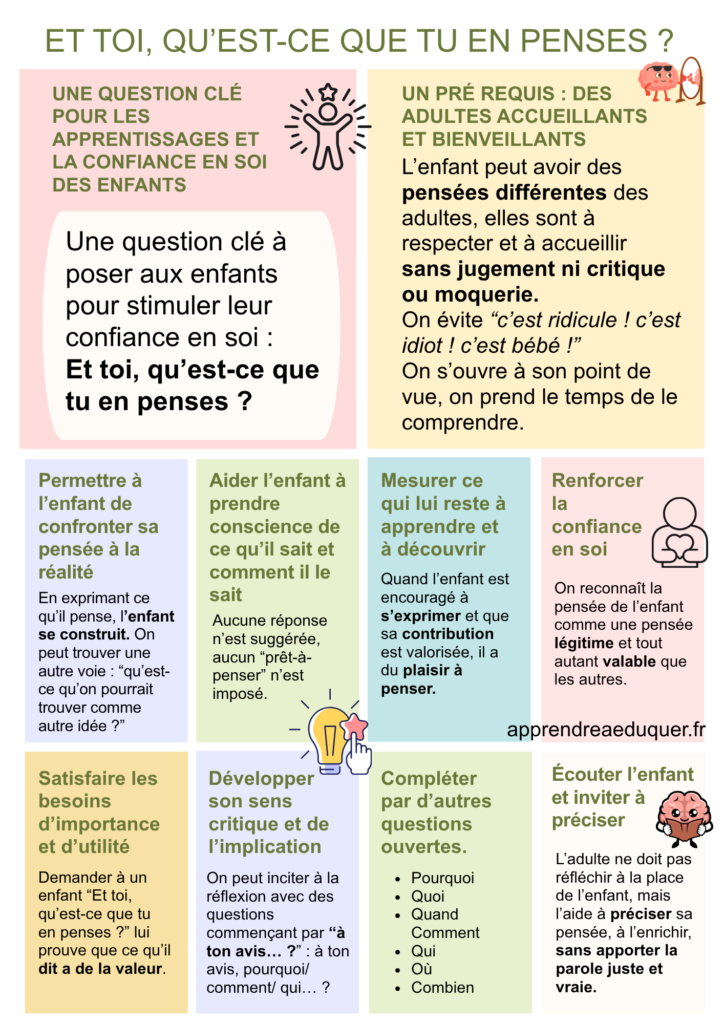
A thought that never meets the outside world, or the thoughts of others, stays hollow. When a child expresses what he thinks, he starts to test how his view of the world fits, matches or differs from the people around him, and he can then reorganise his thinking internally.
This is why the adult should resist thinking on the child's behalf, which is the surest way to stop him thinking at all. The adult's role is to help him sharpen and enrich his own idea, not to hand him the "right words". Leading by example helps here: explain your own opinions and ask the child to justify his.
On a walk, a child once asked about a mossy wall. Instead of answering, the adult asked what she thought. She touched it, crumbled it, smelled it and concluded it was moss, then explained it had the colour, the smell and roots like flowers. Children are full of resources when we let them use them.

Helping children notice what they know and how they know it
By asking "And what do you think?", adults create a thinking space where no answer is suggested and no ready-made opinion is imposed. The child is genuinely invited to reflect, and he becomes aware of what he knows and how he came to know it, which is a cornerstone of confident learning.
When a child's contribution is valued, he takes more pleasure in thinking and wants to gather more knowledge to feed that thinking. Recognising his thought as acceptable and as valid as anyone else's confirms his feeling of being capable of thinking, and you can even open a third path by asking what other idea might be found.
This also meets two deep needs: to feel important, with a place in the family and a right to speak, and to feel useful, with a contribution that is expected and noticed. Asking the question proves that what he says has value, much as a child thrives when daily routines, including Montessori housework, give him a real role.
| Situation | Question to ask | What it builds |
|---|---|---|
| A painting or film | What do you think it means? | Interpretation and expression |
| A maths problem | How did you get there? | Awareness of his own reasoning |
| A dish at dinner | What does it taste like to you? | Sensory observation and vocabulary |
| A word's spelling | Why do you think it is spelled that way? | Critical thinking and memory |
| A nature find | What do you think it is, and how do you know? | Curiosity and argument |
Building critical thinking through genuine dialogue
Dialogue lets you encourage a child not to close an idea too quickly, adding nuance so he thinks with more finesse. Questions beginning with "In your opinion, why, how, when or who?" push reflection further, and the same patient curiosity pays off in everyday parenting puzzles such as throwing things down or the endless hormone game of growing up.
This is also how you support a child through the ordinary upheavals of family life, from removing the diaper to the questions children ask about magical characters. Each conversation is a small rehearsal in thinking for himself.
Why the adult's attitude matters most
The condition for this question to work is that adults welcome the child's words without judgement. His thoughts may differ from ours, and they deserve the same respect as an adult's.
If a child is constantly criticised for how he thinks, mocked with "that's ridiculous, that's silly, that's babyish", or simply not really listened to, he will give up thinking and become passive in learning, whatever the subject. Talking with a child means listening first: opening up to his point of view, underlining what is positive, relativising with respect, and asking him to argue rather than telling him he is wrong. Being told he is mistaken without being heard feels like disinterest, while being pushed to argue helps him forge his own ideas.

Watching confidence grow over the years
These conversations change shape as children grow, and the same respectful listening carries into new stages, from the first kicks in pregnancy to the way young children handle car sickness on family journeys. What stays constant is the child's need to be heard.
Family life offers endless natural openings, whether a trunk for travel packed together before a trip or a bedtime routine built around co sleeping and quiet talk. Even the lighter side of parenting, like the funniest fatherhood tweets, reminds us how much children notice about the adults around them.
And the wider world of play feeds the same curiosity. A child comparing Most Valuable LEGO Sets Ever Sold or wondering how to How to Fix Loose LEGO Joints is practising exactly the reasoning you are encouraging. Answer with "what do you think?" and watch the thinking happen.

My hands-on take
I started using this question almost by accident, mostly to buy myself a moment before answering. What surprised me was how often my child's answer was better than the one I had ready. Now, when she asks what a word means or why something works the way it does, I try to turn it back with "what do you think?" and then ask how she got there.
It does not always land. Some days she shrugs and wants the answer, and that is fine too. But over time I have noticed she argues her point more, and she is less afraid of being wrong, which feels like the real prize.
Frequently asked questions
What if my child says "I don't know"?
Give him time and rephrase gently, for example by asking what he notices first. The goal is not a correct answer but the act of thinking aloud.
Should I correct a wrong idea?
Ask him to explain his reasoning before anything else. You can then add nuance respectfully and explore another angle together rather than simply saying he is wrong.
Does this work for older children too?
Yes. The topics change, but the need to be heard and to argue a point stays the same, and it supports independent thinking in teenage years.
How often should I use it?
There is no set number. Use it whenever a natural opening appears, such as a shared film, a walk or a question about homework.
Product Reviews
 Best Toys for Dogs With High Prey Drive |
Best Outdoor Toys for 3-4 Year Olds |
Best Outdoor Toys for 6 Year Olds |
Best Harness for Poodle |
Best LEGO Sets for Adults |
Best Travel Toys for 4 Year Olds on Airplane |
Best Toy Stores in Washington DC |
Best Potty Training Toys |
Best Toys for Tripod Dogs |
Maillot equipe de france







