


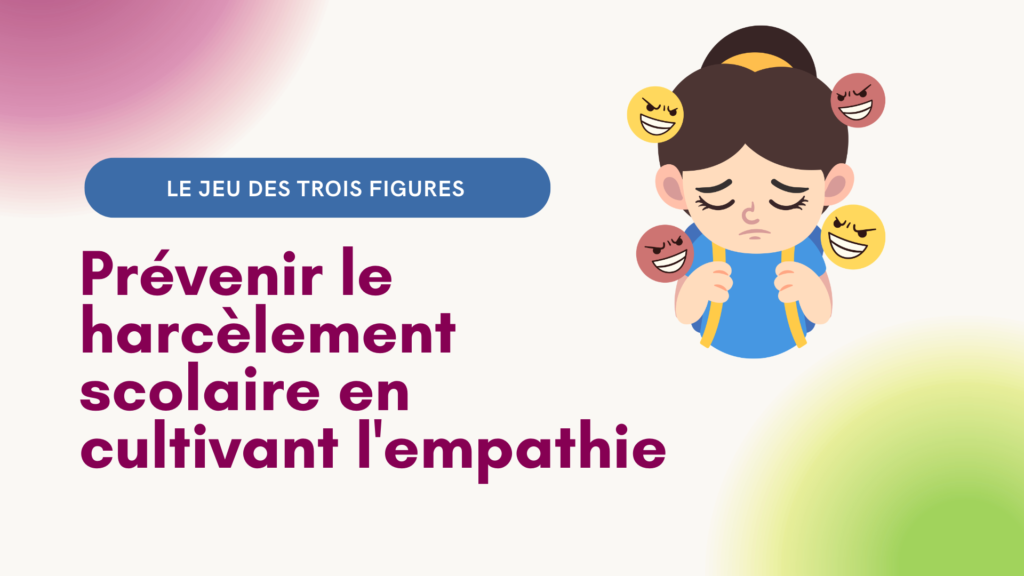
The Three Figures Game is a drama-based activity designed to build empathy in children and reduce violence and bullying, from nursery school through the early teenage years. It was created by Serge Tisseron, a doctor of psychology, who first set out to define empathy along with its different levels, its risks, and how it differs from sympathy and compassion.
His starting point is simple: in any situation of violence or conflict, there are always three possible positions. One person acts, one person suffers the action, and one person intervenes or simply watches. The game gives children the chance to move between all three.

Quick takeaways
- The Three Figures Game uses drama to build empathy and reduce bullying.
- Every conflict has three positions: aggressor, victim and third party.
- Children rotate through all roles, ideally once a week.
- Switching roles prevents children from freezing into one social identity.
- Empathy means understanding feelings, not necessarily sharing them.
- Parents can adapt the idea at home by retelling conflicts from three viewpoints.
Preventing violence and bullying
The Three Figures Game is a theatrical activity that Serge Tisseron imagined in 2006 to develop empathy from nursery school to secondary school and to reduce violence. It takes its name from the three characters at its heart: the aggressor, the victim, and the third party, whether that person is a simple witness, a defender of the wronged, or a rescuer.
According to Tisseron, every situation of violence or conflict contains these three possible positions: the one who acts, the one who endures, and the one who intervenes or observes. Learning to move between these positions allows a child not to become frozen in a single social role. This is the same logic behind why slapping harms, since fear and humiliation teach children to fixate on one position rather than understand another's. It also connects to your first night away, where a child first practices being the one who observes rather than the one who acts.
Why the third figure matters
The bystander is often forgotten in anti-bullying work, yet the third figure holds real power. Naming that role out loud gives a child a script for stepping in rather than freezing.
What the game is for
Each child is led to play every role, regularly — ideally once a week. Each child therefore experiences every position within a relationship and can step out of their usual role, such as that of the class bully. By changing roles, the child learns to understand another person's point of view, to recognise emotions such as fear, anger and sadness, and to avoid being locked into a single role, whether always the victim or always the dominant one.
The game is now present in many nursery and primary schools, and in a few secondary schools, and a dedicated website is devoted to it. Used in class, the Three Figures Game helps participants better understand their own emotions and those of others, encouraging active listening and authentic expression. Children symbolically rehearse conflictual situations so they can handle them better in reality — a gentle rehearsal not unlike the imaginative play you see in a day at kindergarten. Just as learning to speak grows through daily interaction, so does this emotional vocabulary, and no child should be left behind, since a poor child deserves the same chances to express feelings as any other.
| Position | What the child experiences | What the game teaches |
|---|---|---|
| The aggressor | Acting on another person | Understanding the impact of one's actions |
| The victim | Enduring the action | Naming fear, anger and sadness |
| The witness | Watching without acting | Finding the courage to intervene |
| The defender | Stepping in to help | Practising active bystander behaviour |
| The rescuer | Protecting the vulnerable | Recognising responsibility toward others |
How a session works in practice
A session usually begins with a short story or a scene proposed by the adult, drawn from everyday classroom life: a pushed chair, a snatched toy, a whispered insult. Children then take turns acting out the three positions, and the adult pauses the scene to ask what each character might be feeling. No one is cast permanently; the point is rotation, not performance.
The adult's job is to keep the play symbolic and safe, never letting a child relive a real personal incident in front of the group. After the scene, a short debrief helps children name emotions and imagine what the third figure could have done differently. This kind of guided make-believe sits naturally alongside other creative outlets, such as homemade finger paint games, where children also express feelings through play.
Keeping it safe
Gentle pacing and clear stopping rules matter more than dramatic intensity. The goal is understanding, not reenactment.
Building empathy at home
Parents can borrow the spirit of the game without any special training. When a conflict comes up at home, ask your child to tell the story three times: once as the person who acted, once as the person who was hurt, and once as the person who watched. Simply switching the narrator changes everything about how a child sees the scene.
You can also use picture books and films as raw material, pausing to ask which figure each character occupies. Short Christmas stories work especially well for this, since their familiar characters make it easy to ask how each one feels. This habit of perspective-taking grows slowly, much like the physical confidence described in gross psychomotor skills, and it needs repetition rather than a single perfect conversation. Keep your own reactions calm too, since children learn far more from what we model than from what we lecture, and remember that even cravings during pregnancy can be a gentle chance to talk about how bodies and feelings send us signals.

Empathy, sympathy and compassion
Tisseron is careful to distinguish empathy from sympathy and compassion. Empathy is the capacity to understand what another person feels without necessarily sharing that feeling; sympathy is feeling with them; compassion adds a wish to relieve their suffering. Each has value, but empathy is the foundation, because it lets a child grasp a perspective that is not their own.
He also warns of empathy's dangers: it can be selective, extended only to those who resemble us, or manipulated to serve one group against another. That is why the game insists on rotating every role, including the aggressor's. Understanding why someone acts cruelly is not the same as excusing it, and children can learn that distinction early. A calm, honest approach to difficult feelings — the same principle behind being a good father — helps this lesson land.
Why it belongs in every school
Bullying thrives on fixed roles and silent bystanders. By making every child try every position, the Three Figures Game loosens those roles before they harden, and it gives witnesses a vocabulary for acting. It costs almost nothing beyond time and a willing adult, which is why it has spread through so many classrooms.
Its deeper aim is a school culture where children read emotions accurately and speak about them honestly. That culture does not appear overnight, but weekly practice, consistent adult modelling and honest conversation at home all pull in the same direction.

My hands-on take
I first tried the three-positions idea after a playground incident involving my own child, who kept insisting he was "just watching." Instead of lecturing him, I asked him to tell the story again as the boy who was pushed, and then as the boy doing the pushing. The shift was quiet but real: he stopped defending his silence and started asking what he could have done.
Since then, we use the trick at home whenever a squabble blows up. It takes two minutes and no materials, and it has done more for my children's ability to name feelings than any chart on the wall. The weekly rhythm matters more than getting it perfect.
Frequently asked questions
Who created the Three Figures Game?
It was created by Serge Tisseron, a doctor of psychology, in 2006. He designed it to develop empathy and reduce violence from nursery school through secondary school.
How often should children play?
Ideally once a week, so that each child regularly rotates through every role. Repetition is what prevents a child from getting stuck in one position.
Can parents use the idea at home?
Yes. A simple version is to retell a conflict three times, once from each character's point of view. No special training or equipment is needed.
Does understanding the aggressor mean excusing them?
No. The game separates understanding a person's motives from approving their behaviour. Children can learn that distinction early with adult guidance.
Product Reviews
 Best Toys for Dogs With High Prey Drive |
Best Outdoor Toys for 3-4 Year Olds |
Best Outdoor Toys for 6 Year Olds |
Best Harness for Poodle |
Best LEGO Sets for Adults |
Best Travel Toys for 4 Year Olds on Airplane |
Best Toy Stores in Washington DC |
Best Potty Training Toys |
Best Toys for Tripod Dogs |
Maillot equipe de france







